

Brands sponsor TikTok creators when three things are easy to see: who watches, what a sponsored video would look like, and what it costs. Average views matter more than follower count, so an account with 40,000 followers and steady views can land deals that a larger account with uneven views misses.
The steps below apply the general guide on how to get brand deals to TikTok: get the profile ready, show the right numbers, pitch brands that already spend on TikTok, use TikTok One for inbound offers, then price, deliver, disclose and report each deal.
Types of TikTok brand deals
| Deal type | What the brand pays for |
|---|---|
| Sponsored video on your account | One or more videos posted on your profile, for a fixed fee |
| Spark Ads authorization | The right to run your post as a paid ad for a set period, usually priced on top of the video |
| UGC-only video | A video the brand posts or runs as an ad from its own account, without using your audience |
| TikTok Shop affiliate campaign | A commission on the sales your videos drive, sometimes with a small fixed fee |
| Ambassador or retainer deal | Several videos over a few months for a monthly fee |
Many deals combine the first three: a sponsored video often comes with a Spark Ads request, and some brands only want the footage. If you would rather create without posting on your own account, the guide on how to get UGC brand deals covers that route.
What brands check on your TikTok before reaching out
Before replying to a pitch or sending an offer, a brand manager usually checks a few things on your profile:
- Recent views, not your best video. They scroll your last 10 to 20 posts. A steady 20,000 to 40,000 views per video reads better than one viral hit surrounded by 2,000-view posts.
- A clear niche. Your bio, pinned videos and recent posts should point to the same audience.
- Comments from real viewers. Questions such as "where is this from?" or "does it work for oily skin?" show buying intent. Emoji-only comments do not.
- Past branded content. Videos with TikTok's "Paid partnership" label show that you have already delivered for a brand.
- Audience location. A US brand needs US viewers. TikTok Studio shows your top countries.
- Engagement for your size. These TikTok engagement rate benchmarks show what counts as average for an account like yours.
- A way to contact you. A business email in your bio saves the brand a search.
How many followers do you need for brand deals on TikTok?
There is no universal minimum. TikTok One, TikTok's official platform for brand partnerships, asks creators to be at least 18 and in a region where it is available. To take part in its projects, TikTok's sign-up guide lists at least 1,000 followers, with requirements that vary by project.
Brands that contact creators directly care more about views, niche and audience fit than about a follower threshold. Accounts under 10,000 followers tend to receive gifted products, affiliate offers and small fees. Paid requests become more regular once your videos get consistent views from a clear audience.
Step 1: Make your TikTok profile brand-ready
Look at your profile the way a brand would before you pitch anyone:
- Write a one-line bio that names your niche and audience. "Quick breakfast recipes for busy mornings" tells a brand more than "food lover."
- Add a business email. TikTok's Creator Academy recommends a business email or inquiry link in the profile.
- Pin three videos that sell your account. One of your best niche videos, one where a product is clearly shown in use, and one branded video if you have one.
- Group brand work in a playlist once you have a few collaborations, so a brand can see them without scrolling.
- Post in your niche consistently for a few weeks before pitching. A brand that opens your profile should see the kind of content it would be paying for.
It also helps to feature products you already use in your normal videos. Those posts show a brand how its product would look on your account, and they give you examples to link in a pitch.
Step 2: Build a TikTok media kit around views
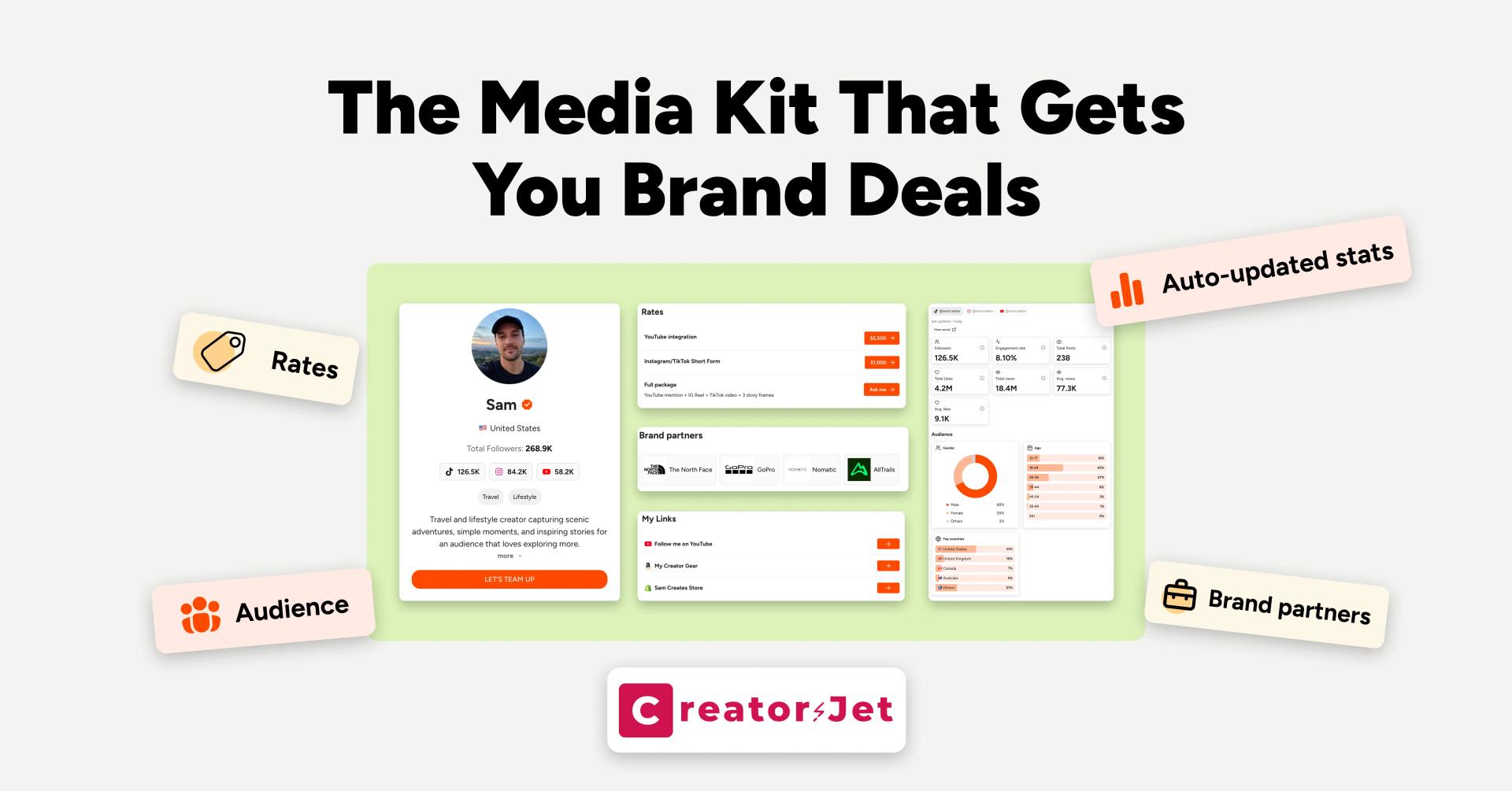
A media kit answers a brand's first questions before they ask them. For TikTok, it should include:
- Your handle, niche and the formats you are known for
- Followers, top countries, and age and gender split, with the date of the snapshot
- Typical video performance: views, average watch time and engagement from recent videos
- Two or three links to relevant videos, with paid results labeled as paid
- Your services, listed separately: sponsored video, UGC-only video and Spark Ads authorization
- A business email and your availability
The performance numbers come from TikTok Studio. Open any video's analytics to see its views, likes, comments, shares, saves, average watch time, the share of viewers who watched to the end, and the new followers it brought in.
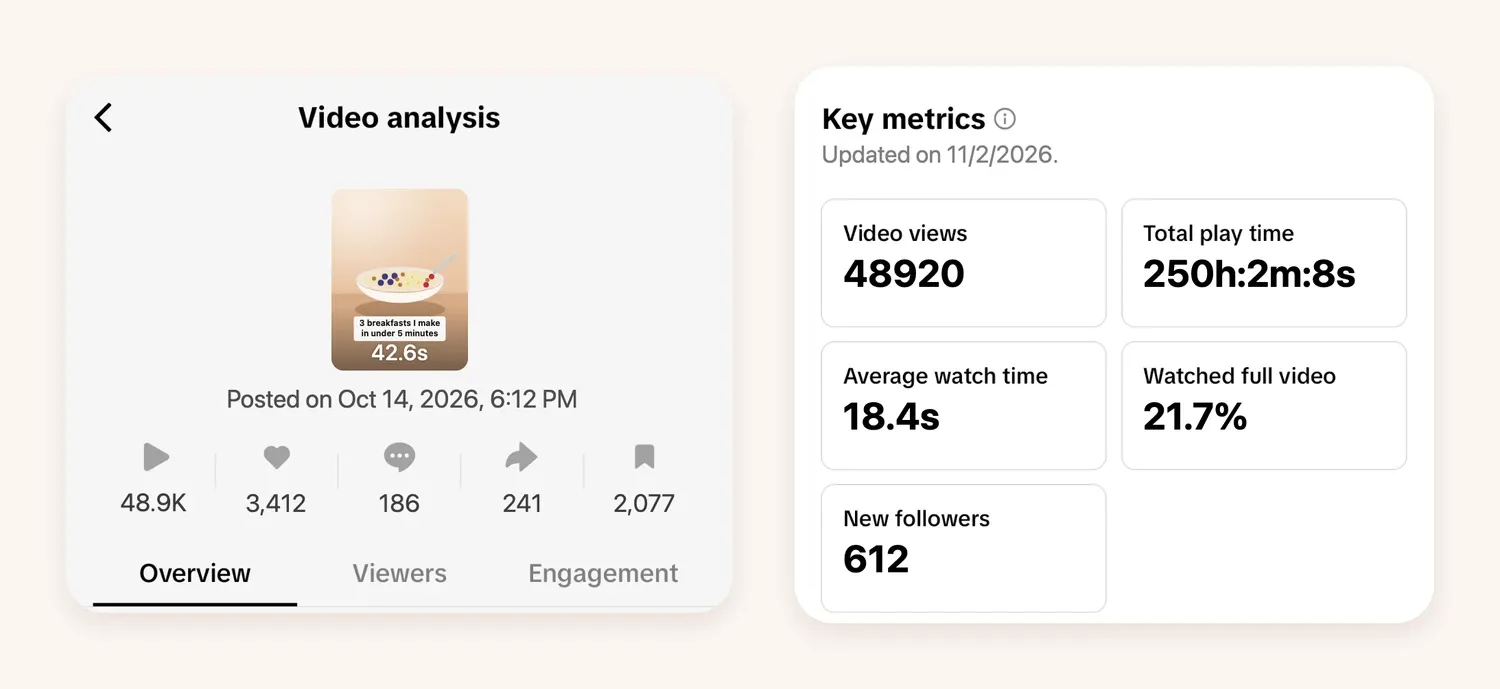
Use the median from your last 10 to 20 organic videos rather than your best result, and leave out paid boosts and one-off viral posts. A brand that books you based on an outlier will judge the campaign against it. To see how other creators lay this out, look at these TikTok media kit examples and the metrics brands compare.
Step 3: Find brands already paying TikTok creators
The easiest brands to pitch are the ones that already have a budget for TikTok creators. A few ways to find them:
- Search TikTok for your niche plus "#ad" or "paid partnership". Look for videos from creators about your size. The brands tagged in those posts already pay creators like you.
- Watch who sponsors the creators you compete with. If a brand worked with three creators in your niche this quarter, it is likely to read a pitch with a fresh angle.
- Check which brands advertise on TikTok. The Top Ads library in TikTok Creative Center can be filtered by industry and set to the United States. A few ads show without an account, and the full list needs a free login.
- Look at brands selling through TikTok Shop in your niche. Many recruit creators for affiliate campaigns, and a good affiliate result gives you a reason to ask for a paid fee next time.
- Start from a list. This list of brands that work with influencers includes brands known for working with TikTok creators, grouped by category.
Then find the person who decides. Most brands run creator campaigns through an influencer marketing manager, a partnerships lead or an agency. CreatorsJet's Find Sponsors directory lists influencer marketing contacts at brands, with their role and email when available.
Step 4: Pitch with a TikTok video concept
Email works better than DMs for paid deals, because the person who approves budgets rarely runs the brand's TikTok inbox. DMs can work with small brands where the founder answers messages.
A TikTok pitch should sell a specific video, not your account in general. Keep it short:
- One line on who you are and who watches you
- Why this brand: a recent launch, a product you use, or creators it already works with
- One concrete video idea, written as the first line a viewer would hear
- One link to a comparable video, with its numbers
- Your media kit link and a clear next step
A template you can adapt:
Subject: TikTok video idea for [product]: [your niche] audience
Hi [Name],
I'm [name], a [niche] creator on TikTok (@[handle]). My videos usually reach [median views] views, and most of my audience is in the US.
I saw [specific detail: a recent launch, a campaign, a creator the brand worked with]. One idea for [product]: a 30-second video that opens with "[hook]" and shows [product] in [real situation].
A similar video of mine reached [views] views and [saves] saves: [link]. My media kit, with audience data and rates, is here: [link].
Would you be open to a sponsored video in [month]? I'm happy to adapt the idea to your brief.
[Name]
A video you post on your own about a product you genuinely use can serve as proof in a pitch. Making custom unpaid content because a brand asked for a "test" is different, and it usually means the budget is not there yet.
If there is no reply, wait five to seven business days before following up, then send one final message. The guide on following up with a brand after a pitch has wording for both messages.
Step 5: Use TikTok One for inbound offers
TikTok One is TikTok's official platform for brand partnerships. It includes the Creator Marketplace, where brands search for creators, send invitations and post open opportunities that creators can apply to. TikTok's overview for creators also mentions flat-fee payments and revenue-sharing options, depending on the project.
To join, search "TikTok One" in the app, or go to TikTok Studio and open Creator Marketplace. Once you are in:
- Complete your profile and keep your content portfolio current
- Check open opportunities regularly and apply only to campaigns that fit your niche
- Treat each brand invitation like an inbound email: read the brief, the deliverables and the usage terms before accepting
Projects created in TikTok One turn on the commercial content disclosure automatically. Inbound offers are useful, but for most creators they add to outreach rather than replace it.
Step 6: Price and scope the deal
How much TikTok brand deals pay
Typical 2026 rates for one sponsored in-feed video of 15 to 60 seconds:
| Followers | Typical fee per sponsored video |
|---|---|
| 1,000 to 10,000 | $25 to $200 |
| 10,000 to 100,000 | $150 to $1,200 |
| 100,000 to 500,000 | $800 to $6,000 |
| 500,000 to 1M | $4,000 to $15,000 |
| Over 1M | $10,000 to $150,000+ |
These ranges match the TikTok figures in this overview of influencer rates by platform and follower count, which also compares TikTok with Instagram and YouTube. Where you land inside a range depends on your views more than your followers. A quick check is expected views × a CPM of $10 to $30 ÷ 1,000: a creator whose videos usually get 30,000 views would land around $300 to $900 per video. The TikTok pricing calculator gives a starting estimate from your views, followers and engagement rate.
What to agree on before filming
Write these points down before you accept, even for a small deal:
- Deliverables: how many videos, their length, the posting date, and how long they stay up
- Revisions: one round of edits included, with extra rounds priced separately
- Spark Ads: whether the brand will run your post as an ad, for how long, and the added fee. Spark Ads usually add 15% to 30% to the video fee, and this guide to TikTok Spark Ads explains how creator authorization works.
- Usage rights: whether the brand can reuse the video on its website, in emails or in ads on other platforms, and for how long
- Exclusivity: which competing brands you cannot work with, and for how long
- Payment: the amount, the payment date, and whether any part depends on performance
If the budget is lower than your rate, change the scope instead of the price: fewer revisions, no Spark Ads, a shorter usage window, or a UGC-only video. This guide to influencer rate negotiation shows how to offer those options without sounding defensive.
Red flags in TikTok brand deal offers
Fake brand offers regularly reach creators through DMs and email. Slow down when a "brand":
- Asks you to pay a fee, buy the product or share login details before the deal starts
- Calls the deal paid but makes payment depend entirely on sales
- Wants unlimited usage or ad rights for the price of one video
- Asks you to post without turning on the disclosure
- Writes from a free email address or a lookalike account instead of the brand's own domain or verified profile
When in doubt, contact the brand through its official website and ask whether the campaign is real.
Step 7: Deliver, disclose, and report
Make the sponsored video feel like your content
Branded videos work best when they look like your normal posts. TikTok's Creator Academy suggests a simple structure:
- A hook in the first seconds that would interest your viewers even without the product
- A real situation where the product fits
- The product shown in use, not just described
- A natural ending, such as asking viewers a question
Agree on the brand's key message before filming so revisions stay small, and get the brand's approval before posting. For the opening line, these TikTok hooks give you formats to adapt to a sponsored video.
Turn on TikTok's disclosure
Every paid or gifted brand deal on TikTok needs TikTok's disclosure turned on. Before posting, open More options, then Content disclosure and ads, turn on Disclose commercial content, and select Branded content, the option for promoting another brand. The "Your brand" option is for promoting your own business. The video then shows a "Paid partnership" label.
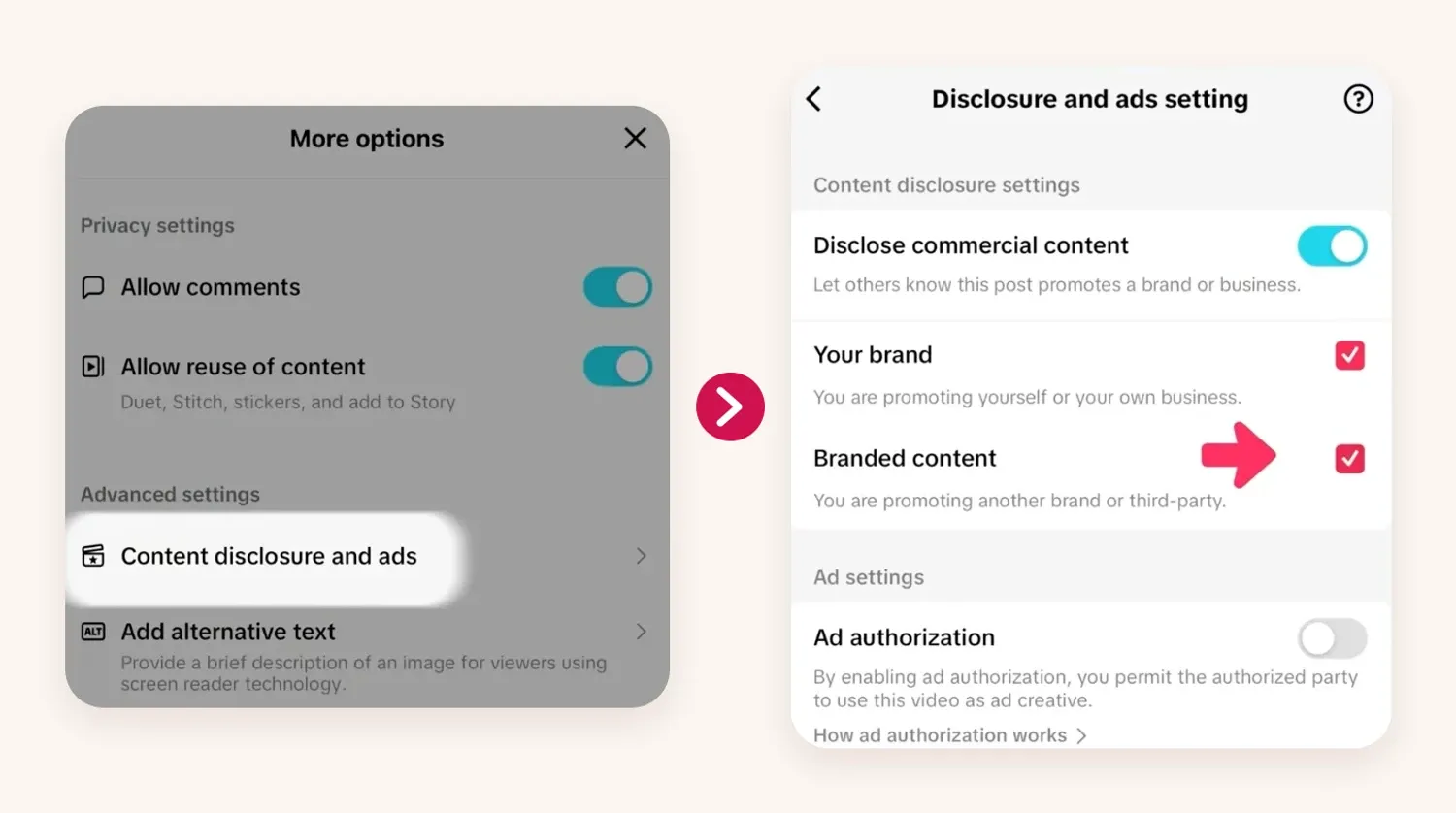
According to TikTok's help center, turning on the setting does not change how TikTok recommends your video. Skipping it can: if TikTok detects undisclosed branded content, you get a notification and 24 hours to respond before the video becomes ineligible for the For You feed.
The same screen has an Ad authorization toggle, which lets the authorized party use the video as ad creative. Turn it on only when Spark Ads are part of the signed deal.
The label is not the only rule. In the US, the FTC's disclosure guide for influencers asks creators to disclose any paid relationship clearly, and in a video that means saying it in the video itself, not only in the caption.
Report the results
After the video goes live:
- Send the brand the live link right away.
- Send a short early recap after 24 to 72 hours if the brand expects fast confirmation.
- Send a full recap after about seven days, with TikTok Studio screenshots of views, average watch time, watched full video, likes, comments, shares and saves, plus any link clicks or code uses the brand tracked.
The guide on what to send a brand after a sponsored post covers the recap format. A clear report is also the easiest way to turn a first deal into a second one.
Final thoughts
Getting brand deals on TikTok depends less on follower count than on being easy to book. A focused profile, a media kit built on typical views and pitches that propose a specific video put you ahead of most creators who simply ask for a collaboration.
From there, price from views, put Spark Ads, usage rights and exclusivity in writing, and make every sponsored video look like your own content. Disclose each deal and report the results, so every campaign makes the next pitch easier.