UGC brand deals rarely come from one perfect platform. Creators who find paid work consistently usually combine direct outreach, marketplaces, job searches, referrals and a portfolio that can generate inbound enquiries.
The important distinction is that a UGC deal pays you to create content a company can use on its own social accounts, product pages or ads. You do not necessarily need a large audience because the brand is buying your creative work and usage rights, not only access to your followers.
Here, paid work means an agreed creation fee with a defined scope, usage and payment date. A free product, affiliate commission or performance bonus may be part of an offer, but it is not the same as guaranteed payment for producing the content.
The seven methods below explain where to find UGC brand deals in 2026, what each route is best for and the first action to take.
7 ways to find UGC brand deals at a glance
| Method | Best for | First action |
|---|---|---|
| Direct outreach | Choosing the brands and niches you want | Build a list of 20 relevant brands |
| UGC marketplaces | Applying to structured briefs | Complete one detailed creator profile |
| TikTok One and social marketplaces | Platform-specific campaigns | Check eligibility and fill every profile field |
| Agencies and production partners | Repeat projects from several clients | Introduce yourself with a focused portfolio |
| Job boards and freelance platforms | Finding active buyers | Create alerts for several UGC job titles |
| Referrals and repeat work | Turning completed projects into a pipeline | Follow up after a successful delivery |
| Portfolio and public content | Letting brands discover you | Publish samples and make your contact route obvious |
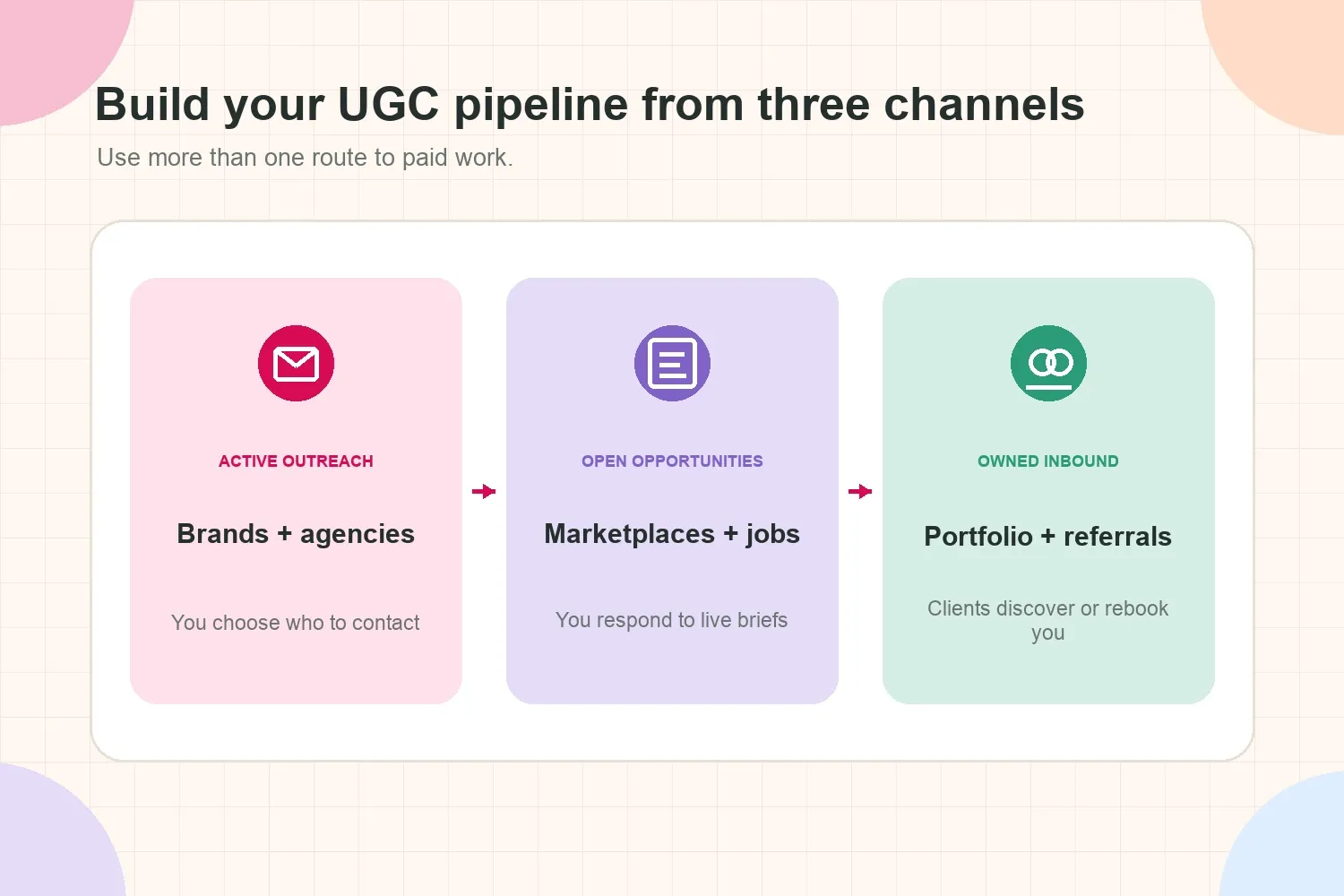
Do not try to master all seven at once. Pick two active channels, where you contact or apply to opportunities, and one passive channel, where brands can discover you.
1. Pitch brands that already use creator-style content
Direct outreach gives you the most control over the companies, products and creative categories you pursue. It also lets you reach brands before they publish an open call that attracts hundreds of applicants.
Start with companies that are already investing in short-form video. Look through their recent TikTok and Instagram posts, product pages and active ads. Meta Ad Library and TikTok Creative Center can help you see which brands are currently running social ads. You are not trying to prove that they need UGC from zero. You are looking for a visible creative gap you can help fill, such as repetitive hooks, no product demonstration, few customer scenarios or content that does not feel native to the platform.
Build a prospect list with these columns:
- Brand and product category
- Contact name and role
- Relevant email or contact route
- One observation about current content
- One UGC idea you could create
- Date contacted and follow-up date
Look for social media managers, creative strategists, influencer marketing managers and paid-social specialists. A general contact form can work, but a relevant person is more likely to understand your proposal and route it to the right budget.
Keep the first message short. Explain why the brand fits your work, suggest one usable content angle and link to the most relevant samples. If you need a starting structure, adapt one of these UGC pitch email templates, then replace its observation, concept and proof with details that belong to the company you are contacting.
Best use of this method: send five to ten researched pitches each week and follow up once or twice. Fewer tailored messages are more useful than a large batch that could have been sent to any brand.
2. Apply through UGC marketplaces
UGC marketplaces bring briefs, applications and sometimes payment into one workflow. They can be useful when you are learning how brands describe deliverables or when you need examples of real campaign requirements.
Examples include Billo, JoinBrands and Insense. Billo currently accepts creators in the United States, Canada, the United Kingdom and Australia, while JoinBrands separates content-only UGC from influencer, affiliate and commission-only jobs. Insense also offers UGC-only creator accounts. These are examples to investigate, not a universal ranking: availability, approval rules, fees and campaign volume depend on your location and profile.
Platforms vary by country, niche and business model. Some list paid briefs, some combine gifted and paid opportunities, and some set or influence creator compensation. Before investing time in a profile, check:
- Whether creators in your country can join
- Whether opportunities are paid, gifted or performance-based
- Any platform or payment fees
- Who owns the content and how long it may be used
- Whether revisions, raw footage or posting are included
- How disputes and late payments are handled
Do not apply to every listing. Choose briefs that match your location, appearance, language, home setting, interests and examples. A specific application that references the requested audience and concept is easier to assess than a general introduction.
Treat marketplaces as one lead source, not your whole business. Competition and available categories can change, and a profile you do not control should not be the only place a client can see your work.
Best use of this method: maintain profiles on one or two suitable platforms, check new briefs on a schedule and track your application-to-reply rate for a month.
3. Use TikTok One and other built-in creator marketplaces
Social platforms increasingly offer their own collaboration tools. These opportunities can be useful when a campaign is tied to a specific platform, format or creator account.
TikTok’s official TikTok One creator signup guide explains how eligible creators can access its Creator Marketplace and complete their profiles. Availability and project requirements vary by region, and TikTok notes that some projects require at least 1,000 followers. That makes it different from content-only UGC work where a following may not matter.
If you are eligible, complete your categories, languages, contact details and starting rates. Choose examples that feel native to the platform rather than uploading every polished video you have made. Check invitations and open applications regularly because timelines can be short.
Also review the professional or creator tools available inside the social platforms you already use. Features and access change, so rely on the current settings in your account rather than an old tutorial.
Best use of this method: pursue campaigns that genuinely match your audience or on-camera style, and confirm whether the brand wants content delivery, a post to your profile or both.
4. Introduce yourself to agencies and UGC production partners
Brands often outsource creator sourcing and production to influencer agencies, paid-social agencies and UGC production companies. One good agency relationship can lead to projects for several clients because the team already knows how you communicate and deliver.
Search for agencies that show creator work in your niche or market. Their website may have a creator application, talent form or casting email. If not, contact a producer, creator partnerships manager or account manager with a concise introduction.
An agency does not need your complete life story. It needs to understand where you are based, which languages and niches you cover, what formats you can produce and whether you meet deadlines. Link to a focused portfolio and include any practical details that affect casting, such as access to pets, a car, a particular setting or specialized knowledge.
Ask how the agency runs its roster. Clarify whether it represents creators exclusively, hires them project by project or simply keeps a casting database. Never assume that joining a database guarantees work, and read any exclusivity clause carefully.
Best use of this method: contact a small number of relevant agencies, update them when you add a genuinely useful new sample and be easy to rebook after the first project.
5. Search job boards and freelance platforms with the right terms
UGC work is not always labelled “UGC creator.” A company may advertise for a short-form video creator, content creator, social video producer, TikTok creator, Reels creator, product video creator or freelance on-camera creator.
Run exact searches such as “UGC creator,” “short-form video creator,” “product video creator” and “freelance TikTok creator” on LinkedIn, general job boards and freelance platforms. Add a niche such as beauty, SaaS or food, plus your country or language, to reduce irrelevant results. Once a LinkedIn search produces relevant listings, turn on a daily or weekly job alert so new matches reach you without repeating the search manually.
Before applying, check whether the listing describes a one-off deliverable, a recurring freelance relationship or a full-time social role. Many results use similar titles but expect very different commitments.
Creator communities on Reddit, Discord, Facebook and X can also surface casting calls before they reach a formal job board. Treat these posts as leads, not proof that an opportunity is legitimate. Confirm the company and contact through an official website, ask for the scope and fixed fee in writing, and do not send finished custom work as an unpaid audition.
Your application should answer the brief directly. Lead with two or three relevant samples, confirm your location and availability, then state the exact parts of the scope you can deliver. If the listing hides the company name, requests free finished content or asks you to move immediately to an unfamiliar messaging app, verify the client before sharing personal information or doing work.
Best use of this method: save several narrow searches, apply early and keep a reusable application framework that you tailor to each brief.
6. Turn completed projects into referrals and repeat deals
The easiest next client may come from someone who has already seen you work. A successful one-off video can lead to another batch, a monthly package or an introduction to another marketer.
After the project is approved, thank the client and ask whether another product, angle or upcoming campaign needs content. Make the suggestion concrete. For example, if you delivered a product demonstration, propose two alternative hooks or a testimonial-style version for the next testing cycle.
You can also ask for a referral without making the client write a long recommendation:
I’m opening two UGC production slots next month. If another brand or teammate needs short-form product content, would you feel comfortable introducing us?
Stay in touch when you have a relevant reason. A short message tied to a product launch, seasonal campaign or useful new sample is better than a monthly “just checking in” email with no idea attached.
Best use of this method: add a follow-up task to every completed project and make rebooking easy by keeping your offer, availability and contact information current.
7. Create a clear path for inbound enquiries
Inbound work happens when a marketer discovers your content, quickly understands what you offer and can contact you without searching. You do not need to turn every personal account into a permanent advertisement, but your professional presence should make the next step obvious.
Post samples that resemble the work you want to sell. A skincare creator might share a product demonstration, a problem-and-solution ad and a natural testimonial. A travel creator might show a room tour, an app walkthrough and a voiceover itinerary. Clearly label samples that were not commissioned by a client so no one mistakes them for paid partnerships.
Your bio or profile should state that you create UGC, mention your location or languages when relevant and provide one working contact link. Your portfolio should load quickly, play correctly on mobile and show a small selection of your best work. To choose a clear structure, compare these UGC portfolio examples and notice how they group samples by format, niche or campaign purpose so a client can find relevant work in seconds.
Publishing useful observations can also attract the right buyers. Break down a hook, show how you filmed a scene or explain why you created two versions of an ad. This demonstrates how you think, not only how you look on camera.
Best use of this method: make every public profile lead to the same current portfolio and check the contact route yourself on mobile.
How to choose which channels to use first
Choose channels based on what you already have and where you can compete.
- If you have no paid work yet: create three to six relevant samples, maintain one suitable marketplace profile, send five focused pitches each week and run one job alert.
- If you have client examples: prioritize direct outreach, agencies and rebooking past clients.
- If you have an engaged social audience: add platform marketplaces and inbound content, while separating content creation from the value of posting to your followers.
- If your country has limited marketplace access: focus on regional brands, local agencies, freelance searches and direct outreach in the languages you can work in.
The goal is a balanced pipeline. One active channel gives you opportunities now, another builds relationships, and one owned channel lets people find you without an application.
A weekly UGC deal-finding routine
Consistency becomes easier when prospecting has a fixed place in your week. A simple routine might look like this:
- Add ten qualified brands, agencies or listings to your tracker.
- Send five tailored pitches or applications.
- Follow up on messages that received no reply after a reasonable interval.
- Check one or two marketplaces for new briefs.
- Publish or improve one portfolio sample.
- Contact one previous client with a relevant new idea.
- Record replies, calls, offers and reasons for rejection.
After four weeks, compare channels by qualified replies and paid offers, not by the number of applications sent. If a marketplace creates many gifted offers but no suitable paid work, reduce the time you give it. If agencies reply but need a different sample category, create that proof before sending more introductions.
Check the deal before you say yes
Finding an opportunity is only the first step. Before accepting, confirm the work, rights and payment in writing.
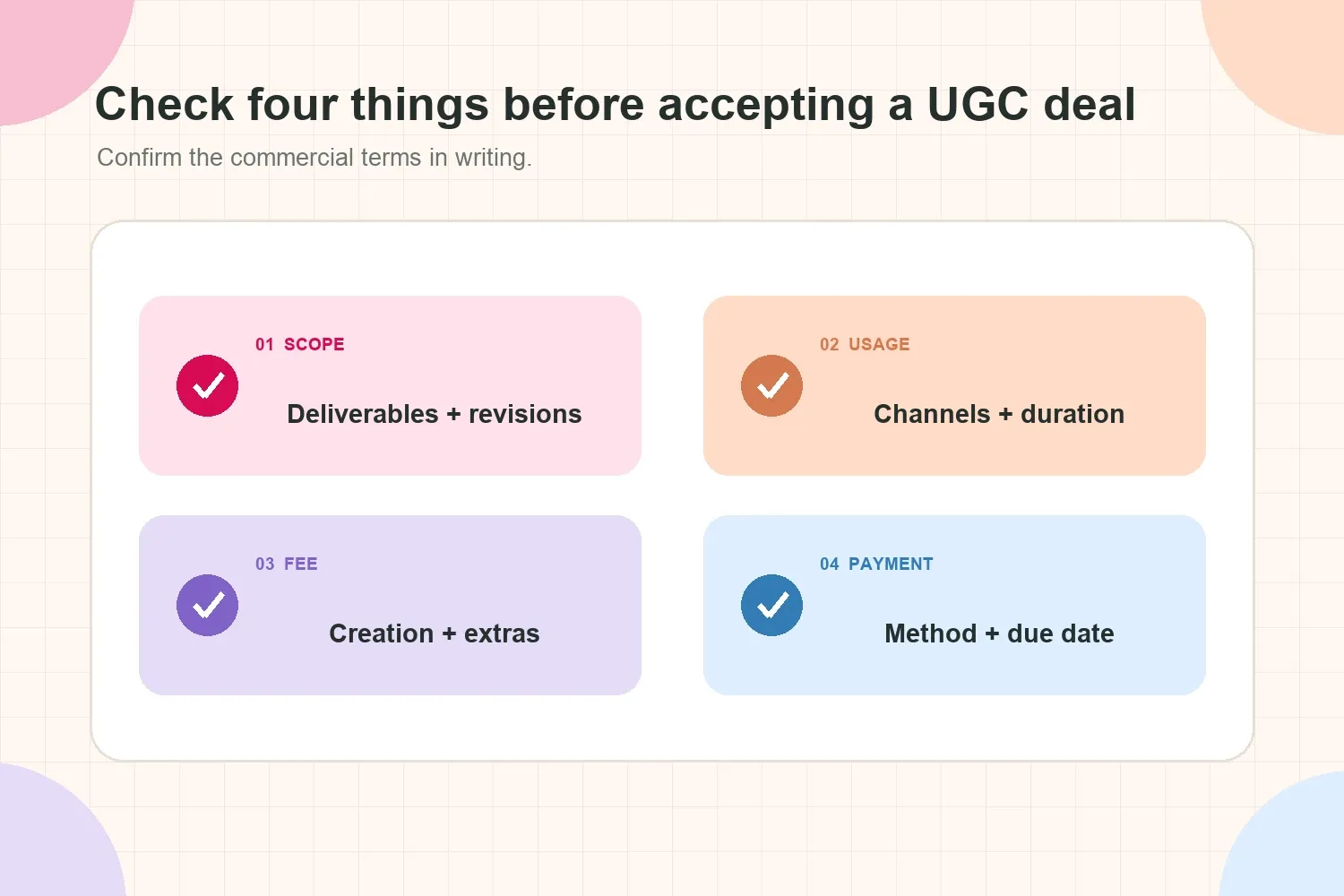
At minimum, clarify:
- The number, length and format of deliverables
- Who supplies the concept or script
- The number of revisions and what counts as a reshoot
- Whether raw footage is included
- Where the content may appear and for how long
- Whether the brand can run paid ads or use your identity in advertising
- Whether exclusivity applies to competing products
- The fee, payment method and payment due date
- Whether you must post to your own account
Content creation, paid usage, raw footage and audience distribution are different parts of the value. Once the scope is clear, use the free UGC rate calculator to build a starting quote that separates the creation fee, paid usage and raw footage instead of hiding everything inside one number.
Be cautious when a supposed client avoids a written scope, asks you to buy expensive products with a promise of reimbursement, sends suspicious files, requests account credentials or wants extensive custom work before agreeing to payment. A real logo and a familiar brand name do not prove that the person contacting you works there. Verify the sender through an official website or company profile.
Build a system, not a lucky break
The best way to get UGC brand deals is to combine methods that create opportunities on different timelines. Direct outreach and applications can start conversations now. Agencies, referrals and repeat clients compound over time. A clear portfolio and useful public content make it easier for buyers to find and trust you.
Start with two active channels and one inbound channel for four weeks. Track what produces qualified replies, improve the proof clients ask for and move your time toward the sources that lead to paid, well-scoped work.