
Influencer rates are messy because brands and creators often talk about different things at the same time. One person is quoting a one-off Instagram Story. Another is quoting a Reel with paid usage. Another is quoting a YouTube integration that took three days to script, film, and edit.
That is why follower count is only the first filter. It helps estimate reach, but it does not explain the full value of a sponsored post, a creator package, or a usage-rights deal.
This benchmark uses 12,486 paid influencer campaigns across Instagram, TikTok, YouTube, and X to give creators and brands a practical starting point. The goal is not to turn pricing into a rigid menu. The goal is to make rates easier to explain.
Influencer rate benchmarks by platform
The ranges below work best as starting points. They assume a standard sponsored deliverable, no long paid-usage window, no category exclusivity, and a normal production timeline.
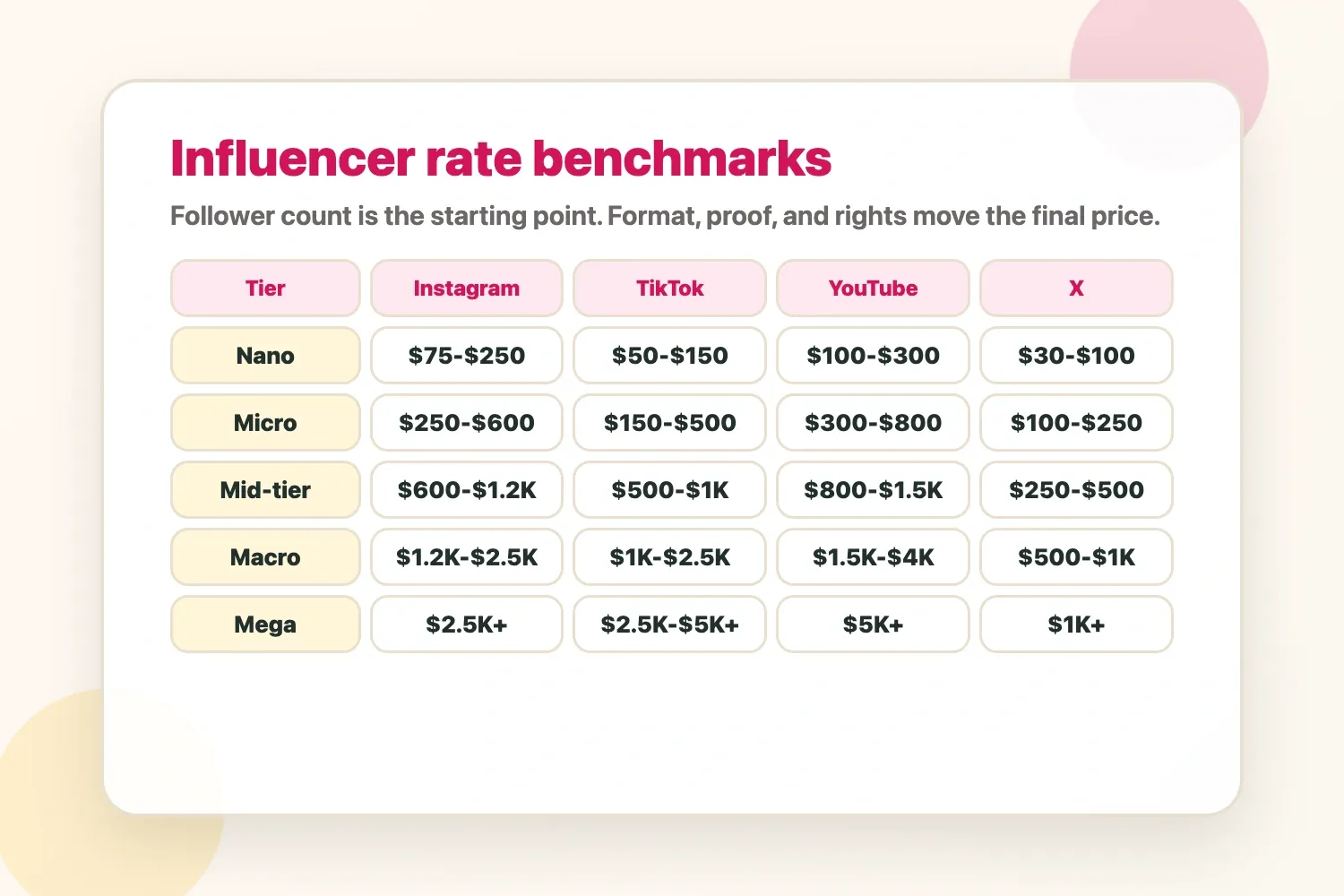
Here is the practical way to read them: if a micro creator charges $400 for an Instagram Reel, that number may be completely fair if the creator has relevant audience fit, consistent views, clean production, and useful past results. The same rate may be too high if the account has weak engagement, unclear positioning, or the brand needs heavy revisions.
| Creator tier | Audience size | Typical use case |
|---|---|---|
| Nano | 1K-10K followers | Niche trust, UGC-style posts, local campaigns |
| Micro | 10K-50K followers | Product launches, creator-led Reels, niche awareness |
| Mid-tier | 50K-100K followers | Broader reach with still-specific audience fit |
| Macro | 100K-500K followers | Larger launches, recognizable creators, wider reach |
| Mega | 500K+ followers | Mass awareness, celebrity-style campaigns, premium usage |
The important part is not memorizing every number. It is understanding which tier the creator sits in, which platform the content lives on, and what the brand is actually buying.
Why platform changes the price
A sponsored post is not worth the same amount on every platform because each platform gives the brand a different kind of value.
Instagram is often priced around visual trust, lifestyle fit, and social proof. A Reel can generate discovery, while Stories can drive clicks, replies, and quick product consideration. If the campaign includes link stickers, multiple frames, or creator whitelisting, the rate should usually move up.
TikTok is usually more format-driven. Brands pay for short-form creative that feels native, fast, and easy to reuse. A creator with a smaller audience can still charge well if the content style is good enough for the brand to repurpose in ads or Spark Ads.
YouTube often costs more because the production is heavier and the viewer relationship is deeper. A dedicated video or integration can take more planning, and the content can keep driving views long after the campaign goes live. For YouTube-specific pricing, this guide on how much brands pay for YouTube sponsorships goes deeper into CPMs, integrations, and dedicated videos.
X is usually more context-dependent. It can work for B2B, tech, finance, founder-led brands, and creator accounts with clear authority. But a single post is rarely priced only from follower count. The brand is usually buying credibility, distribution, and conversation quality.
What follower count gets wrong
Follower count is visible, easy to compare, and useful for sorting creators quickly. It is also one of the easiest numbers to overvalue.
A creator with 25,000 followers and 2,000 average Reel views is not offering the same reach as a creator with 25,000 followers and 18,000 average Reel views. A creator with 8,000 followers in a specific niche may be more valuable than a creator with 80,000 broad followers if the audience is more likely to buy.
Brands usually care about these signals once the follower tier looks reasonable:
- Average views on the specific format being bought
- Engagement rate and comment quality
- Saves, shares, story replies, profile visits, and link clicks
- Audience location, age, gender, and niche fit
- Past brand examples and content quality
- Whether the creator can explain the value of the package clearly
This is also why creators should not send a rate without context. A rate card is more convincing when it sits next to audience data, content examples, and campaign proof. A clean influencer media kit can make that context easier for a brand to review.
The pricing formula that actually works
The cleanest way to build an influencer rate is to start with a base price, then adjust for everything the brand is adding to the scope.
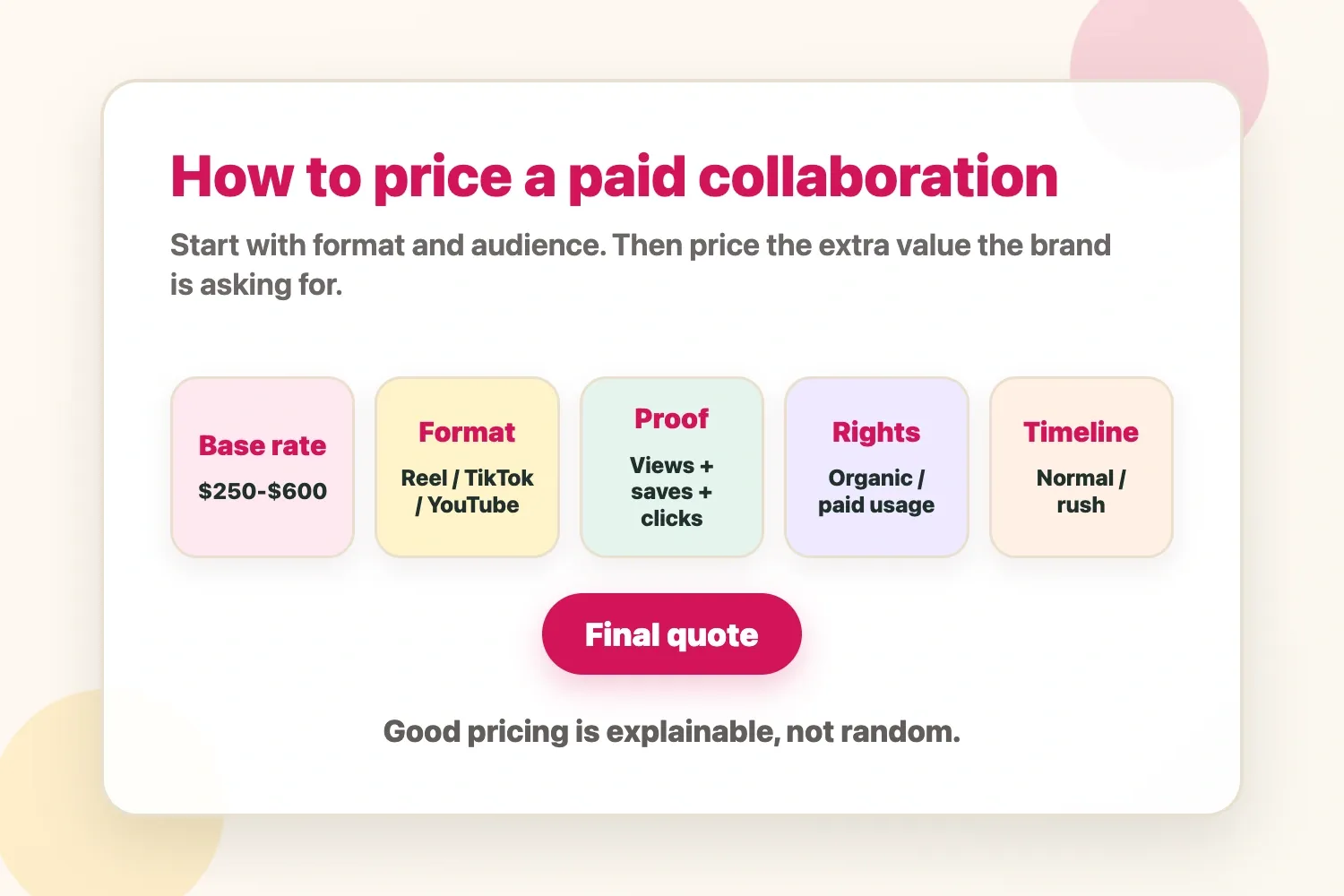
A simple pricing flow looks like this:
- Start with the platform and follower tier.
- Check average views for the exact format.
- Adjust for niche, audience quality, and past campaign proof.
- Add extra fees for usage rights, whitelisting, exclusivity, revisions, or rush timelines.
- Send the final quote with the deliverables written clearly.
For example, a micro creator might use $400 as the base for an Instagram Reel. If the brand wants 30 days of paid usage, the quote might become $600. If the brand also wants category exclusivity for one month, the rate could move higher again.
The number is easier to defend when the creator can explain what changed.
What changes the final rate
Two creators with the same follower count can charge very different rates. That is normal. The final price depends on the campaign structure.
Usage rights are one of the biggest rate movers. If a brand wants to reuse the content on its own channels or run it as a paid ad, the creator is no longer selling only a post. The creator is licensing creative work.
Exclusivity also matters. If a beauty creator cannot work with other skincare brands for 30, 60, or 90 days, that restriction has a cost. The brand is blocking future income, so the rate should reflect that.
Production quality can change the price too. A talking-head TikTok filmed in one hour is not the same as a fully edited Reel with product shots, voiceover, captions, transitions, and multiple reshoots.
Timeline matters when a brand needs content quickly. Rush work usually means the creator has to move other work, shoot under pressure, or edit faster than usual.
Proof is the final layer. Creators with past results, clean reporting, and brand examples can price with more confidence because they are not asking the brand to guess.
Creator pricing conversations online can be useful, but they work best as context rather than exact rate cards. The helpful thing to notice is how creators explain scope: deliverables, rights, revisions, usage, and what the brand is really asking for.
That is the mindset creators need when using any public pricing example. A number without scope can be misleading. A number with deliverables, rights, and proof becomes much easier to evaluate.
Average rates by format
Follower count gives a tier, but format usually decides the workload. A static post, short-form video, Story package, and YouTube integration all carry different production expectations.
| Format | Why brands buy it | Pricing note |
|---|---|---|
| Instagram Reel | Discovery, product education, visual proof | Usually higher than static posts because production is heavier |
| Instagram Story | Clicks, replies, urgency, launches | Often priced as a package of frames |
| TikTok video | Native short-form creative and reach | Usage rights can matter as much as posting |
| YouTube integration | Deeper attention and long-tail views | Often priced from CPM, topic fit, and production work |
| X post or thread | Authority, conversation, niche distribution | Best for accounts with clear expertise |
For Stories specifically, pricing can change a lot depending on expected views, number of frames, and link performance. This article on how much brands pay for Instagram Stories breaks that down separately.
How creators should present their rates
A creator rate should not arrive as a random number in a DM. It should feel like a small proposal.
A good rate response usually includes:
- The deliverables included in the price
- The platform and format
- The expected timeline
- Whether usage rights are included or billed separately
- Whether exclusivity is included or billed separately
- Any package options if the brand wants more than one asset
- A short reason the rate fits the audience and content quality
This does not need to be complicated. A creator can simply write that the quoted rate includes one Reel, one revision round, organic posting only, and no paid usage. If the brand wants to run the Reel as an ad, that can be scoped as an extra fee.
Clear scope protects both sides. The brand knows what it is buying, and the creator avoids turning one sponsored post into five unpaid extras.
How brands should use influencer rate benchmarks
Brands should use these rates to plan budgets, not to force every creator into the same box.
A fair budget starts with the campaign goal. If the brand wants awareness, reach and audience fit matter most. If the brand wants content for ads, usage rights and production quality matter more. If the brand wants conversions, link clicks, landing page fit, and offer quality also matter.
Brands should also avoid comparing creators by follower count alone. A creator with a smaller audience but better comments, better niche fit, and cleaner reporting may create more value than a larger creator with weak audience alignment.
For disclosure and compliance, paid collaborations should also follow the relevant advertising rules. The FTC disclosure guidance for social media influencers is a useful reference for campaigns targeting U.S. audiences.
Common mistakes with influencer rates
The biggest creator mistake is underpricing because the brand says the campaign is “simple.” Simple for the brand does not always mean simple for the creator. Filming, editing, revisions, captions, approvals, reporting, and usage rights all take time or carry value.
Another mistake is sending one flat rate without asking what the brand needs. A $500 Reel can become a bad deal if it quietly includes paid usage, multiple revisions, exclusivity, and a rush deadline.
Brands make mistakes too. The most common one is asking for a rate before sharing enough scope. Creators cannot price properly without knowing the deliverables, timeline, usage rights, exclusivity, and campaign goal.
A better process is simple: define the scope first, then discuss the rate.
Final thoughts
Influencer rates are not fixed prices carved into a platform chart. They are benchmarks that help creators and brands start the pricing conversation with more clarity.
Follower count still matters, but it should not carry the whole quote. The best pricing decisions look at platform, format, average views, niche fit, audience quality, content quality, campaign scope, usage rights, exclusivity, and proof.
Creators should be able to explain their rate without sounding defensive. Brands should be able to understand what they are paying for without guessing. When both sides treat pricing as scope plus value, the conversation gets much easier.