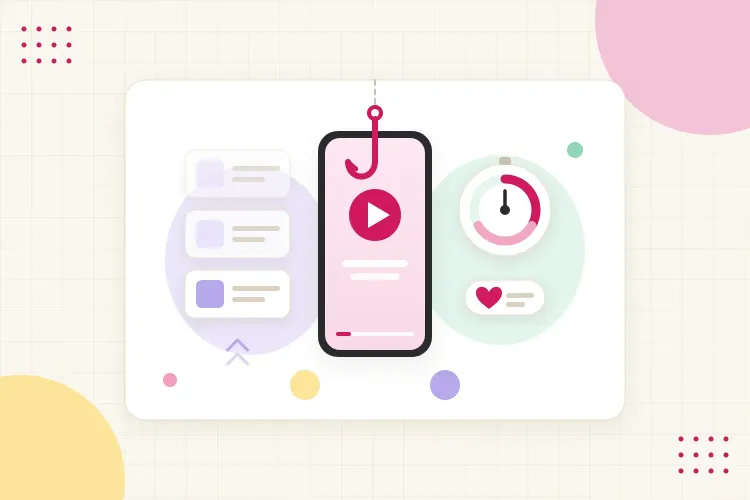


A TikTok hook is everything that happens in the first one to three seconds that makes someone stop scrolling: the opening shot, the text on screen, and the first line you say. Below are 100+ TikTok hooks you can copy, each written as a template with a filled-in example, plus 15 visual hooks with filming notes and real examples.
Pick the group that fits your video, swap in your niche, and make sure the rest of the TikTok delivers what the opening promises. A hook that overpromises still loses the viewer, just a few seconds later.
What makes a TikTok hook work
On TikTok, the hook is rarely just a sentence. The For You feed starts playing the moment a video appears, so the opening has to work on three layers at the same time:
- The visual hook: what moves in the first frame. A camera move, an entrance, an object, or something that looks slightly off.
- The text hook: the on-screen line that tells the viewer what the video is about, even with the sound off.
- The spoken hook: the first sentence out loud, which should add to the text rather than read it word for word.
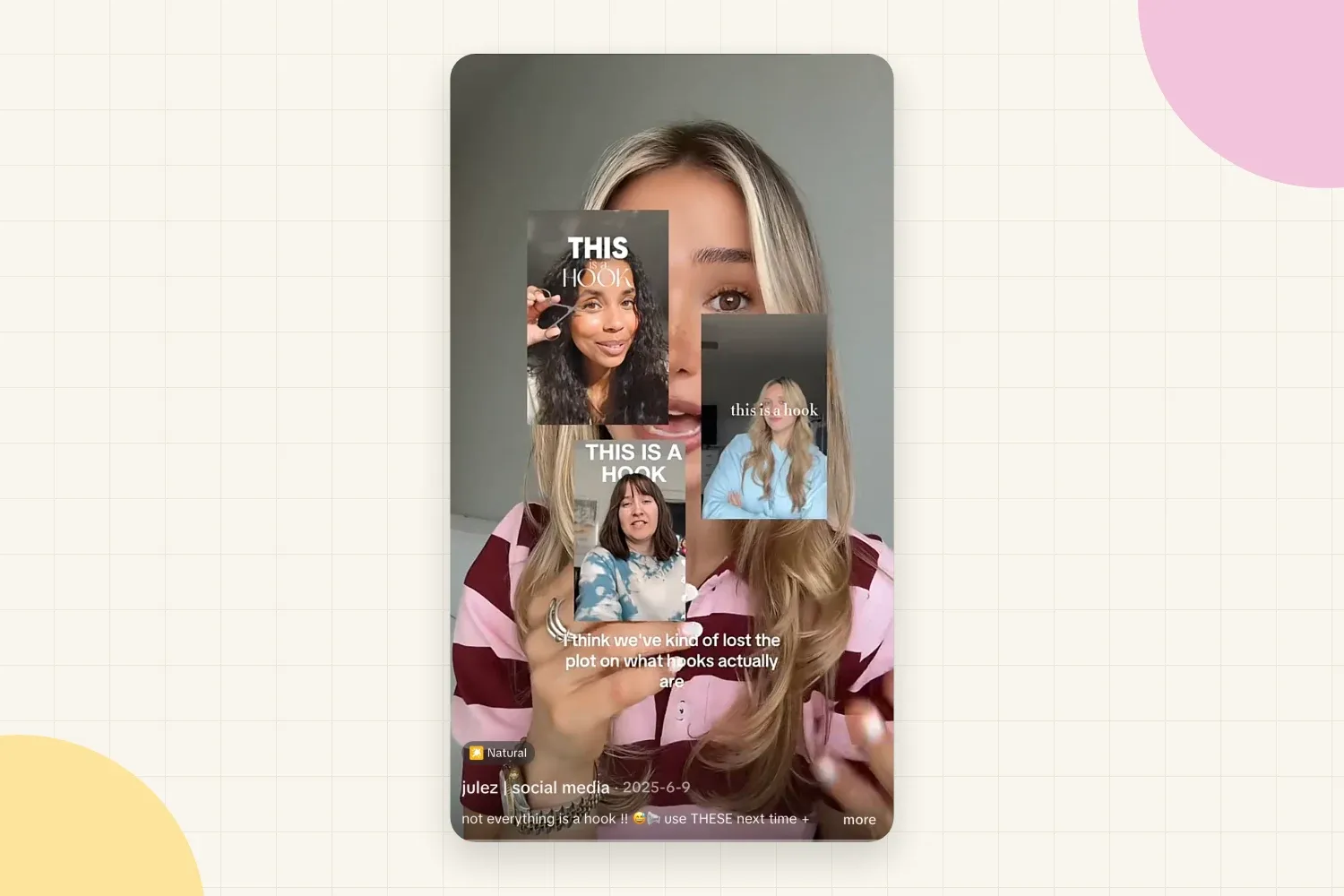
The rule behind every opening below is the same: one clear promise, made fast, backed by something worth looking at.
100+ TikTok hooks you can copy
Each hook below has a template in brackets and one example. Copy the structure, not the example: the example only shows how specific the filled-in line should be.
Not sure where to start? Pick the groups that match what the video needs to do:
| What the video needs to do | Hook groups to try first |
|---|---|
| Reach people who don't follow you yet | Curiosity, question, opinion, and POV hooks |
| Earn saves and shares | List, quick win, and save hooks |
| Build trust in your expertise | Proof and results, mistake and warning hooks |
| Turn viewers into followers | Storytime, comment reply, and follow hooks |
| Sell a product | Product and review, proof and results hooks |
Curiosity hooks
Curiosity hooks open a question the viewer can only close by watching. They work when the answer is genuinely useful or surprising, not when it is withheld for the sake of it.
- "The [thing] that changed how I [activity]." Example: "The $20 light that changed how I film every video."
- "Nobody in [industry] wants you to know this." Example: "Nobody in real estate wants you to know this about open houses."
- "I wasn't going to post this, but [reason]." Example: "I wasn't going to post this, but it saved me $3,000 on my taxes."
- "Here's what [number] [units] of [activity] taught me." Example: "Here's what 1,000 hours of editing taught me about pacing."
- "This [thing] has a hidden feature." Example: "This airport lounge has a hidden nap room."
- "I finally figured out why [problem]." Example: "I finally figured out why my sourdough never rises."
- "Keep watching if you've ever [situation]." Example: "Keep watching if you've ever been ghosted by a brand after sending your rates."
- "The [profession] trick I still use every day." Example: "The bartender trick I still use every day at home."
- "What [result] actually looks like behind the scenes." Example: "What a sold-out pop-up actually looks like behind the scenes."
- "I can't believe this is legal." Example: "I can't believe this hotel points trick is legal."
Question hooks
A direct question makes the viewer answer it in their head before they swipe. Aim it at the right person, and answer it in the video.
- "Why is nobody talking about [topic]?" Example: "Why is nobody talking about how long TikTok Shop payouts take?"
- "Would you [choice] for [reward]?" Example: "Would you work four 10-hour days for a three-day weekend?"
- "Have you ever noticed [observation]?" Example: "Have you ever noticed every coffee shop plays the same playlist?"
- "How much do you think [thing] costs?" Example: "How much do you think it costs to run a food truck for a month?"
- "Do you know what [term] actually means?" Example: "Do you know what 'usage rights' actually means in a brand deal?"
- "What happens if you [action]?" Example: "What happens if you skip stretching for 30 days?"
- "Am I the only one who [habit]?" Example: "Am I the only one who reads the last page of a book first?"
- "Which [option] are you: [A] or [B]?" Example: "Which packer are you: rolling or folding?"
Mistake and warning hooks
Loss feels bigger than gain, so a warning gets attention fast. Keep it specific and back it up, or it reads as fearmongering.
- "Stop [habit] if you want [result]." Example: "Stop opening with 'Hey guys' if you want people to stay past the first second."
- "Don't [action] until you watch this." Example: "Don't sign a gym membership until you watch this."
- "The [number] mistakes I made [doing thing]." Example: "The 3 mistakes I made pricing my first brand deal."
- "If you're still [outdated habit], [what it's costing you]." Example: "If you're still washing raw chicken, you're spreading bacteria around your sink."
- "This [common thing] is costing you [loss]." Example: "This default setting is costing you battery every single day."
- "I wasted [amount] on [thing] so you don't have to." Example: "I wasted $400 on camera gear so you don't have to."
- "Never say this to [person]." Example: "Never say this to a recruiter in the first interview."
- "You're [doing thing] wrong." Example: "You're loading your dishwasher wrong."
- "Red flags when [situation]." Example: "Red flags when a brand reaches out for a 'collab.'"
- "Before you buy [product], know this." Example: "Before you buy a standing desk, know this."
Quick win and how-to hooks
These promise a useful result in very little time. The video has to deliver it fast too.
- "How to [result] in [short time]." Example: "How to clean your oven in 10 minutes without scrubbing."
- "The easiest way to [task]." Example: "The easiest way to cut a mango without a mess."
- "Do this once and [result] forever." Example: "Do this once and never lose your AirPods again."
- "[Number]-second fix for [problem]." Example: "A 30-second fix for a squeaky door."
- "Here's how I [result] without [usual cost]." Example: "Here's how I post every day without filming every day."
- "Try this next time you [situation]." Example: "Try this next time your coffee tastes bitter."
- "The only [thing] you need to [result]." Example: "The only stretch you need to fix desk posture."
- "How to [task] like a [expert]." Example: "How to fold a fitted sheet like a hotel housekeeper."
- "Turn [ordinary thing] into [better thing]." Example: "Turn leftover rice into crispy rice cakes."
- "Copy this [template or setting]." Example: "Copy this exact camera setting for brighter indoor videos."
List hooks
Numbers set expectations and make the video feel finite. Keep the number small and the items specific.
- "[Number] things I'd never [action] again." Example: "3 things I'd never pack for a beach holiday again."
- "[Number] apps that [result]." Example: "4 apps that run my business while I sleep."
- "[Number] signs you're ready to [milestone]." Example: "5 signs you're ready to go full-time as a creator."
- "[Number] [items] under [price] that [result]." Example: "3 kitchen tools under $15 that I use every day."
- "Ranking [category] from worst to best." Example: "Ranking every protein bar at Costco from worst to best."
- "[Number] rules I follow for [activity]." Example: "5 rules I follow for every brand partnership."
- "Everything I [did] in [time period]." Example: "Everything I ate in a week as a marathon runner."
- "[Number] [places or things] in [location] you can't skip." Example: "3 bakeries in Paris you can't skip."
Proof, results, and experiment hooks
Showing the result first earns the right to explain how. Use real numbers and real footage.
- "I tried [thing] for [time]. Here's what happened." Example: "I tried posting twice a day for 30 days. Here's what happened."
- "From [before] to [after] in [time]." Example: "From 2,000 to 40,000 followers in four months."
- "I tested [number] [things] so you don't have to." Example: "I tested 6 ring lights so you don't have to."
- "This is what [amount] gets you in [place]." Example: "This is what $1,500 a month gets you in Lisbon."
- "Day [number] of [challenge]." Example: "Day 47 of learning piano as an adult."
- "I followed [famous routine] for a week." Example: "I followed a pro athlete's morning routine for a week."
- "This [thing] made me [result]." Example: "This one email made me $8,000 last year."
- "Watch [thing] go from [state] to [state]." Example: "Watch this thrifted chair go from trash to $300."
- "I asked [number] [people] [question]." Example: "I asked 100 brand managers what makes them hire a creator."
- "Results after [time] of [habit]." Example: "Results after 90 days of red light therapy."
Opinion and myth-busting hooks
A clear opinion gives viewers something to agree or argue with, which keeps them watching and commenting. Make sure you can defend it.
- "Unpopular opinion: [opinion]." Example: "Unpopular opinion: you don't need a niche to grow."
- "[Common advice] is wrong." Example: "'Post every day' is wrong for most creators."
- "Stop believing [myth]." Example: "Stop believing you need 10,000 followers to get brand deals."
- "[Popular thing] is overrated, and here's why." Example: "Avocado toast is overrated, and here's why."
- "Hot take: [opinion]." Example: "Hot take: hotel breakfasts are a scam."
- "Everyone's doing [trend] wrong." Example: "Everyone's doing the 12-3-30 workout wrong."
- "I don't care what [group] says, [opinion]." Example: "I don't care what nutritionists say, cereal is a valid dinner."
- "The truth about [topic] nobody wants to hear." Example: "The truth about passive income nobody wants to hear."
POV and relatable hooks
POV and "tell me without telling me" formats are native to TikTok. They work when the situation is specific enough that the viewer thinks "that's me."
- "POV: [specific situation]." Example: "POV: you finally quit your job to create full-time and your mom asks what you do all day."
- "Tell me you're [identity] without telling me." Example: "Tell me you're a nurse without telling me you're a nurse."
- "Things [group] will understand." Example: "Things only people with curly hair will understand."
- "When [relatable moment]." Example: "When the client says 'quick change' and sends 14 revisions."
- "Me pretending [situation]." Example: "Me pretending I didn't just spend $90 at Sephora."
- "Every [role] has done this." Example: "Every freelancer has done this at 11 p.m. on a Sunday."
- "Nobody: ... Me: [behavior]." Example: "Nobody: ... Me at 2 a.m.: reorganizing my spice rack."
- "Name a more [adjective] [thing]. I'll wait." Example: "Name a more satisfying sound than the first crack of a new book's spine. I'll wait."
Storytime hooks
Storytime is one of TikTok's longest-running formats. The hook has to drop the viewer into the tension, not the background.
- "Storytime: the day [event]." Example: "Storytime: the day a brand tried to pay me in exposure."
- "So this happened [time]." Example: "So this happened at my cousin's wedding yesterday."
- "I got [result] and I still can't believe it." Example: "I got fired over a TikTok and I still can't believe it."
- "The worst [experience] I've ever had." Example: "The worst Airbnb I've ever stayed in."
- "How I [result] by accident." Example: "How I started a business by accident."
- "I need to tell someone about [event]." Example: "I need to tell someone about what my neighbor just did."
- "Part 1 of how I [story]." Example: "Part 1 of how I moved to Japan with one suitcase."
- "[Number] years ago, I [starting point]." Example: "Two years ago, I was making $12 an hour at a call center."
Comment reply and stitch hooks
TikTok lets you reply to a comment with a video and stitch another creator's clip. Both give the viewer instant context: a question already exists, and you are answering it.
- "Replying to [username]: [short answer to their question]." Example: "Replying to @sam: yes, you can still grow in 2026, and here's how."
- "You asked for [thing], so here it is." Example: "You asked for the full recipe, so here it is."
- "Someone in my comments said [claim]. Let's test it." Example: "Someone in my comments said this lipstick survives a full meal. Let's test it."
- "[Number] of you asked about [topic]." Example: "300 of you asked about my editing setup."
- "Stitch this if you [situation]." Example: "Stitch this if you've ever been underpaid for a brand deal."
- "Let me add to this." Example: "Let me add to this, because it's missing the part about taxes."
- "This is wrong, and here's why." Example: "This is wrong, and here's why nobody should microwave an egg in the shell."
- "Answering the most asked question about [topic]." Example: "Answering the most asked question about my morning routine."
Product and review hooks
Product hooks power TikTok Shop and brand content, but they work best when they sound like a recommendation, not an ad.
- "TikTok made me buy [product]. Was it worth it?" Example: "TikTok made me buy this mini waffle maker. Was it worth it?"
- "Honest review after [time] of using [product]." Example: "Honest review after six months of using the Dyson Airwrap."
- "I found the dupe for [expensive product]." Example: "I found the dupe for the $120 cashmere sweater."
- "Is [viral product] actually worth it?" Example: "Is the Stanley cup actually worth it?"
- "The [product] I'd buy again in a heartbeat." Example: "The carry-on I'd buy again in a heartbeat."
- "Unboxing [product] so you know what you're getting." Example: "Unboxing the new Kindle so you know what you're getting."
- "Don't buy [product]. Buy this instead." Example: "Don't buy a ring light. Buy this instead."
- "[Product] vs [product]: which one wins?" Example: "AirPods Pro vs Sony buds: which ones win?"
Save, share, and follow hooks
These tell the viewer upfront why the video is worth keeping or sending. Use them only when the content truly deserves it.
- "Save this for your next [situation]." Example: "Save this for your next trip to Rome."
- "Send this to the friend who [behavior]." Example: "Send this to the friend who always forgets birthdays."
- "Bookmark this before [deadline]." Example: "Bookmark this before you file your taxes."
- "You'll need this when [future situation]." Example: "You'll need this when you negotiate your first raise."
- "Part [number] of [series]. Follow for the rest." Example: "Part 3 of turning my garage into a studio. Follow for the rest."
- "Share this with someone who needs to hear it." Example: "Share this with someone who's about to quit."
15 visual TikTok hooks (filming ideas)
Visual hooks work on mute and before the viewer reads anything. Pair any of them with a text hook from the lists above.
1. The sliding entrance
Start on an empty frame or a background, then slide into the shot from the side, already mid-sentence. The empty frame creates a beat of "what am I looking at?", and the entrance answers it with you.
Here @saladpictures_ opens on an empty room and slides in from the right holding a mini microphone, already asking "So how does ray tracing work?" Two visual hooks in one: the entrance and the prop mic.
2. The quick zoom-out
Open tight on a detail, such as a fabric, an ingredient, a screen, or a face, then zoom out fast to reveal the full scene. The close-up raises a question and the zoom-out answers it within a second.
@brandonbalfourr starts on the knit texture of his sweater and pulls back to the full outfit while the text "3 Tricks Guaranteed To Make Your Outfits Better" sets up the video.
3. Holding a random object as a microphone
Hold a hairbrush, a banana, a TV remote, or a whisk like a reporter's microphone and start "reporting." The object is slightly absurd, which stops the scroll, and it signals that the video will not take itself too seriously.
4. Flipping the computer screen
Start with the back of the laptop facing the camera, then turn it around to reveal the screen: a dashboard, a result, a website, or a spreadsheet. It works well for business, finance, and tech content where the proof lives on a screen.
5. Moving the camera backwards
Start close to your face and pull the camera back while you talk, revealing the room, the setup, or the outfit. The movement adds energy to a talking-head video without a single cut. A gimbal or a phone on a sliding surface keeps it smooth.
6. Talking in front of the subject
Stand in front of the place, product, or thing you are talking about, so the background explains the video before you finish your first sentence.
@marktilbury films in front of a Costco and holds up a 10-gram gold bar while saying "I just bought this from Costco." The store and the gold bar do most of the hook's work before he explains anything.
7. Wearing your earphone as a microphone
Hold a wired earbud up to your mouth like a lavalier microphone, as if you are on a live broadcast. It is a quick way to make a talking-head video look like an interview or a "breaking news" segment.
8. Camera rotation
Rotate the camera 90 or 180 degrees into the opening shot, or turn the phone with your body as you start talking. The rotation breaks the visual rhythm of the feed, which is exactly what a hook needs.
9. Action stacking
Stack three or more quick actions in the first two or three seconds, cutting on every movement. The pace tells the viewer that the video moves fast and that it will not waste their time.
@panaceapalm stacks pizza rolls one after another in quick cuts, with one word on screen per cut, before revealing the finished roll and the text "High Protein Cheesy Pepperoni Pizza Rolls."
10. Object metaphor
Use an object to stand for the idea: an ice cube melting for "your reach," a leaking cup for "your budget," a tangled cable for "your schedule." The image makes an abstract topic concrete in one shot.
11. Mirror split screen
Show yourself twice side by side, either with a mirrored copy of the clip or two takes, and have the two versions talk to each other. It works well for "me vs me," before and after, or two opinions on the same topic.
12. Countdown timer
Put a visible timer on screen from the first frame: "I have 60 seconds to explain how index funds work." The countdown creates a deadline, and viewers stay to see if you make it.
13. Doing something else while talking
Do your makeup, cook, fold laundry, or pack a bag while you talk to the camera. The activity gives the eye something to follow while the words do the work, which makes it a natural fit for storytime and opinion videos.
14. Talking while driving
The car is one of TikTok's most familiar talking-head settings, and it feels like an unfiltered conversation. Film only when parked or from the passenger seat: no video is worth a distracted drive.
15. Walking towards the camera while talking
Set the camera on a tripod, start a few steps back, and walk towards it while talking from the very first frame. The movement makes the video feel like it is already underway when the viewer arrives.
Niche hook packs
Templates work best once they carry niche-specific detail. These ready-made lines show what that looks like in five common creator niches.
Fitness
- "If your lower back hurts after deadlifts, watch your hips, not your back."
- "What I'd do if I had to lose 10 pounds in 12 weeks with no gym."
- "3 warm-up moves that fixed my squat depth."
- "Rating every pre-workout I've tried this year."
- "This is what 150 grams of protein looks like on a budget."
Beauty and skincare
- "If your concealer creases by lunch, you're using too much."
- "The $8 product doing the work of my $60 serum."
- "Watch my skin go from flaky to smooth in one routine."
- "3 makeup habits that age you faster."
- "Testing the viral blush trick on a 10-hour workday."
Food and cooking
- "This one-pan dinner takes 15 minutes and uses five ingredients."
- "Stop buying jarred pesto."
- "What I eat in a day for $10."
- "The reason your pasta is always bland."
- "Turning sad leftovers into a dinner my family actually asks for."
Business, freelance, and UGC
- "If a brand asks 'what's your rate?', don't answer with a number yet."
- "How I'd pitch a brand that has never heard of me."
- "What a UGC creator actually earns from one video."
- "Stop sending your media kit as a PDF attachment."
- "The contract clause that protects your content after the campaign."
Travel
- "Don't book a hotel in Rome before watching this."
- "How to see Bali without the crowds."
- "Everything I packed for a month in a 40-liter backpack."
- "What one day in Tokyo costs on a budget."
- "The airline trick that got me a free upgrade."
How long should a TikTok hook be?
Aim to make the promise within the first one to three seconds and to start paying it off soon after. The hook is not a separate intro. It is the first beat of the video, so cut anything that comes before it: greetings, logos, "So today...", or a long establishing shot.
Longer videos can afford a few more seconds of setup after the hook, but the hook itself should stay short. If the opening line needs a second sentence to make sense, rewrite it.
How TikTok measures your hook
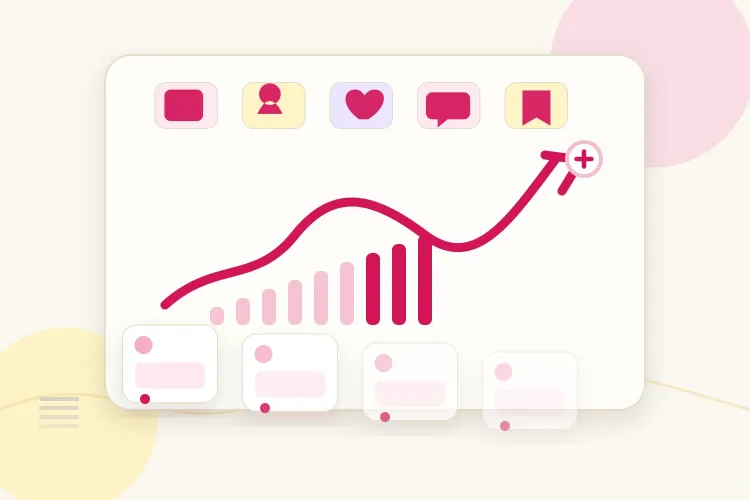
TikTok does not show a hook score, but the retention chart in each video's analytics comes close. It plots the share of viewers still watching at every second. The first three seconds of that curve are your hook. Everything after shows whether the video kept the promise.
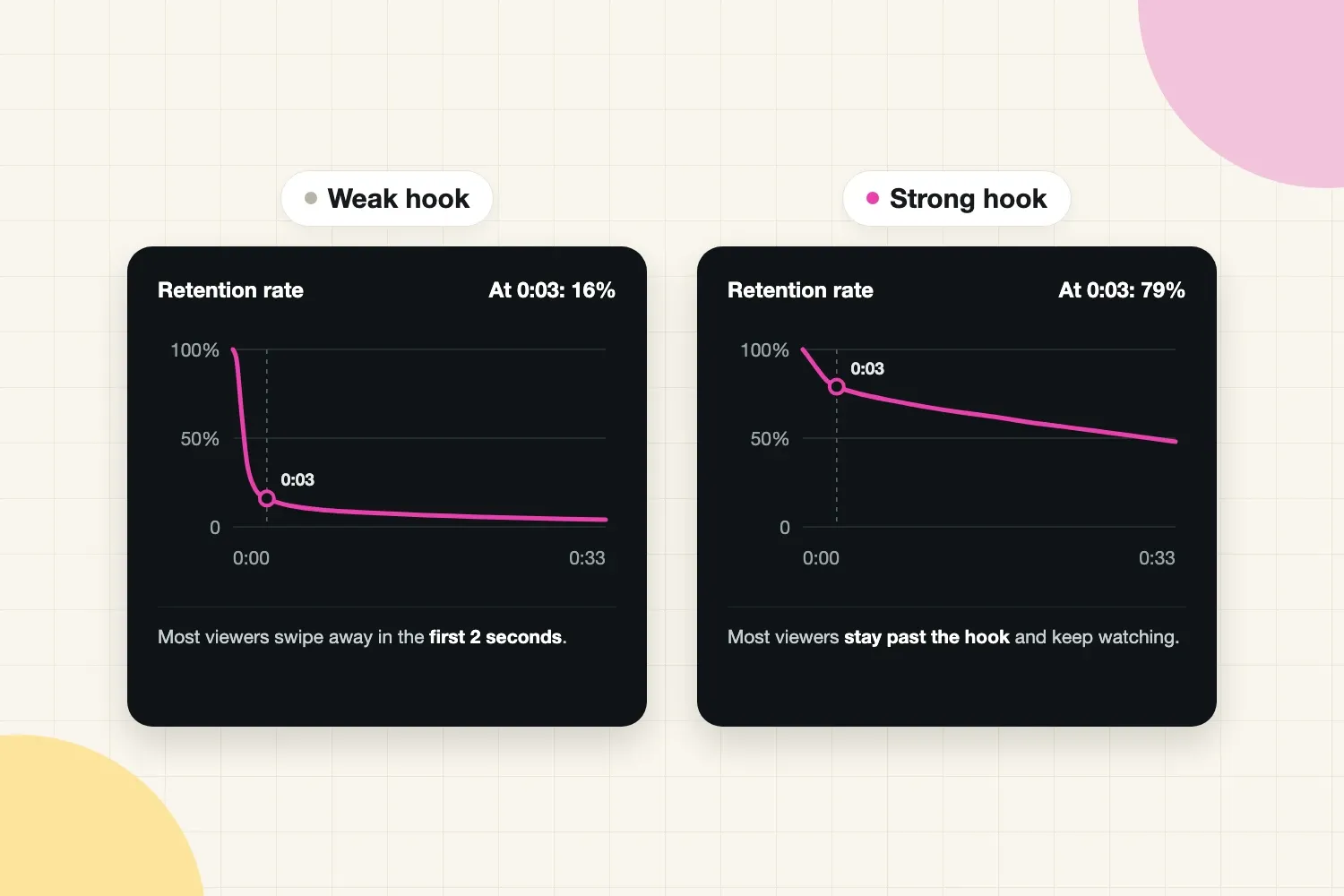
The two curves above are illustrative, but the shapes are the ones to look for. A weak hook drops off a cliff before 0:03 and never recovers. A hook that works bends gently in the first seconds and then declines slowly. Next to the chart, check average watch time and the share of viewers who watched the full video.
TikTok's own research points the same way. In its creative tips for auction ads, TikTok reports that over 63% of the videos with the highest click-through rate highlight their key message or product within the first 3 seconds. That data comes from ads, but the lesson carries over to organic videos: say what the video is about before the viewer has to wonder.
If you also post your videos as Reels, Instagram judges the same opening with skip rate: the share of viewers who leave in the first three seconds. This guide to Instagram Reel hooks explains that metric and has its own set of Reel-specific templates.
How to write your own hook in five minutes
Templates speed things up, but the best hooks come from the video itself. A quick process:
- Write the payoff first. Finish the sentence "By the end of this TikTok, the viewer will know or see..." If you cannot finish it, rethink the video before the hook. If you need a sharper angle, these TikTok content ideas are sorted by format, from educational videos to series.
- Name the viewer. Decide who should stop scrolling. "Small business owners" is vague. "Bakery owners who can't get foot traffic" is a hook on its own.
- Pick the job. Curiosity, question, mistake, quick win, list, proof, opinion, relatability, story, reply, product, or save. One job per hook.
- Write three versions. Use three different groups from the list above and say them out loud. Keep the one you would stop for.
- Choose the visual. Pick a visual hook that shows the promise or creates tension, then put a short version of the line on screen.
- Check it on mute. Play the first three seconds with the sound off. By 0:03, the viewer should know what the video is, who it is for, and why to keep watching. If one of the three is missing, fix the opening before you post.
Pair the hook with on-screen text and a caption
On-screen text is what most viewers read first, so keep it under about ten words and keep it away from the bottom and right edges of the frame, where the caption and buttons cover it. It should name the topic, not repeat every word you say.
The caption is a second chance. Many viewers use TikTok search the way they would use Google, so write the first line of the caption with the words people would actually type, such as "high protein dinner" or "how to price UGC," then add the detail the video could not fit. A video with the hook "Stop sending your media kit as a PDF attachment" could open its caption with "How to send a creator media kit brands actually open."
Hook mistakes that kill retention
- A slow start. A greeting, a recap of who you are, or "Hey guys, so today..." spends the seconds that matter most.
- An opening that looks like an ad. A logo card, a polished studio intro, or a scripted pitch reads as advertising, and viewers have learned to swipe past ads. A plain, phone-shot opening usually feels more native to the feed.
- A promise the video doesn't keep. Viewers who feel tricked swipe away, and the retention curve shows it.
- Vague lines. "You need to see this" could open any video. Specific beats clever.
- Text that fights the visual. If the on-screen text says one thing and the frame shows another, the viewer processes neither.
- Trending audio as the only hook. A popular sound helps with discovery, but it does not tell anyone why your video is worth watching.
- Copying a hook word for word. The same line on thousands of videos stops being a pattern break. Keep the structure, change the words.
How to test TikTok hooks
Hooks are easier to judge with data than with instinct. A simple routine:
- Film the video once and plan two or three openings that change only the first three seconds: a different visual, line, or text hook.
- Post the versions a few days apart, at similar times, as separate videos with their own edit, not as identical reposts.
- Wait a few days before comparing: TikTok often keeps showing a video well after the first day.
- In each video's analytics, compare the retention at 0:03 first, then average watch time, then the share of viewers who watched the full video.
- Keep the winning hook structure and reuse it on your next videos in the same format.
Change one thing at a time. If the hook, the topic, and the length all change between versions, the result tells you nothing about the hook.
Also compare each version with your usual retention at 0:03, not only with the other versions. If every version sits below what your videos normally hold, no hook has won yet.
Final thoughts
The best TikTok hooks are specific, fast, and honest about the payoff. Use these 100+ templates as starting points, add a visual hook that works on mute, write on-screen text and a caption that match the words people search, and let the retention curve tell you which openings hold strangers. Once a structure works for your audience, reuse it until the numbers say it is time for a new one.