

TikTok Spark Ads are useful when a brand does not want an ad that feels completely separate from the content people already watch on TikTok. Instead of uploading a polished ad from scratch, the brand can promote an existing organic post from its own account or from a creator who gives permission.
That small difference changes the whole campaign. The ad keeps the original post identity, creator handle, likes, comments, shares, and native TikTok feel. For creators, Spark Ads can make a collaboration more valuable because the brand is not only paying for a video. It is paying to scale content that already has proof.
The practical question is not only “what are TikTok Spark Ads?” It is: when should a brand use them, what should a creator approve, and what needs to be agreed before a normal post becomes paid media?
What are TikTok Spark Ads?
A TikTok Spark Ad is a paid ad that boosts an existing organic TikTok post. The post can come from the brand’s TikTok account, or it can come from a creator’s account if the creator authorizes the brand to use it.
TikTok describes Spark Ads as a native ad format that lets advertisers use organic TikTok posts in paid campaigns. The important part is that the ad is connected to the real post, not recreated as a separate dark ad. That means the post can keep its engagement and feel more natural in the feed than a standard uploaded ad.
For creators, this is why Spark Ads should be treated differently from a normal organic deliverable. If a brand wants to use a creator’s post as paid media, the creator should understand how long the brand can run it, where it can be used, what budget range is expected, and whether paid usage is included in the original rate.
Spark Ads vs regular TikTok ads
Regular TikTok ads are usually uploaded by the advertiser directly into TikTok Ads Manager. They can still look native, but they are not tied to a live organic post in the same way.
Spark Ads start from content that already exists on TikTok. That gives the ad a different kind of credibility. A creator video with comments, saves, shares, and real engagement can feel less like a brand interruption and more like content the audience would already stop to watch.
| Format | What it uses | Best for |
|---|---|---|
| Regular TikTok ad | A video uploaded by the advertiser | Controlled creative, direct response testing, product demos |
| Spark Ad from brand post | A brand’s existing organic post | Boosting a post that is already getting traction |
| Spark Ad from creator post | A creator’s existing post with permission | Scaling creator content, influencer campaigns, social proof |
This is also why Spark Ads sit between creator marketing and paid social. The creative still needs to work like TikTok content, but the campaign also needs the discipline of paid media: targeting, budget, reporting, and clear usage rights.
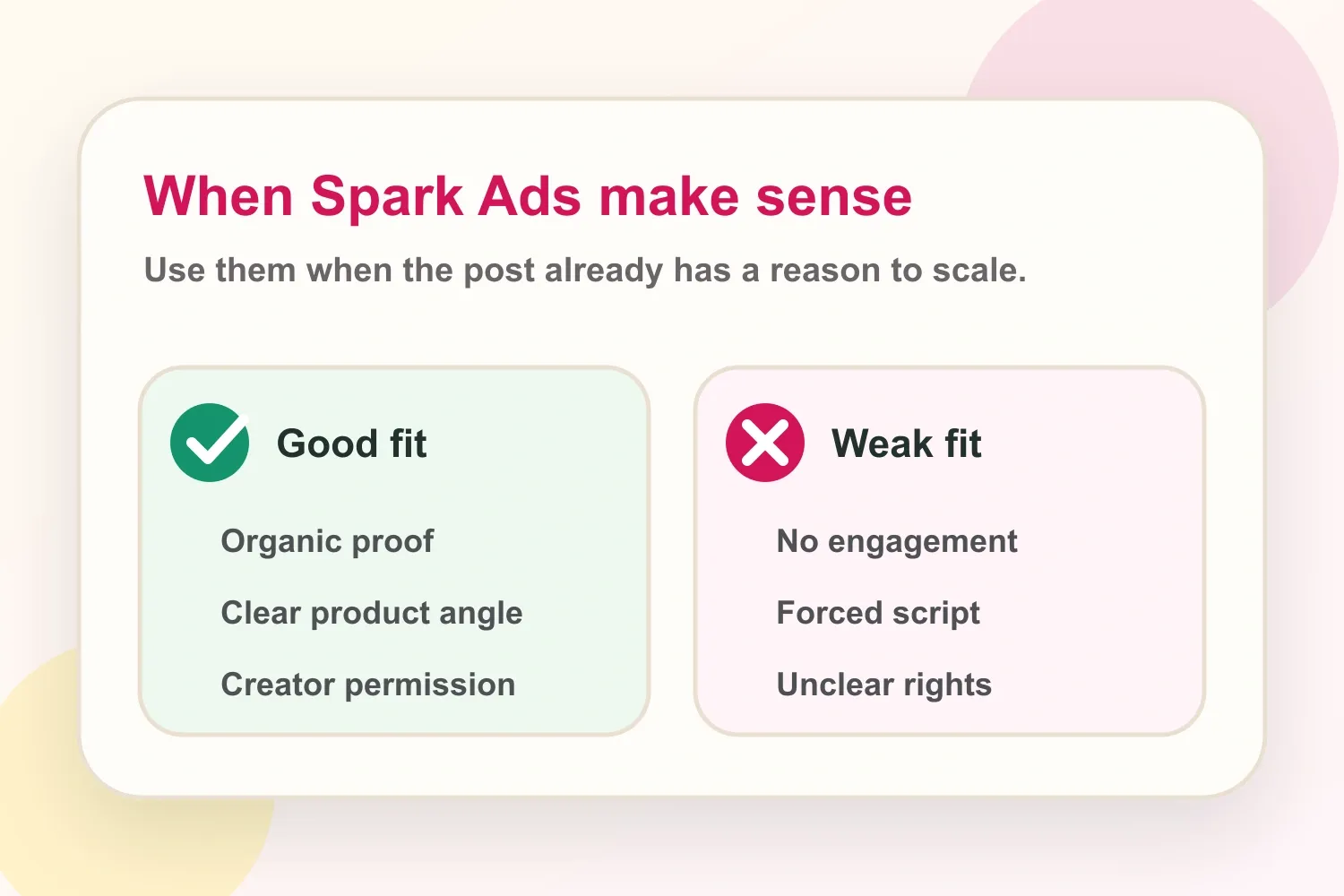
When Spark Ads make sense
Spark Ads work best when the original post already has a reason to scale. That does not always mean millions of views. It can mean strong watch time, useful comments, good saves, clear product interest, or a creator audience that matches the buyer.
They usually make sense when:
- A creator post is already getting better engagement than the brand’s usual ads.
- The content explains the product in a natural way.
- The comments show buying intent, questions, or objections the brand can learn from.
- The creator is comfortable with paid usage.
- The brand wants to test the creator’s content with a bigger audience.
They are weaker when the post only looks nice but has no clear product angle, no engagement signal, or no agreement around usage. If the content feels forced organically, putting paid spend behind it usually just scales the wrong problem.
How creator authorization works
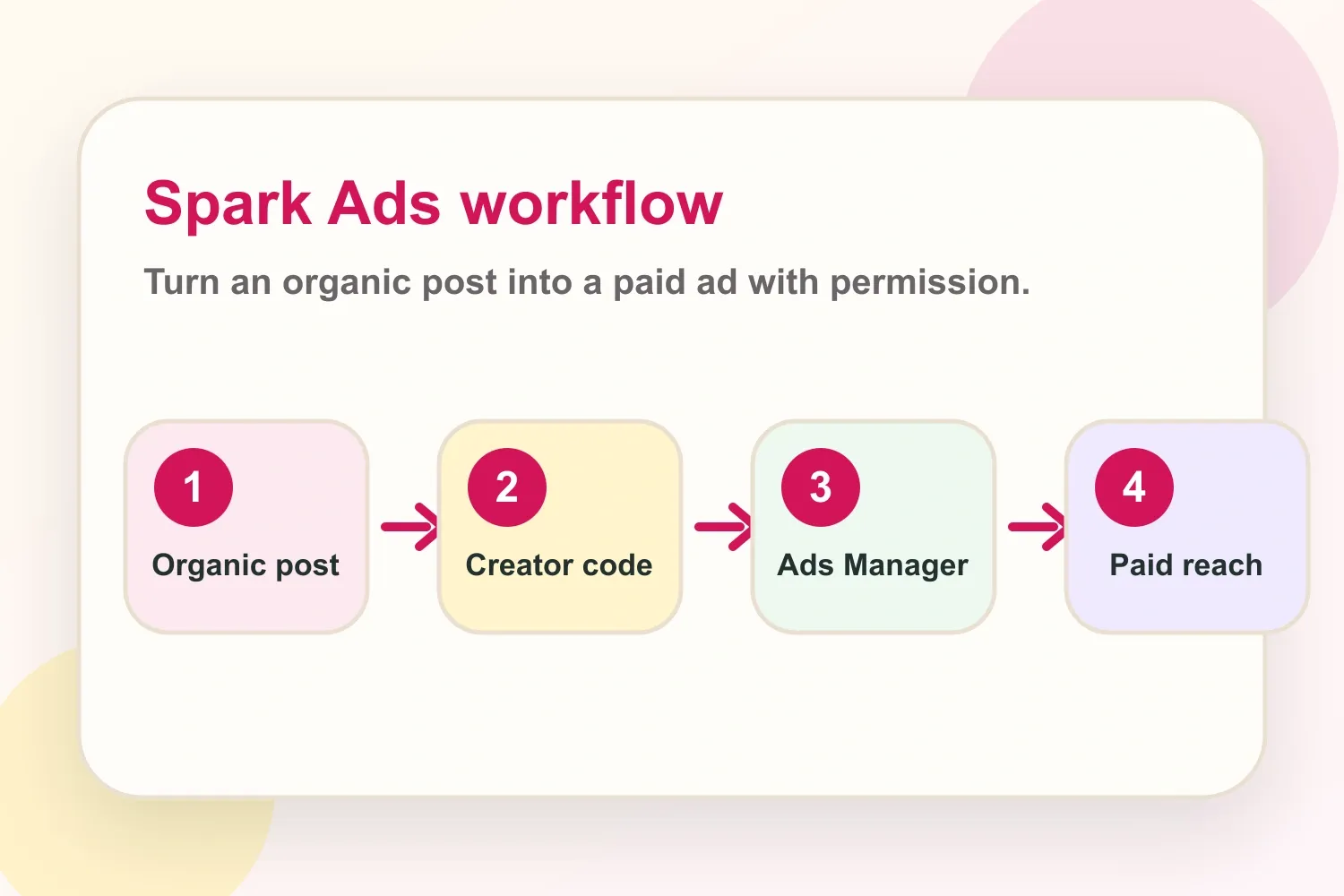
For a brand to run a Spark Ad from a creator’s account, the creator has to authorize the post. The common workflow is that the creator generates a video code from TikTok, chooses the authorization period, and shares that code with the brand. The brand then uses the code inside TikTok Ads Manager to create the campaign.
TikTok’s own help center explains the Spark Ads format and the video-code process in more detail through its Spark Ads overview and Spark Ads creation guide.
The setup is not complicated, but the business terms matter. Before sharing a code, the creator should know:
- Which video the brand wants to boost.
- How long the authorization will last.
- Whether the brand can use the post only on TikTok or in other paid placements too.
- Whether usage rights are included in the collaboration fee.
- What reporting the brand will share after the campaign.
Creators often hear “just send a Spark code” as if it is a small admin task. It is not huge, but it is still permission to use creator content in paid media. That should be priced and documented clearly.
What creators should charge for Spark Ads
There is no universal Spark Ads fee because the value depends on the creator, the content, and the paid usage. A small creator with a very specific audience can still create high-performing Spark Ads if the content is credible and the product fit is obvious.
The starting point is the normal organic deliverable rate. From there, add paid usage if the brand wants to run the post as an ad. The usage fee can depend on the authorization period, expected spend, exclusivity, whether the brand wants revisions, and whether the creator is giving the brand broader rights beyond TikTok Spark Ads.
For creators trying to price the original deliverable, a TikTok pricing calculator can help set a starting range. The Spark Ads usage fee should then be handled as a separate layer, especially if the brand plans to put meaningful budget behind the post.
What brands should check before boosting a creator post
Brands should not choose Spark Ads only because a post looks casual. The post still needs a campaign job.
Before boosting, check:
- Audience fit: Does the creator reach the people the product is actually for?
- Engagement quality: Are the comments useful, or are they generic reactions?
- Hook strength: Does the first few seconds make someone stop scrolling?
- Product clarity: Does the viewer understand what is being shown and why it matters?
- Brand safety: Is the creator, caption, comment section, and context suitable for paid promotion?
- Rights: Has the creator clearly approved paid usage?
If the post is strong but the audience is wrong, Spark Ads may generate cheap views and weak outcomes. If the audience is right but the content is slow or unclear, the brand may need a new creator brief before spending.
How to measure Spark Ads performance
Spark Ads should be measured like both content and advertising. Looking only at views is too shallow, because a boosted post can get reach without proving that the creative is useful.
For awareness campaigns, watch reach, video views, watch time, engagement rate, profile visits, follower growth, and comment quality. For conversion campaigns, watch click-through rate, landing page views, add-to-cart events, purchases, cost per result, and return on ad spend.
The original organic metrics still matter too. A creator post with strong organic engagement can be a better starting point than a polished ad with no proof. If the creator’s normal TikTok engagement rate is healthy, the brand has more context for deciding whether the post’s performance is unusually strong or just average for that creator.
Common Spark Ads mistakes
The first mistake is treating Spark Ads like a cheap way to get paid usage without paying for paid usage. If a creator made the content, appeared in the video, and built the audience that made the post credible, the brand is using more than a file. It is using trust.
The second mistake is boosting too early. Some brands want to turn every creator post into an ad immediately, but Spark Ads work better when there is at least some organic signal first. Give the post enough time to show whether people care.
The third mistake is changing the content until it no longer feels native. If the creator’s post worked because it felt honest, too many brand notes can remove the reason it worked in the first place.
The fourth mistake is skipping reporting. Creators should know how their Spark Ads performed, especially if the brand may want future paid usage. Reporting helps creators understand what content brands value and gives both sides a stronger basis for the next collaboration.
Spark Ads and influencer partnerships
Spark Ads are most useful when they are part of a real influencer strategy, not a one-off boost. A brand can test several creator posts, learn which angles convert, then build longer partnerships with the creators whose content keeps performing.
For creators, the opportunity is to show that their content can work beyond organic reach. If a post performs well as a Spark Ad, that becomes proof for future pitches, rate conversations, and long-term brand deals. This is one reason creators should track paid usage results when brands are willing to share them.
Spark Ads also connect naturally to platform strategy. A creator who posts differently on TikTok and Instagram may give brands better testing options, because the same idea might need different pacing, hooks, or creative structure. This is where a guide on Instagram Reels vs TikTok content can help creators think beyond reposting the same video everywhere.
Final thoughts
TikTok Spark Ads are not magic. They work when the original content already feels native, the creator-brand fit is clear, and the paid usage terms are handled properly.
For brands, the best Spark Ads usually start with creator content that already has proof. For creators, the key is to treat Spark Ads as paid media usage, not just a normal post getting a little extra reach. When both sides are clear on permission, pricing, and reporting, Spark Ads can turn a good organic post into a stronger campaign without losing the reason people watched it in the first place.