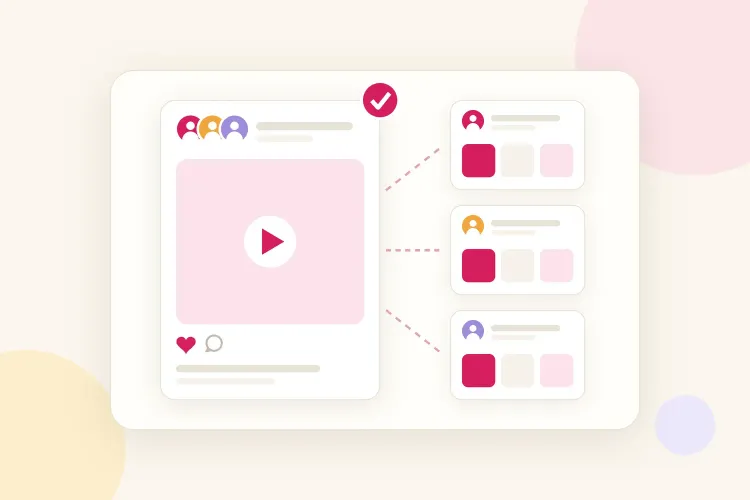


An Instagram Collab post is a single feed post or Reel that up to five invited accounts co-author with the original creator. To make one, tap Tag people on the last screen before sharing, then Invite Collaborators, pick the accounts and share. Each account that accepts gets its username in the post header, the post on its profile and the post shown to its followers, with one shared count of likes, comments and views.
This guide covers the full cycle: creating a Collab, adding a collaborator after posting, accepting or leaving one, fixing invites that do not show up, boosting a Collab as an ad, and judging whether it was worth doing.
What an Instagram Collab post is
A Collab is one post with several authors. The original creator invites collaborators, and once an account accepts, the post appears on its profile grid and is distributed to its followers. Likes and comments stay in one place instead of being split across two uploads.
Collabs are often confused with tags, reposts and the "Add to Grid" option Instagram rolled out in September 2026, which lets you place a post you are tagged in on your own grid. The difference is distribution and credit:
| Option | Who sees it | How it is credited |
|---|---|---|
| Collab post | Followers of every account that accepts | Every collaborator listed as an author in the header |
| Tag or mention | Followers of the poster only | Tagged account linked, not listed as an author |
| Repost | Can reach your followers, and sits in your Reposts tab | Original poster stays the only author |
| Tagged post added to your grid | Shown on your grid, distribution stays with the poster | Original poster stays the only author |
If you want the post pushed to your partner's followers with both names on it, you need a Collab. A tag, a repost or a tagged post added to a grid does not do that.
How to make a Collab post on Instagram
You can only create a Collab in the Instagram app on a phone or tablet. Instagram's guide to collaborative posts confirms there is no desktop version.
- Create your feed post, carousel or Reel as usual and go to the last screen before sharing.
- Tap Tag people.
- Tap Invite Collaborators.
- Search for each account you want to add and select it. You can invite up to five.
- Tap Done, finish your caption and tap Share.
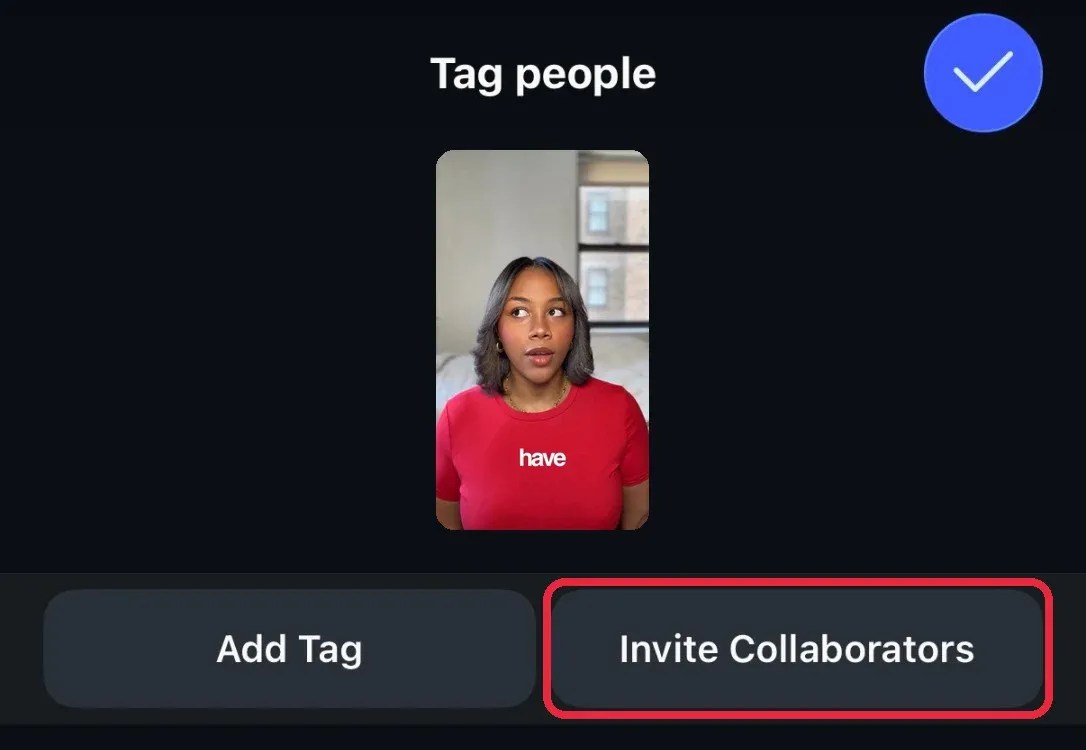
The post goes live on your profile right away. It only appears on a collaborator's profile, and reaches their followers, once they accept.
How to add a collaborator after posting
If you forgot to invite someone, you do not have to delete and repost. Open the post, tap the three dots, tap Edit, then Tag people and Invite Collaborators. Select the account, tap Done and save. The same screen lets the original creator remove a collaborator later by tapping Remove next to their name.
Avoid deleting and reposting: the new post starts from zero likes, comments and views.
How to accept a collaboration on Instagram
An invite reaches you in two places: your messages and the Tags and mentions filter of your Activity (the heart icon).
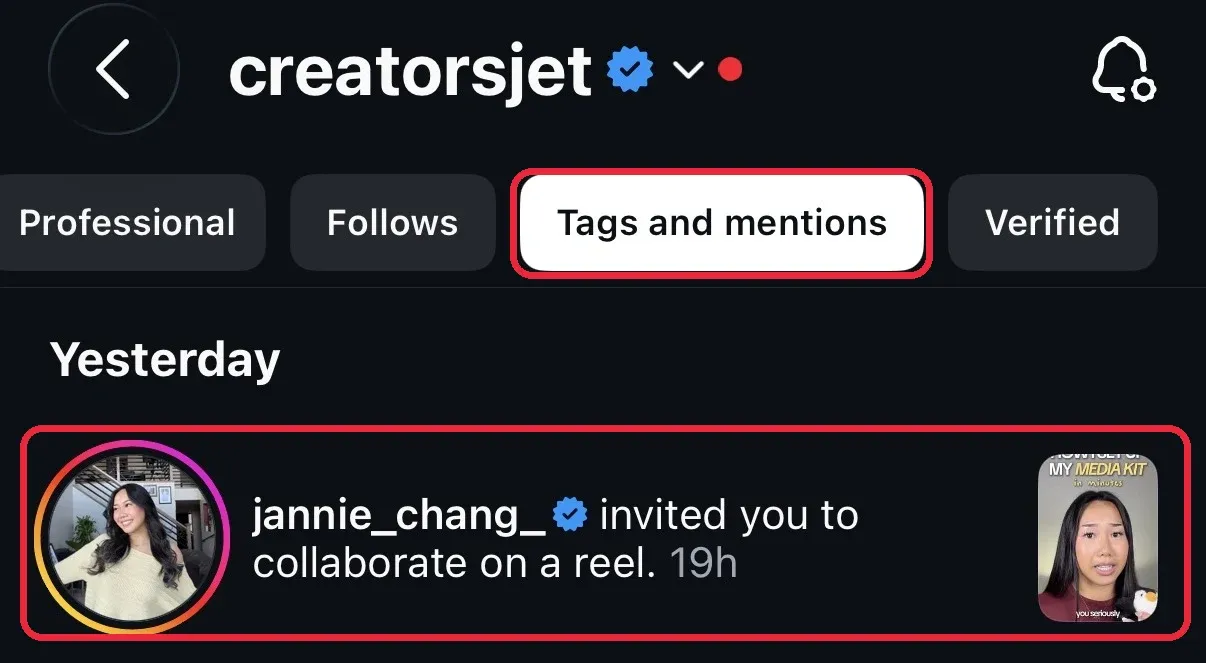
To accept:
- Open the invite from your Activity or from the chat where it was sent.
- Tap the post preview, then Review.
- Tap Accept.
The post is added to your profile and shown to your followers. Tap Decline instead if you do not want to be listed. If you decline by mistake, the original creator has to invite you again from the post's edit screen.
Read the caption before you accept a brand's invite. Your name will sit on it, and only the original creator can edit it.
Collab invite not showing or Collab option missing
There is no setting to switch Collabs on: the option lives in the Tag people screen. When it is missing or an invite never arrives, check these causes in order:
- The invite is in message requests. If you do not follow the account that invited you, its message can land in Requests instead of your main chat list.
- Privacy blocks the invite. A private account can only invite accounts that follow it. A public account can invite anyone.
- Tag settings are restricted. If the invited account only allows tags from people it follows, or from nobody, the invite may not go through. The setting is under Settings and activity, then Tags and mentions.
- The format does not support Collabs. Stories cannot have collaborators. You can mention accounts in a Story, but there is no Invite Collaborators option.
- The post already has five collaborators. Remove one before adding another.
- You are on a computer. Collabs are created and accepted in the mobile app.
- The app is out of date. Update Instagram and restart it if the Invite Collaborators button is missing on a supported format.
Instagram also says that accounts that have gone against its guidelines may lose access to Collabs. If everything above checks out and the option is still missing, that is a possible cause.
How to remove yourself from a Collab post
A collaborator can leave at any time. Open the post, tap the three dots and choose one of two options:
- Remove me from reel (or the same option on a feed post) ends your collaboration. Your name leaves the header and the post leaves your profile.
- Hide From My Profile takes the post off your grid without ending the collaboration.
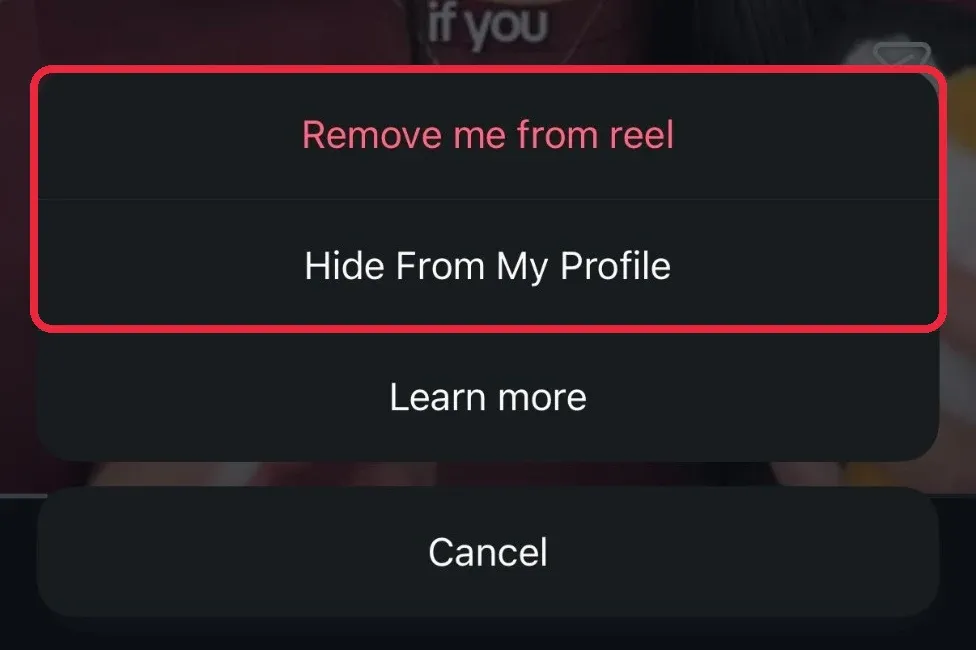
Either way, the post stays on the original creator's profile.
Instagram Collab rules to know before you post
According to Instagram's Help Center:
- Five collaborators maximum per post, on top of the original creator.
- The original creator owns the post. Only they can edit the caption or delete it, and deleting it removes it from every collaborator's profile. If they deactivate their account, the post disappears from every profile until they reactivate.
- Privacy follows the original creator. Public accounts can invite public or private accounts. Private accounts can invite public or private accounts too, but only ones that follow them. If a public account accepts a private account's invite, the post becomes visible publicly through that collaborator. If the original creator switches to private later, only their followers can see the post.
- Blocking ends the Collab. If either side blocks the other, the post stays only on the original creator's profile.
- Likes and comments are shared. Every collaborator who accepts sees all likes and comments on the post.
For brand deals, the ownership rule matters most: whoever publishes the post controls whether it stays live.
Who should send the Collab invite?
Social media managers commonly advise that the account with the larger, more engaged audience should create the post and invite the other, because the post starts on the original creator's profile and builds early momentum there before collaborators accept. Instagram has not published how Collab authorship affects ranking, so treat this as a practical default rather than a rule.
Timing matters more than who posts. The post only reaches a collaborator's followers after they accept, so send the invite when your partner can accept right away. An invite left unanswered for a day wastes the hours when a new post gets most of its distribution.
Can you boost a Collab post on Instagram?
Yes. The route Meta documents is a partnership ad: the brand runs the creator's post as an ad with one or both accounts in the header, pays for it and controls the targeting. Many creators find that the standard Boost button is not available on co-authored posts, which is why this route matters. A creator can give a brand permission in two ways:
- A partnership ad code. The creator generates a partnership ad code from the post: three dots, Partnership label & ads, then Get partnership ad code. The code lets a partner boost that content, including archived posts and hidden Collab posts, and up to two partners can use it at a time. Turning the toggle off stops new ads, but ads already running keep going.
- Account-level permissions. The brand sends an account-level permission request from Creator Marketing Hub in Meta Business Suite. Once the creator accepts, the brand can turn any of the creator's posts that tag it, Collabs included, into partnership ads without asking each time.
The brand creates the ad in Meta Business Suite or Ads Manager by choosing the partner's content. Both accounts need to be professional accounts eligible for branded content.
For creators, a boosted Collab is paid media built on your face and audience, which brands often call influencer whitelisting. It is priced separately from the post itself, so agree before the campaign on which post can be boosted, for how long and for what fee.
Do Collab posts decrease reach or engagement?
A Collab post does not reduce reach by itself. It is distributed to the followers of every account that accepts, so its potential audience is larger than a solo post from either account. What changes is how the numbers should be read.
Engagement on Instagram is already hard to win. In its social media benchmarks report, Socialinsider analyzed 70 million posts across major platforms and found an average Instagram engagement rate of 0.48% in 2025, slipping to 0.45% in the first half of 2026, even as Instagram views grew 29% and shares 12% year over year. More reach is easy to get. Engagement that keeps pace with it is not.
That is why a Collab can look like it "hurt engagement" when it actually worked. If reach doubles and engagement rises by half, the engagement rate falls even though more people interacted. A Collab only underperforms when the extra audience does not care: reach goes up, but saves, comments, follows and clicks stay flat.
The fix is to compare engagement against reach, not against follower count, and to judge each Collab against a similar solo post.
How to tell if a Collab post was worth it
Compare the Collab with a similar solo post from the same account: same format, similar topic and, if possible, a similar posting time. For a quick public benchmark before you pick a partner, Inflact’s Instagram profile analyzer shows a creator's engagement rate, posting activity and most popular recent posts. After the Collab goes live, rely on Instagram Insights for reach, follows, clicks and conversions.
Track these numbers at 24 hours, 72 hours and 7 days:
| Metric | How to calculate it | Good sign |
|---|---|---|
| Incremental reach | Collab reach minus your usual solo reach | Clearly above similar solo posts |
| Engagement rate by reach | Engagements divided by reach | Equal to or above your solo benchmark |
| Save rate | Saves divided by reach | Higher than your usual posts |
| Follow rate | New follows divided by reach | A visible follower lift |
| Clicks or conversions | Tracked clicks or sales divided by reach | A measurable lift during the post window |
For example, if a similar solo Reel usually reaches 12,000 people and a Collab reaches 28,000, the incremental reach is 16,000. If saves, follows and comments grow with it, the Collab is easy to defend. If they barely move, the extra reach was shallow. Running both posts through the same Instagram engagement rate calculator keeps the comparison fair.
Good and poor Collab fits
The best signal is not the partner's follower count. It is audience overlap, creative fit and whether the post feels natural on both profiles.
Collabs tend to work when:
- The partner's audience is adjacent to yours, not identical.
- The idea needs both accounts, like a creator showing a brand's product in a real routine, or two creators answering one question from two angles.
- Both sides reply to comments and share the post to Stories after publishing.
They tend to disappoint when:
- The two audiences are almost the same people, so there is little new reach.
- The brand or topic does not match what the creator usually posts.
- A giveaway attracts freebie hunters instead of interested followers.
- The creative is weak. A Collab amplifies a good post but rarely rescues a bad one.
Collab post vs paid partnership label
A Collab and the paid partnership label solve different problems. A Collab shares distribution and authorship. The paid partnership label discloses that the content is sponsored, adding "Paid partnership with" and the brand name under your username.
A sponsored Collab still needs clear disclosure. Having the brand as a co-author makes the relationship visible, but it does not replace the label or a clear disclosure in the caption. For sponsored work, use both: invite the brand as a collaborator and add the paid partnership label.
Using Collab posts in brand deals
For creators, a Collab shows brands that your content travels beyond your own followers, which is useful proof when you go after brand deals. For brands, it puts all the engagement on one asset and makes the creator's endorsement visible on the brand's own profile. A Collab is usually one deliverable inside a larger offer, packaged and priced alongside Stories, Reels and feed posts.
Before agreeing to a Collab in a brand deal, settle these points in the contract:
- Who publishes the post and therefore owns it.
- How long it stays live on both profiles, and whether either side can hide it or leave the collaboration.
- Who approves the caption before the invite is sent.
- Whether the brand can boost it, for how long and for what fee.
- How results are reported: which Insights screenshots, at which intervals.
If the brand needs clicks, code redemptions or sales, pair the post with tracked links, UTM parameters or a discount code. A Collab is a distribution format, not a campaign report.
Final thoughts
Making an Instagram Collab post takes a few taps: Tag people, then Invite Collaborators, and the post reaches every account that accepts. The harder part is choosing the right partner and agreeing on ownership, captions and boosting before the post goes live.
Treat each Collab as a test. Compare it against a similar solo post, keep the partnerships that grow reach while engagement quality holds, and drop the ones that only add a name to the header.