

An influencer proposal is the short document a creator sends once a brand shows interest, so the brand can approve a specific collaboration. A good one fits on one or two pages and answers, in order, every question the brand will ask before saying yes: why you, what you will make, when, with which rights, and for how much.
Below is a copyable influencer proposal template, guidance for each section, a filled-in example, and the mistakes that keep brands from replying.
What to include in an influencer proposal
Every influencer proposal needs these eight sections, in this order:
- Brand fit: why your audience matches what the brand is trying to do right now, with a few key numbers.
- Campaign idea: one concrete concept the brand can picture.
- Deliverables: each piece of content with its platform, format, number and length.
- Timeline: dates for product delivery, approvals, publishing and the results report.
- Usage rights and exclusivity: how the brand may reuse the content, and which competitors you will avoid, for how long.
- Price: two or three options, with payment terms and a validity date.
- Proof: one or two past results that match the brand's goal, plus your media kit.
- Next step: one action the brand can take, such as picking an option.
What an influencer proposal is, and when to send it
Creators often mix up three documents that do different jobs in a brand deal:
- The pitch is the first message. It gets a brand's attention with a short idea and a reason to reply. It does not need full pricing or terms.
- The proposal comes next, usually after the brand says "tell me more" or asks for rates. It turns the idea into an offer the brand can approve internally: what will be made, when, for how much, and with which rights.
- The contract comes last. It makes the agreed terms legally binding, with payment conditions, approvals, cancellation and liability.
The proposal sits in the middle, and that is why it matters. A brand manager rarely approves a collaboration alone. They forward the proposal to a team lead or a client, so it has to explain itself without the email thread around it.
Keep the proposal to the commercial offer and leave the legal wording for later. Whatever you promise here, such as deliverables, usage, exclusivity and payment terms, will be copied into the contract, so only offer terms you would sign. The guide to influencer contract clauses covers what to check once that contract arrives. When it does, compare each term with your proposal, because brand contracts often add deliverables, extend usage or push back payment dates.
The same document goes by several names: influencer proposal, brand collaboration proposal or brand partnership proposal. The structure is the same. Only the length of the commitment changes, which is covered further down. Agencies and marketing teams also use "influencer proposal" for a campaign plan they present to a client. This guide covers the creator side: a creator, or a manager acting for one creator, proposing a collaboration to a brand.
The influencer proposal template
To start from a ready-made file, make your own copy of this influencer proposal template in Google Docs. It has the template in one tab and the filled-in example in another, plus a short check to run before sending. Otherwise, copy the template below into a document or the body of an email, replace every bracketed field, and delete any line that does not apply. Keep the section order: it follows the questions a brand asks before saying yes.
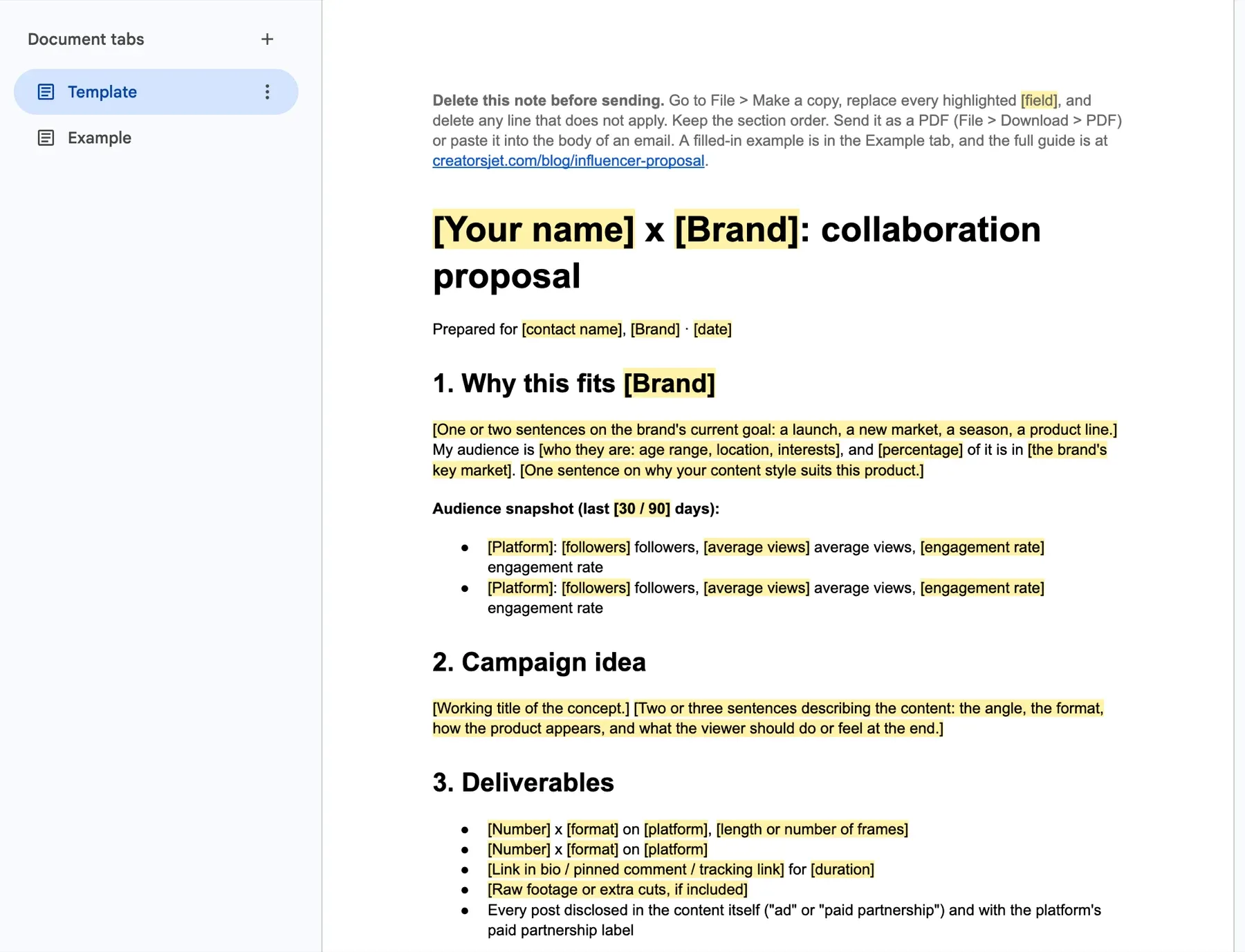
Subject: [Your name] x [Brand]: proposal for [campaign or product]
1. Why this fits [Brand]
[One or two sentences on the brand's current goal: a launch, a new market, a season, a product line.] My audience is [who they are: age range, location, interests], and [percentage] of it is in [the brand's key market]. [One sentence on why your content style suits this product.]
Audience snapshot (last [30 / 90] days):
- [Platform]: [followers] followers, [average views] average views, [engagement rate] engagement rate
- [Platform]: [followers] followers, [average views] average views, [engagement rate] engagement rate
2. Campaign idea
[Working title of the concept.] [Two or three sentences describing the content: the angle, the format, how the product appears, and what the viewer should do or feel at the end.]
3. Deliverables
- [Number] x [format] on [platform], [length or number of frames]
- [Number] x [format] on [platform]
- [Link in bio / pinned comment / tracking link] for [duration]
- [Raw footage or extra cuts, if included]
- Every post disclosed in the content itself ("ad" or "paid partnership") and with the platform's paid partnership label
4. Timeline
- Product received by: [date]
- Concept or script shared for approval: [date]
- Draft content shared: [date], with [number] round(s) of revisions included
- Publishing date(s): [date or window]
- Results report with [reach, views, link clicks, code uses] sent: [number] days after the last post
5. Usage rights and exclusivity
- Organic reposting on [Brand]'s channels for [duration]: [included / priced separately]
- Paid usage (ads, whitelisting, Spark Ads): [not included / channels, duration and fee]
- Exclusivity: no competing [category] brands for [duration], [included / priced separately]
6. Investment
- Option A: [deliverables], [price]
- Option B: [deliverables], [price]
- Option C: [deliverables plus usage or extra content], [price]
Payment terms: [deposit, if any, and due date after invoice]. This proposal is valid until [date].
7. Results and proof
[One or two past collaborations with the result that matters to this brand: views, saves, clicks, code redemptions, sales.] Media kit with current audience data: [link].
8. Next step
I can hold the [publishing date] slot for you until [date]. Once you pick an option, I will send a short confirmation of the brief.
Contact
[Your name] · [email] · [main handle and platform]
How to write each section of an influencer proposal
Open with the brand's goal, not your bio
The first lines decide whether the rest gets read. Start with what the brand is trying to do right now, then connect your audience to it. "You are launching the decaf line in Canada this spring, and 38% of my audience is in Canada" does more work than a paragraph about how long you have been creating.
Under that opening, add a short audience snapshot, one line per platform with followers, average views and engagement rate. A brand reading a forwarded PDF should see the key numbers without opening another file. Use the same figures as your media kit, from the same date range, so nothing contradicts when the brand compares them.
Make the campaign idea concrete
A proposal gets approved when the brand can picture the content. Name the concept, describe the hook, and say where the product appears. "A travel tips Reel" is vague. "A 30-second Reel packing the same carry-on twice, with and without the organizer cubes, ending on both suitcases side by side" can be approved.
One idea is usually enough. Two ideas work when they serve different goals, for example one awareness format and one conversion format. More than that makes the brand do your planning.
List deliverables a brand can count
Every deliverable should be countable: the platform, the format, the number, and the length. Add the extras that often cause friction later, such as link placement, how long the link stays live, and whether raw footage is included.
Mention disclosure in the deliverables. It shows the brand you know the rules and settles how the post will be labeled before anything is filmed. In the US, the FTC's disclosure guide for social media influencers asks for the disclosure to sit in the post or video itself, in clear words such as "ad" or "sponsored", and warns against relying on a platform's paid partnership tool alone. Other countries have their own rules, so check the ones that apply to your audience.
Put dates on the timeline
Brands plan around launches, so a timeline with real dates is easier to approve than "two weeks after product arrives". Include the approval steps, not only the posting date. A concept approval date and a draft date protect both sides: the brand sees the content before it goes live, and you avoid a last-minute rewrite.
State the number of revision rounds included. One or two rounds are common. Without a number, revisions have no limit.
Spell out usage rights and exclusivity
This is the section most proposals skip, and it is where a lot of money is lost. Posting content on your account and letting a brand run it as an ad for three months are different products with different value.
Separate organic reposting from paid usage, give each one a channel list and a duration, and price paid usage on its own line. If the brand has not said how it wants to use the content, leave paid usage out of the price and mark it as available on request. Before quoting it, ask which assets, channels, duration and markets the brand has in mind: this guide on how to respond when a brand asks for usage rights lists those questions and the usage options you can offer.
Exclusivity needs the same precision: name the category and the dates. A short category exclusivity around the posting dates is often reasonable. A long one blocks other paid work and should cost more.
Price it with options
Two or three options give the brand a choice inside your offer instead of a yes or no on a single price. A common structure:
- Option A: the core deliverable alone.
- Option B: the core deliverable plus a second platform or format, at a lower combined price than buying them separately.
- Option C: option B plus paid usage or extra content.
To set the numbers themselves, start from typical ranges for your audience size. These influencer rates by platform and follower count give benchmarks for Instagram, TikTok and YouTube, which you can then adjust for your average views, niche, usage rights and exclusivity.
Write the price per option, not per item, so the brand does not start removing pieces. Add payment terms and a validity date. A validity date keeps an old quote from being accepted months later, after your audience or rates have changed.
If the brand has already shared a budget, build option B around it and make the other two options slightly below and above it.
Add proof that matches the brand's goal
Choose results that match what this brand cares about. A brand chasing sales wants clicks, code redemptions or conversions. A brand launching a product wants reach and saves. One or two relevant results are better than a list of every partnership.
In the proposal itself, show only the audience snapshot and these one or two results. Link the media kit for everything else, such as demographics, past partners and full platform data, so the proposal stays short.
End with one clear next step
Finish with a single action the brand can take: pick an option, confirm a publishing date, or approve the concept. Holding a slot until a specific date gives the brand a reason to answer without sounding pushy.
A filled-in influencer proposal example
Here is the template completed for a fictional home-barista creator with about 48,000 Instagram followers and 22,000 TikTok followers, writing to a fictional coffee grinder brand. The figures are illustrative: rates vary widely by niche, market and engagement.
Subject: Lena x Moltaro: proposal for the Moltaro Mono launch
1. Why this fits Moltaro
You are launching the Moltaro Mono in the US in March and want home baristas who already buy specialty beans. 41% of my Instagram audience is in the US, and my most saved posts are grinder and espresso dial-in tutorials.
Audience snapshot (last 90 days):
- Instagram: 48,000 followers, 21,000 average Reel views, 4.8% engagement rate
- TikTok: 22,000 followers, 15,000 average views, 6.1% engagement rate
2. Campaign idea
"Same beans, different grinder." A side-by-side test: the same espresso pulled with my current grinder and with the Moltaro Mono, ending on a blind taste test with a friend. The product is in the frame for the whole video, not only at the end.
3. Deliverables
- 1 x Instagram Reel, 30 to 45 seconds
- 3 x Instagram Stories with a link sticker to the launch page
- 1 x TikTok video, 30 to 45 seconds (options B and C only)
- Tracking link in bio for 30 days
- "Ad" said and shown in every video and Story, plus the paid partnership label
4. Timeline
- Product received by: February 20
- Concept and script for approval: February 24
- Draft video for review: March 3, one round of revisions included
- Publishing: March 10, launch day
- Results report with reach, views, link clicks and saves: March 24
5. Usage rights and exclusivity
- Organic reposting on Moltaro channels for 90 days: included
- Paid usage on Meta for 60 days: option C only
- No competing grinder brands from February 20 to April 10: included
6. Investment
- Option A: Reel and 3 Stories, $1,400
- Option B: Reel, 3 Stories and TikTok, $2,100
- Option C: option B plus 60 days of paid usage on Meta, $2,700
Payment: 50% on signature, 50% within 30 days of publishing. Valid until February 10.
7. Results and proof
My espresso dial-in Reel for a bean subscription brand reached 310,000 accounts and drove 1,150 clicks to their site in the first week. Media kit with current audience data: [link].
8. Next step
I can hold the March 10 launch slot for you until February 10. Once you pick an option, I will send a short confirmation of the brief.
Contact
Lena · [email] · [Instagram handle]
Notice what the example does not include: no long biography, no list of every brand worked with, and no price per item. Each line answers a question the brand would otherwise ask by email.
Adapting the template for a one-off collaboration or a long-term partnership
The template above fits a one-off brand collaboration proposal: one campaign, one set of deliverables, one payment. A brand partnership proposal for an ambassador role or a retainer uses the same sections with three changes:
- Deliverables become a monthly cadence, for example two Reels and four Story sets per month, with a fixed review rhythm.
- Pricing becomes a monthly or quarterly fee, usually lower per piece than one-off work in exchange for a commitment of three to twelve months. Add a minimum term and how either side can end the partnership.
- Proof shifts to consistency: how your results held up across several posts, not only your best one.
Exclusivity deserves extra care in long-term partnerships. A full category exclusivity for a year can rule out a large share of your other income, so price it accordingly or narrow it to direct competitors.
Mistakes that stall a yes
- Sending the proposal as a cold first message. Before a brand has shown interest, a full proposal reads as a sales document. Pitch first.
- A generic proposal. If the brand name could be swapped for any other without changing a sentence, the brand will notice.
- Too much about you. A proposal that opens with a biography, or runs past two pages, gets skimmed. The brand's goal comes first, and everything else should fit on one or two pages.
- Old statistics. Audience figures that do not match the brand's own tools, or a media kit from last year, hurt trust more than smaller current numbers.
How to send the proposal and follow up
Send the proposal in the format the brand can forward most easily. A short PDF or shared document works well because it can go to a manager or client as is. For a small deal, the same structure pasted into the email body is enough. If you attach a PDF, repeat the price summary in the email itself so the decision does not depend on opening the attachment. Keep the covering email to a few lines:
Subject: Lena x Moltaro: proposal for the Moltaro Mono launch
Hi [first name], thanks for your reply. As promised, here is the proposal for the launch, attached as a PDF. In short: a side-by-side grinder test on Instagram, with three options from $1,400 to $2,700 depending on TikTok and paid usage. I can hold the March 10 slot until February 10. Happy to adjust the scope to your budget.
Name the file clearly, for example "Lena x Moltaro proposal, February", so it can be found weeks later.
If there is no answer after four or five business days, follow up with something useful: a confirmed date, an extra idea, or a reminder of the validity date. If a second follow-up a week later gets no answer either, move on and keep a note of the date, the options offered and the brand contact for a later season.
Conclusion
An influencer proposal works when a brand can approve it without asking another question. The structure stays the same from one brand to the next. What changes is the opening, the campaign idea and the options, so rewrite those three parts for every brand and keep usage rights and dates explicit every time.