

Influencer whitelisting is when a creator gives a brand permission to run paid ads through the creator's own account. The ad shows the creator's name and profile photo, not the brand's, and the brand controls the budget, targeting, and schedule from its own ad account. On Instagram and Facebook, Meta now calls this format partnership ads. For the creator, it turns one sponsored post into ongoing paid media running in their name, which is why it needs its own fee, its own time limit, and its own clauses in the contract. This guide covers how it works today, how it differs from usage rights, and how to price and set it up.
What influencer whitelisting means
In a normal sponsored post, the creator publishes content and the brand gets whatever reach that post earns organically. With whitelisting, the brand also puts ad spend behind content that appears to come from the creator's handle. People who do not follow the creator see it in their feed, labelled as sponsored, with the creator's name at the top.
The term comes from the older practice of adding a brand to an approved list ("whitelist") of advertisers allowed to use an account. Some agencies now say allowlisting or creator licensing instead, and Meta's own product name is partnership ads, formerly branded content ads. They all describe the same arrangement: the creator's identity, the brand's ad budget.
Here is what that looks like in practice. These are live ads from Linktree in Meta's Ad Library, each one running from a different creator's account with the brand shown as the partner.
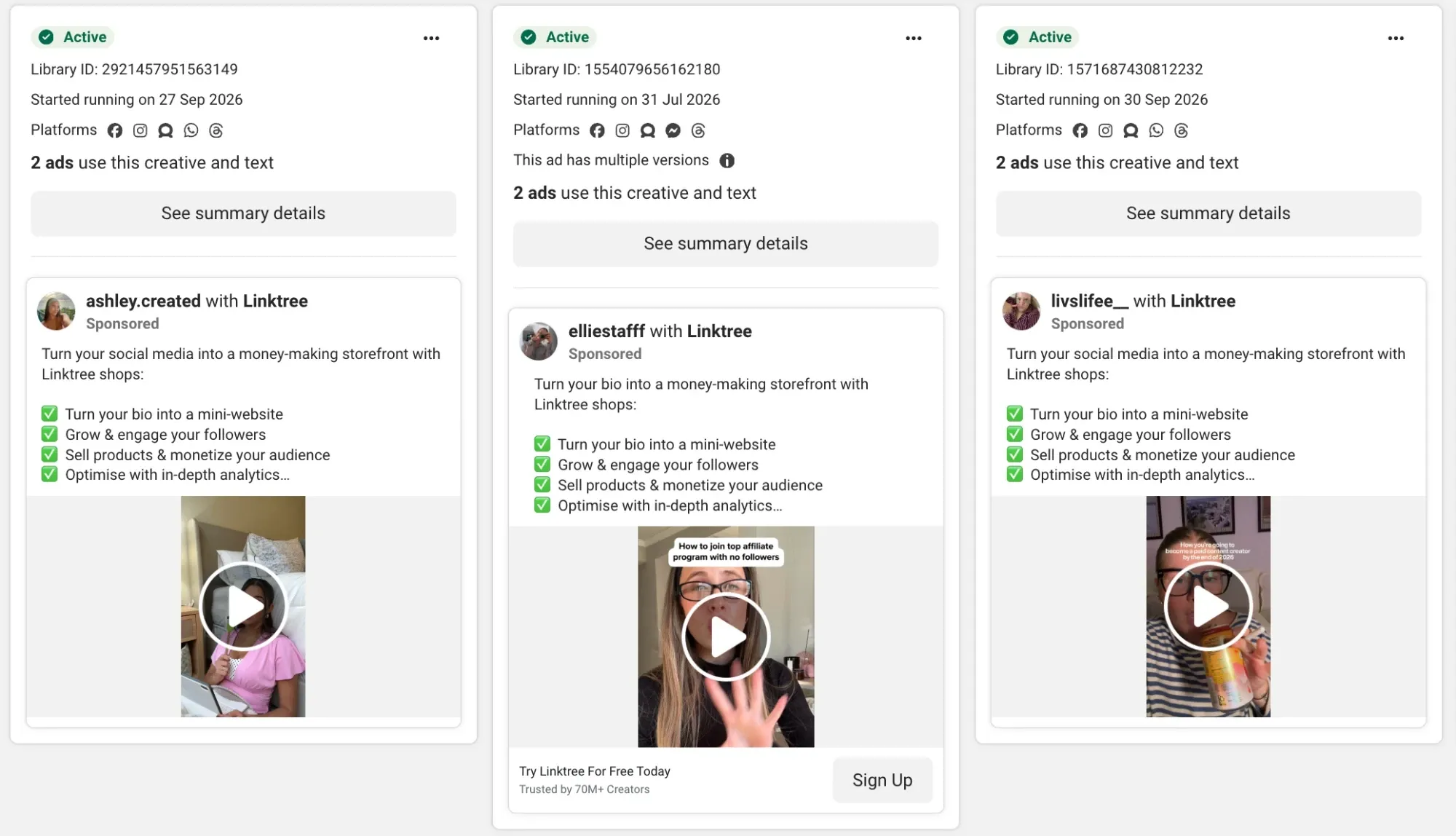
The header reads "creator with Linktree", the copy and call to action are written by the brand, and the same script runs across several creators at once. That last detail is one of the main reasons brands ask for whitelisting: paid distribution lets them test which face and voice sells their product best.
Whitelisting vs. paid partnerships, usage rights, and dark posts
These terms get mixed up in briefs and contracts, and each one carries a different price. The table below separates them.
| Term | What the brand can do | Whose name appears |
|---|---|---|
| Paid partnership label | Get an organic post the creator publishes and discloses | The creator, brand tagged as partner |
| Usage rights | Reuse the content on its own account, site, or ads | The brand, not the creator |
| Whitelisting (partnership ads) | Run paid ads from the creator's handle | The creator, brand shown as partner |
| Dark posts | Run creator-handle ads that never appear on the grid | The creator, seen only by targeted users |
Usage rights and whitelisting are often bundled, but they are separate permissions. A brand with usage rights can put your video in its own ads, while a brand with whitelisting access can put money behind your name. If a brand asks for both, price both. For the usage rights side of the request, including how to scope it, price it, and reply to the brand, see the guide on how to respond when a brand asks for usage rights.
Whitelisting is also different from an Instagram Collab post, where the brand and creator co-author one organic post that appears on both profiles. A Collab can later be boosted as a partnership ad, but co-authoring alone gives the brand no ad access. If a brand proposes a Collab instead of whitelisting, the guide to how Instagram Collab posts work and when they are worth it helps compare the two.
Boosting is a third, separate case. When a creator boosts a post, the creator pays and the ad runs from the creator's own account. With whitelisting, the brand pays and runs the ads from its own ad account, with the creator's permission.
How whitelisting works on Instagram and Facebook today
The old method was to add the brand as a partner in Meta Business Manager with advertiser access to the creator's Facebook Page and Instagram account. Some agencies still use it, but Meta's partnership ads flow is now the standard route, and it gives the creator more control. There are two levels of permission.
Post-level permission: the partnership ad code
The creator turns on partnership ad permission for one specific post and shares a code with the brand. In the Instagram app, open the post, tap the three dots, choose the partnership label and ads option, and switch on "Get partnership ad code". The brand pastes that code into Ads Manager and can promote that single post, nothing else. One code can be used by up to two partners at a time, so share it only with the brand named in your agreement.
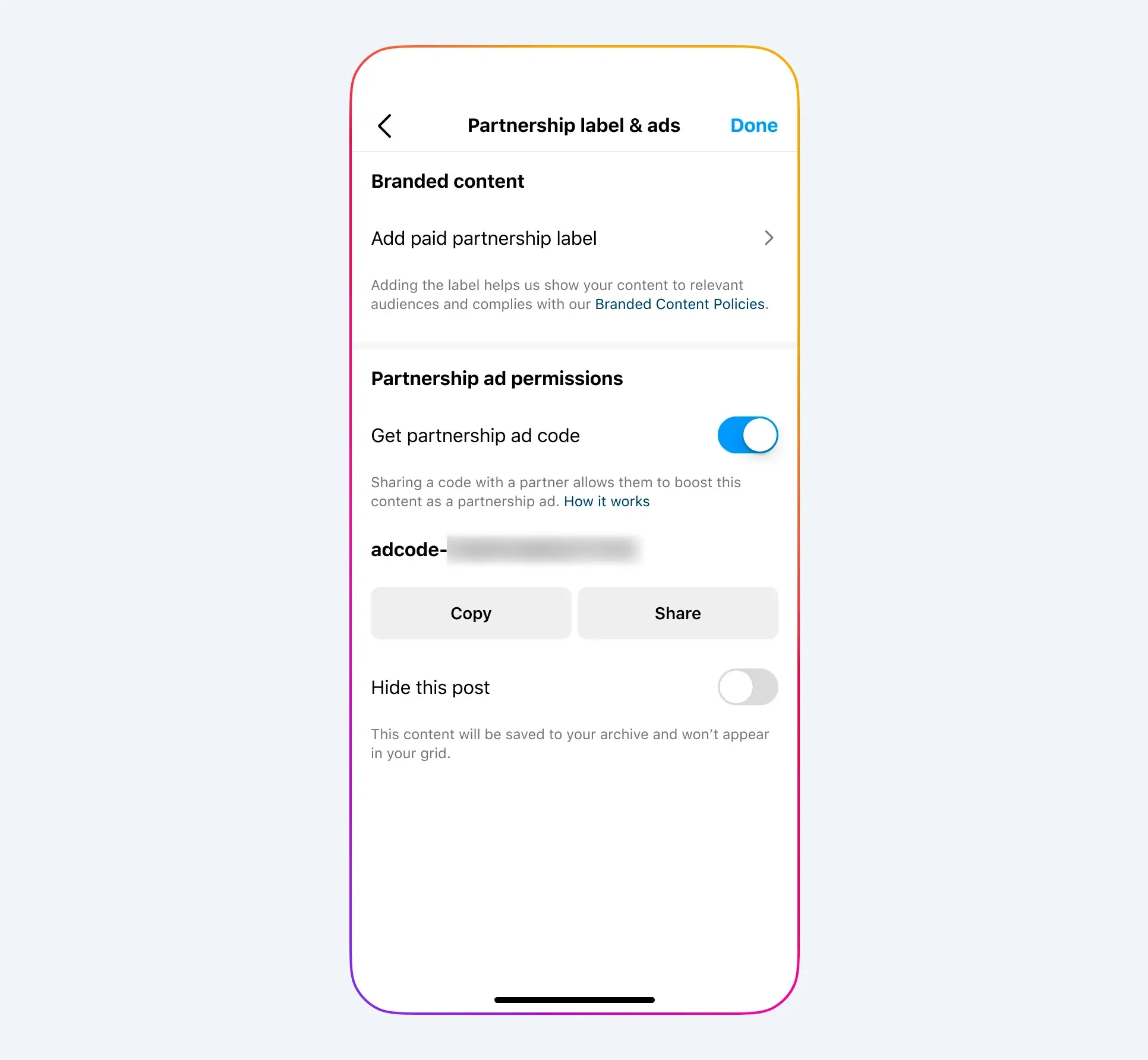
This is the safest starting point for a first collaboration. The brand can only run what is already on your profile, and the ad looks like the post your audience has already seen.
Account-level permission: an ongoing ad partnership
For longer partnerships, the brand sends an account-level request that the creator accepts in the Instagram app. According to Instagram's help page on partnership ad permissions, this lets the brand create ads from the creator's handle without a pre-existing post, and turn the creator's posts that tag or mention the brand, including Collab posts, into ads. In practice, this is where dark posts come from: ad creative that runs in your name but never appears on your grid.
Account-level access is broader, so it needs tighter terms. Ask for approval rights over any new copy or creative before it runs, and agree in writing on which campaigns it covers.
What the brand sees in Ads Manager
On the brand side, partnership ads are a toggle at the ad level. The brand turns on "Partnership ad", then either enters the creator's ad code, picks an existing partnership, or creates ads from a list. The identities section links the ad to the creator's Instagram and Facebook profiles.
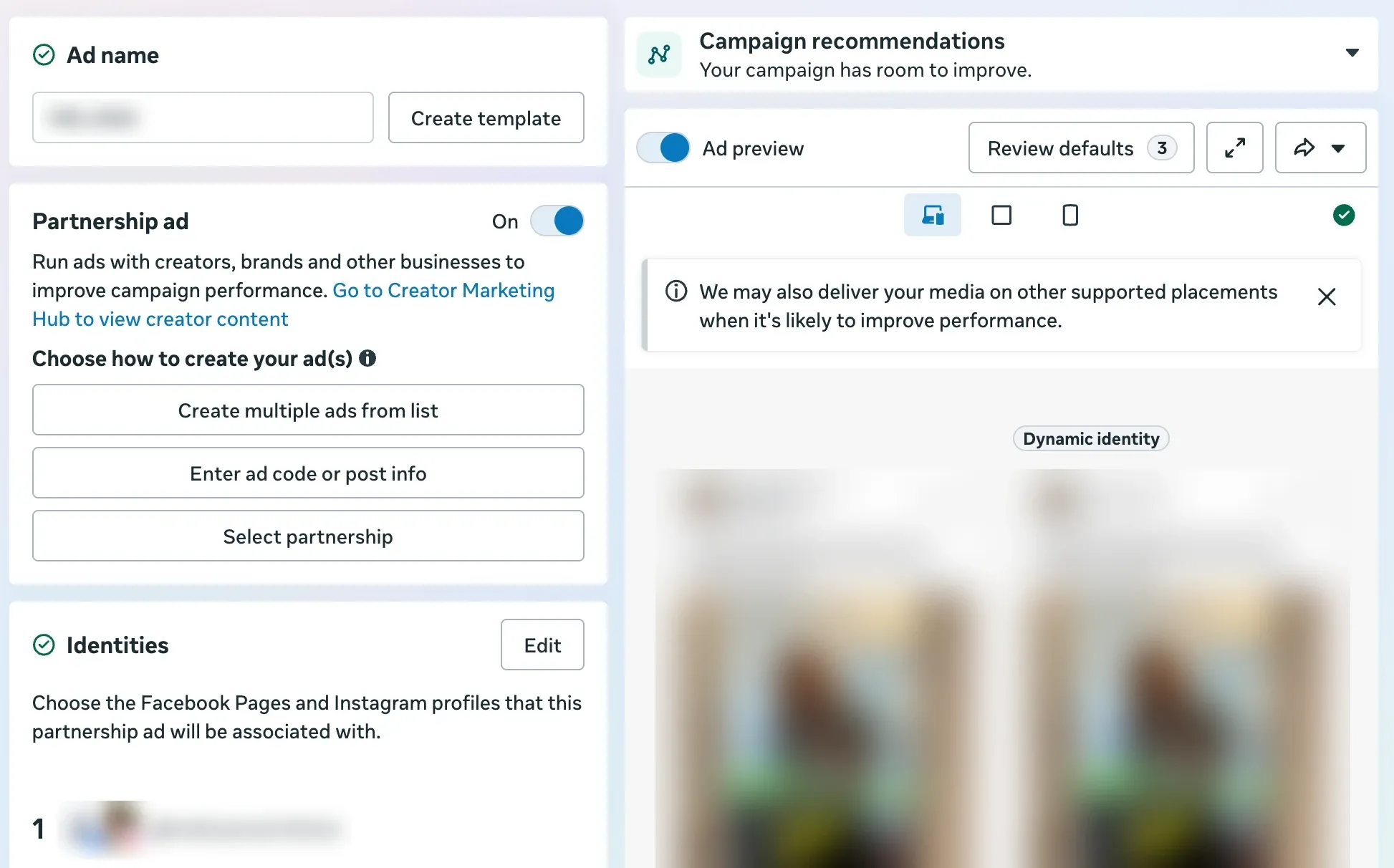
The preview on the right shows a "Dynamic identity" setting, with two versions of the same ad: one headed by the creator and the brand together, one headed by the creator alone. Ask the brand which identities and placements it plans to use, because that decides how and where your name appears.
What the brand can and cannot access
Whitelisting does not hand the brand your account. With partnership ads, the permission covers advertising only: the brand never gets your password, cannot post or edit anything on your profile, and cannot read your messages. It can run ads from your handle and see how those ads perform. The older Business Manager route is different, because it gives the brand a role on your Facebook Page and Instagram account, so check exactly which permissions a partner request includes before accepting it. Never share your login details to set up whitelisting.
Ending access
Either side can end partnership ad permissions at any time, but switching off an ad code does less than many creators expect. Instagram's help center says it only stops the code from being used for new ads: ads already running with it keep running, and archiving the post does not remove the brand's access either. Stopping active ads and removing account-level permissions are separate steps in the app. That is why the end of the paid period belongs in the contract as a procedure: on the agreed date, the brand switches off its ads, then the creator turns off the code or removes the partner. The same procedure protects the brand from being cut off mid-campaign.
Why brands ask for whitelisting
- Performance data. In a creator marketing report published in October 2026, Meta reported a 45% lower median cost per incremental purchase for campaigns where at least 30% of assets were partnership ads, based on 20 conversion lift studies with EMEA advertisers. The study is Meta's own and limited in scope, but it explains why brands increasingly put creator ads in their paid budgets.
- Trust at scale. An ad from a creator reads like a recommendation. A brand can reach people who have never seen that creator before, while keeping the social proof of a real person's face and voice.
- Creative testing. One script filmed by five creators gives the brand five ads to test. The winners get more spend, the others get switched off.
- A longer life for the content. A Story disappears after 24 hours and a Reel's organic reach drops after a few days. As a partnership ad, the same content can run for weeks.
- Targeting options. The brand can choose to include or exclude the creator's existing audience, an option a standard brand-owned ad does not offer.
When whitelisting is not worth it
Whitelisting multiplies what already works. It does not rescue content that fell flat organically, and some deals are better off without it.
- The brand has no paid budget. Whitelisting only matters if money goes behind the ads. Without planned spend, the permission sits unused while it still ties the creator's name to the brand.
- The content has not been tested. Whitelisting a post before seeing how it performs organically is a guess. A safer pattern is to wait for the first organic results, then promote the posts that earned it.
- The goal is awareness with no tracking. Without a pixel, conversion tracking, or a lift study, neither side can tell whether the ads worked, which makes the fee hard to justify and harder to renew.
- The audience fit is weak. If the creator's followers do not resemble the brand's customers, the trust that makes creator ads work does not carry over to the people the brand targets.
- The terms stay vague. If the brand will not commit to a duration, approval rights, or a separate fee, the creator is better off offering usage rights only, or a standard sponsored post.
What whitelisting means for the creator
Whitelisting can raise the value of a deal without any extra filming, and it exposes your profile to thousands of people who may follow you after seeing the ad. It also has costs that are easy to miss when the request arrives as one line in a brief.
- Your name carries the brand's message. With account-level access, the brand can write new ad copy that appears under your handle. Your audience will not know you did not write it.
- Frequency can wear on your audience. If the brand targets your followers heavily, they may see the same ad many times. Agree whether your existing audience is included or excluded.
- Comments land on your account. Ad comments can be negative or off-topic, and they sit under your name. Decide who moderates them.
- Exclusivity gets implied. If a skincare brand runs ads in your name for six months, a competing brand may not want to book you during that window, even without a written exclusivity clause.
- It is paid media, not a post. The brand may spend thousands of euros or dollars on ads that use your identity. That is a separate asset from the content fee and should be priced as one.
How to price influencer whitelisting
There is no standard rate, and published benchmarks vary widely. Agencies and platforms commonly quote a whitelisting fee of roughly 20% to 50% on top of the content fee, but treat that as a starting range rather than a rule. What moves the price is how much of your identity the brand gets and for how long.
| Factor | Lower fee | Higher fee |
|---|---|---|
| Permission level | Post-level ad code on one existing post | Account-level access with new creative in your name |
| Ad period length | 30 days from first ad launch | Three months or more, or renewing |
| Creative control | Brand runs your post as published | Brand writes new copy or edits your video |
| Audience and markets | One country, your followers excluded | Several markets, your followers included |
| Exclusivity terms | No exclusivity clause | Category exclusivity during the ad period |
Three pricing structures work well:
- Flat fee per period. For example, a $1,000 content fee plus $400 for 30 days of post-level whitelisting, renewable at the same rate.
- Percentage of the content fee. Simple to explain and easy to apply across deals, but it undercharges when the brand plans heavy ad spend on a cheap piece of content.
- Monthly licence. A fixed monthly amount for account-level access across several assets, common in longer partnerships and agency deals.
Always tie the fee to a start date and an end date. "Whitelisting included" with no duration hands the brand open-ended use of your name for a one-time price. Listing whitelisting as a separate line in your rate card helps brands see it as an add-on from the first quote rather than a favour negotiated later.
What to put in a whitelisting agreement
Whitelisting terms belong in the contract or statement of work, not in a DM thread. Cover these points:
- Permission level. Post-level codes for named posts, or account-level access for the partnership.
- Duration. Start date, end date, and what happens at the end: access revoked, ads paused, renewal fee if the brand wants to continue.
- Platforms and placements. Instagram only, Facebook too, and whether Stories, Reels, and feed placements are all included.
- Creative approval. Whether the brand can run new copy or edited versions in your name, and how many days you have to approve or reject them.
- Audience and markets. Countries, and whether your own followers can be targeted.
- Comment moderation. Who hides, replies to, or reports comments on the ads.
- Exclusivity. Any category exclusivity during the ad period, priced separately.
- Reporting. Access to spend, reach, and results for the ads that ran in your name. These numbers are useful in your next pitch.
- Revocation. How either side ends access early, with notice, and what the brand owes if it does.
The full list of terms to check in any brand deal, including usage, payment, and exclusivity, is in the guide to influencer contract clauses to check before signing.
How to set up whitelisting step by step
- Agree on the terms first. Permission level, duration, fee, and approval rights should be signed before any access is granted.
- Use a professional account. Partnership ad permissions need an Instagram creator or business account.
- Publish the post with the paid partnership label. For post-level whitelisting, tag the brand as partner so the post is disclosed from the start. With account-level access, ask the brand to confirm how new ads in your name will be labelled.
- Grant access. For post-level permission, generate the partnership ad code on that post and send it to the brand. For account-level permission, accept the brand's partnership request in the Instagram app.
- Confirm the setup. Ask the brand for a preview of the ad before launch, including copy, call to action, and placements.
- Track the end date. Put the expiry date in your calendar and revoke the code or remove the partner when the paid period ends, unless a renewal is signed. Ask the brand to confirm its ads are switched off, since turning off a code does not stop ads that are already running.
Disclosure still applies
A partnership ad shows "Sponsored" and the brand's name, but the content is still an endorsement made in your name. Keep the disclosure in the caption clear, and make sure ad copy written by the brand does not make claims you could not make yourself. The FTC's disclosure guide for social media influencers is a useful reference even outside the US, since many countries apply similar rules to sponsored content.
Treat whitelisting as a separate product
Whitelisting is not a detail of a sponsored post. It is a licence for a brand to buy ads with your identity, and it should be scoped, priced, and ended like one. Start with post-level ad codes for new brands, move to account-level access only with approval rights and a clear end date, and keep the fee separate from the content fee so it grows with the value the brand gets. Handled that way, whitelisting becomes one of the simplest ways to earn more from content you have already made.