

Writing Instagram captions for sponsored posts is mostly about balance. The caption has to satisfy the brand brief, disclose the partnership clearly, explain the product in a useful way, and still sound like something the creator would naturally say to their audience.
The common mistake is choosing one side too heavily. If the text only follows the brand brief, it can feel like ad copy pasted into a personal account. If it is too casual, it can miss required messaging, discount details, disclosure language, or approval requirements. The better approach is to treat the brief as raw material, then translate it into the creator's actual voice.
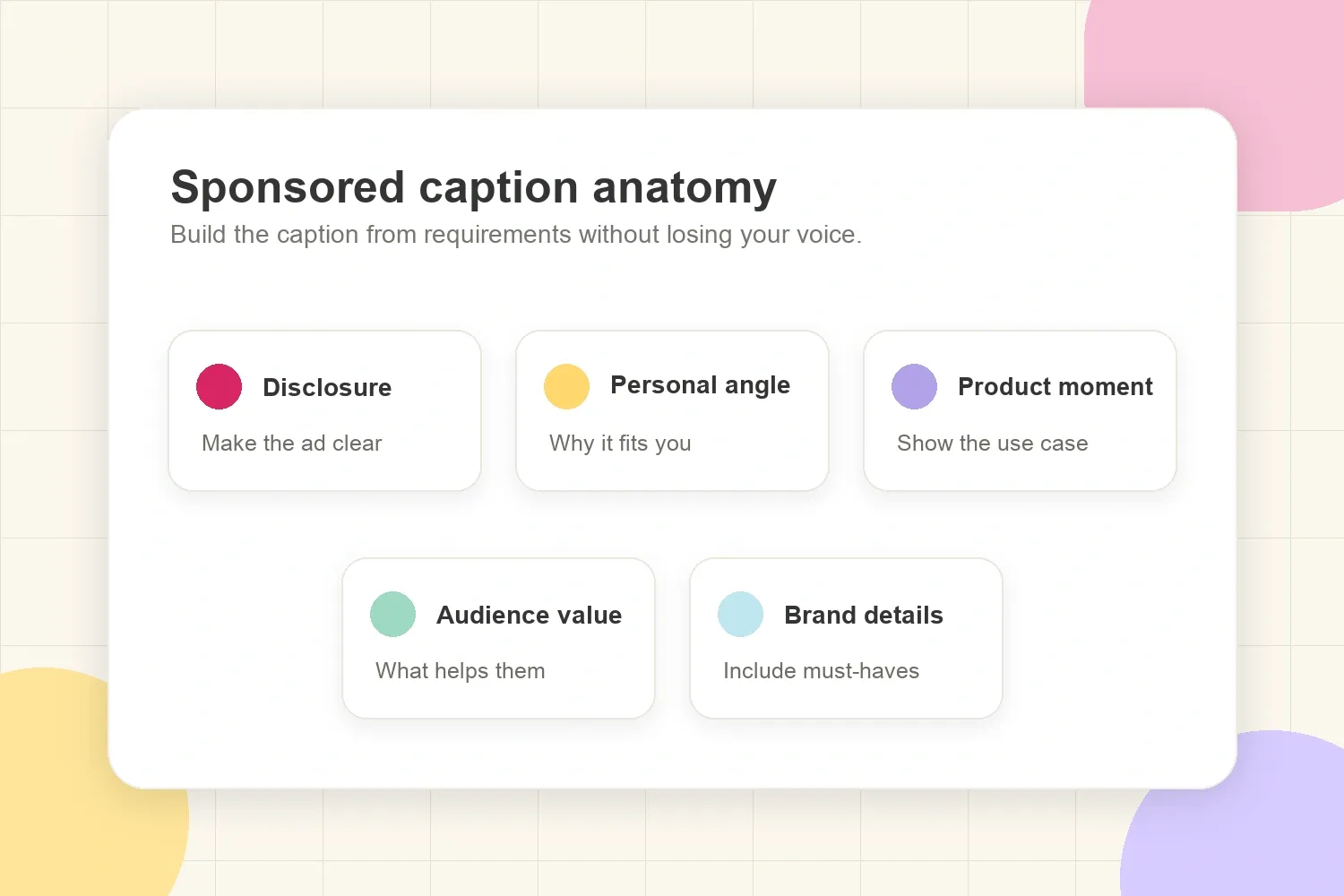
Instagram captions for sponsored posts need five things
A good sponsored caption does not need to be long, clever, or packed with every possible product detail. It needs to give the brand what it asked for while giving the audience a real reason to keep reading.
Most sponsored captions need five core pieces:
- A clear disclosure: The reader should understand quickly that the post is sponsored, gifted, paid, or part of a brand partnership.
- A natural reason for the product: Explain why the product, service, place, or tool fits the creator's content.
- One specific use case: Show where the product appears in real life, not only what the brand says it does.
- The brand's required details: Include campaign hashtags, tags, product names, launch dates, discount codes, claims, or legal wording that the brief requires.
- A clean next step: Tell the audience what to do only when it fits the post, such as checking a tagged product, saving the idea, using a code, or reading the caption for details.
That structure keeps the post useful for both sides. The brand sees the required message. The audience sees why the creator is talking about it.
Start with the brand brief before writing the caption
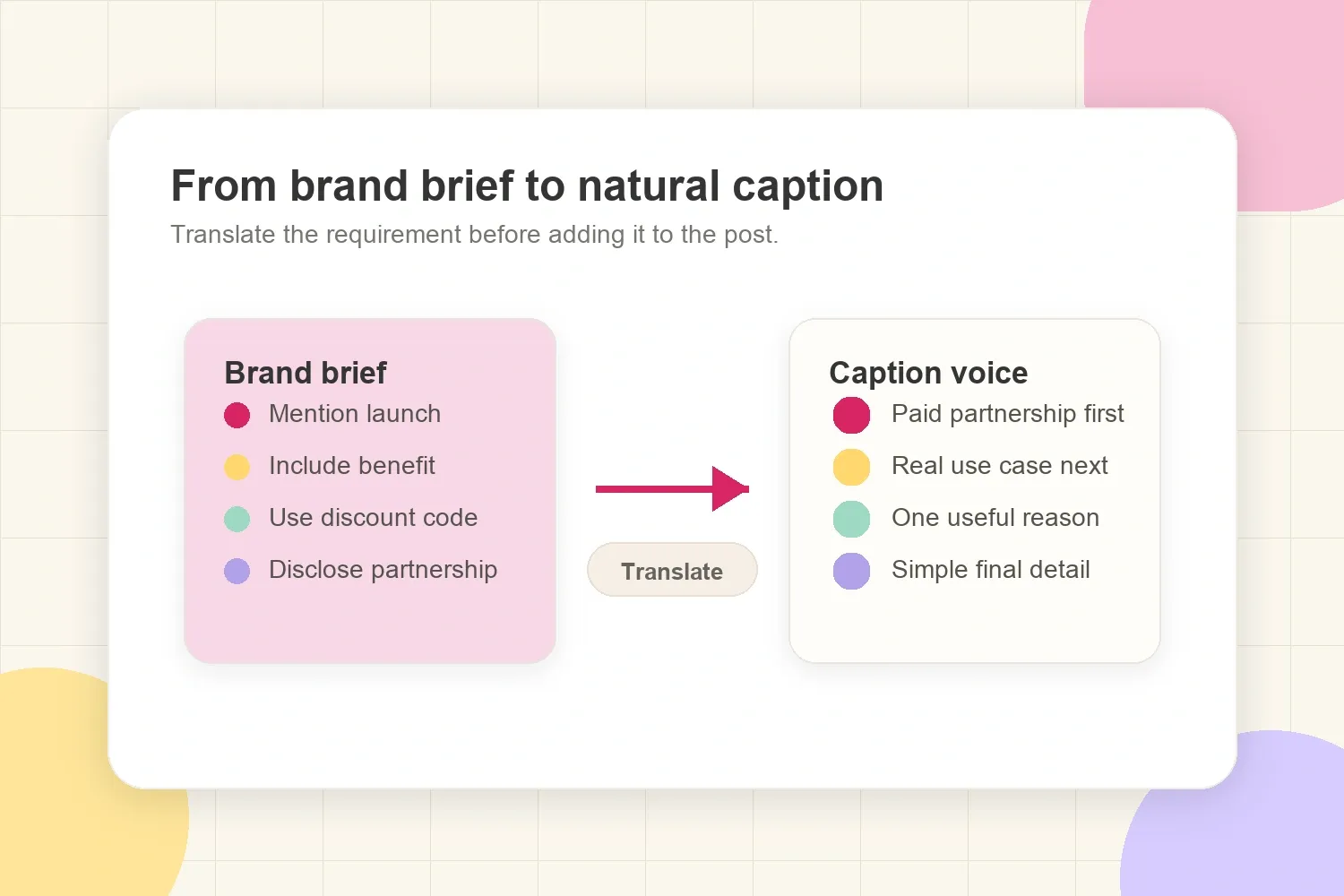
Before writing the caption, separate the brand brief into required and flexible parts. This prevents the caption from becoming either too scripted or too loose.
Required parts might include:
- Product name and approved spelling.
- Disclosure wording or the paid partnership label.
- Account tags and campaign hashtags.
- Discount code, link-in-bio mention, or launch date.
- Approved claims, especially for beauty, wellness, finance, food, or health-adjacent products.
- Words, claims, or comparisons the creator cannot use.
Flexible parts are where the caption can sound more human. These might include the hook, the personal story, the example, the transition into the product, and the ending.
For example, a brand might ask a skincare creator to mention that a moisturizer is fragrance-free, lightweight, and available online. The creator does not need to write: "This lightweight fragrance-free moisturizer is available online now." A more natural caption could explain when the creator uses it, then include the same facts in a smoother way.
The useful question is not "How can every brand point fit in?" It is "Which points are mandatory, and how can they be said in a way the audience would expect from this account?"
Make the sponsorship clear without making the caption stiff
Disclosure is not the place to be vague. If the creator has a material relationship with the brand, the audience needs to understand that relationship.
The FTC's social media influencer disclosure guidance says disclosures should be clear and hard to miss. Instagram also defines branded content as content influenced by a business partner for an exchange of value in its branded content policies.
For creators, the practical caption rule is simple: put the disclosure early enough that the audience sees it before the caption becomes a story, a list of hashtags, or a long product explanation.
Examples of clear disclosure language:
- "Paid partnership with @brand"
- "Ad | Partnered with @brand to..."
- "Sponsored by @brand"
- "Gifted by @brand" when the post is based on a gifted product and the wording fits the campaign rules.
- "This post is part of a paid partnership with @brand."
The paid partnership label is useful, but captions should still be written clearly. If a caption buries #ad after twenty hashtags, it may technically include a disclosure while still feeling hidden to the reader.
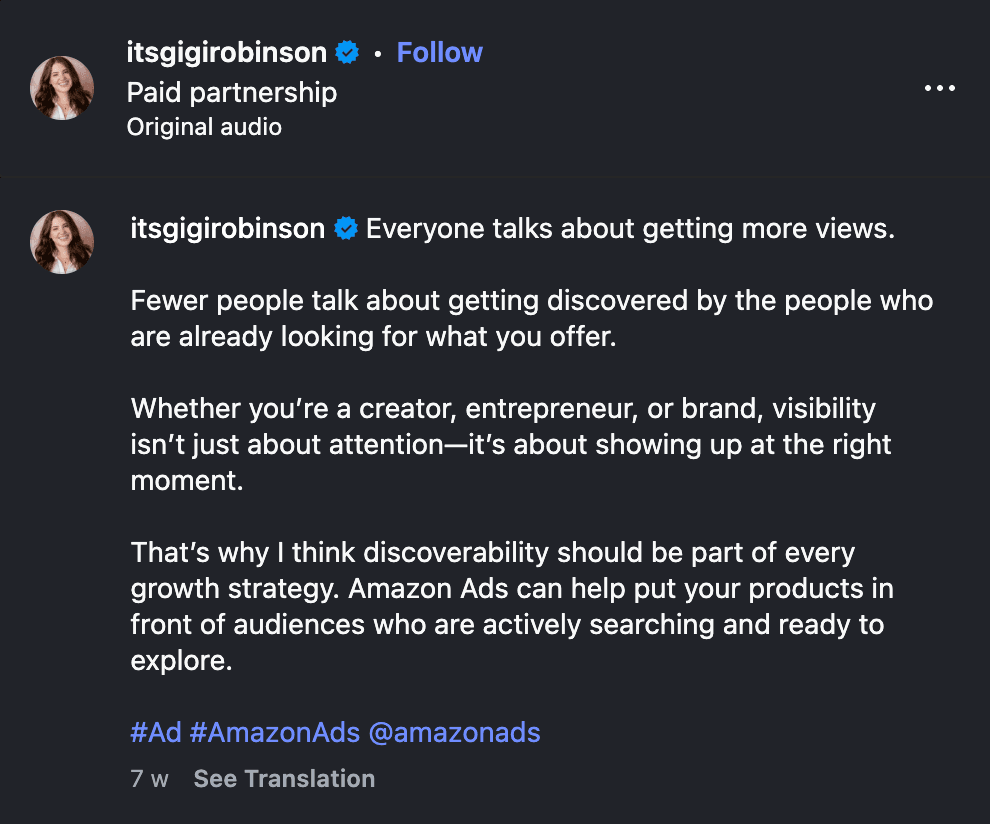
A real sponsored caption often works best when the disclosure is visible and the opening still feels like a creator idea. In this example, the paid partnership label, #Ad, and brand tag are clear, but the caption starts with a broader point about discoverability before tying the thought back to the sponsor.
Use a caption structure that sounds like you
Sponsored captions often sound unnatural because the creator starts with the product instead of the context. A better structure starts with the audience's reason to care, then brings in the brand.
Use this order when the caption needs to feel natural:
- Open with a real moment or problem.
Talk about the routine, question, frustration, goal, or content moment the audience already understands.
- Introduce the partnership clearly.
Add the disclosure or partnership phrase early.
- Explain the product through the use case.
Show how it fits into the routine, video, outfit, recipe, workout, travel day, setup, or workflow.
- Add required brand details.
Include the product name, tag, code, hashtag, or approved wording without turning the caption into a spec sheet.
- End with a small, relevant next step.
Use a practical ending, not a hard sell. "Saving this for the next packing list" can fit better than "Shop now" depending on the creator's voice and the campaign goal.
This is also where a creator media kit can help before the campaign starts. When the brand already understands the creator's niche, audience, tone, and past content examples, it is easier to approve a caption that sounds natural instead of asking for generic sales copy.
Sponsored Instagram caption examples
Use examples as patterns, not scripts. The best caption for a sponsored post depends on the creator's niche, the format, the product, the brand requirements, and the audience's expectations.
Skincare sponsored caption example
Ad | Winter skin has been making my usual morning routine feel heavier than it needs to be, so I have been using @brand's fragrance-free moisturizer before sunscreen. It feels lightweight, sits well under makeup, and keeps the routine simple on busy mornings. Use code CREATOR15 if you want to try it this week.
Why it works: the caption discloses the partnership early, explains the real routine, includes specific product language, and keeps the code as a useful detail instead of the whole point.
Fitness sponsored caption example
Paid partnership with @brand. The easiest way to stay consistent with workouts has been keeping recovery as simple as the workout itself. These electrolyte packets go in my gym bag because they are quick after a long run and do not take up space. Full routine is in the Reel, and the flavor is tagged.
Why it works: the product appears inside a believable creator routine. The caption gives the brand a clear mention but still reads like fitness content, not a product brochure.
Creator tool sponsored caption example
Ad | Planning sponsored content gets easier when the deadline, caption draft, and deliverables are in one place. I used @brand to map this week's Reel, Story frames, and approval notes before sending everything over. The template I used is linked in bio for anyone organizing brand work right now.
Why it works: the caption speaks to a practical creator problem, then explains the tool through the workflow.
Weak vs better caption example
A weak sponsored caption usually sounds like it was written from the brand's product page:
Ad | So excited to partner with @brand! Their new bottle is stylish, durable, and perfect for every lifestyle. Use my code for 20% off. #ad #brandpartner #sponsored
The problem is not that the caption is short. The problem is that it gives the audience no real context. It could belong to almost any creator, any product, and any campaign.
A better version sounds more specific:
Ad | The bottle that has actually made it into my filming bag this month is @brand's insulated 24oz one. It does not leak next to my camera gear, fits in the side pocket, and keeps coffee hot through a morning shoot. Code CREATOR20 is active this week if you have been looking for a less bulky option.
The second caption still includes the sponsor, product, use case, and code. But it gives the audience a reason to believe the mention belongs in the creator's content.
What changed:
- The disclosure stays early, so the partnership is not hidden.
- The product appears in a real routine, not as a list of adjectives.
- The benefit is specific, with details like filming bag, camera gear, side pocket, and hot coffee.
- The code comes after the context, so it feels like a useful detail instead of the whole caption.
How to include brand requirements without sounding scripted
Brand requirements are not the enemy of a good caption. What matters is how they are worked into the story.
A useful method is to turn every required point into a caption role:
- Product name: Mention it where the product naturally enters the story.
- Discount code: Place it after the audience understands why the product matters.
- Campaign hashtag: Keep it near the end unless the brand requires a specific placement.
- Approved claim: Pair the claim with a real use case instead of listing it alone.
- Brand tag: Add it early enough for clarity, but avoid tagging the brand in every sentence.
- Launch date: Connect it to audience timing, such as a sale, seasonal routine, event, or content series.
For example, "must mention lightweight fabric" can become "the lightweight fabric made sense for a hot studio day." "Must mention new shade range" can become "the new shade range made finding a summer shade easier." The requirement stays intact, but the caption feels written for the creator's audience.
What to check before sending the caption for approval
Caption approval can slow down a campaign when creators send a draft that is almost done but missing small required pieces. Before sending the caption to a brand or agency, check it against the brief.
Review:
- Disclosure is clear and early.
- Brand handle is correct.
- Product name is spelled exactly as requested.
- Required hashtags are included.
- Discount code, URL direction, or link-in-bio language is correct.
- Claims match the approved language.
- Caption does not promise results the product cannot guarantee.
- Tone still feels like the creator's normal content.
- Any usage rights, whitelisting, or partnership ad wording matches the contract.
- The caption fits the actual creative, not just the brief.
This is especially important when the post is part of a larger brand deal with multiple deliverables. A caption that works for a Reel may need different wording for a carousel, Story sequence, or static post. Creators handling several deliverables can map caption notes alongside the full scope in a brand deal workflow before the approval round.
What to avoid in sponsored captions
The most common sponsored caption problems are easy to miss because each one looks small on its own.
Avoid:
- Buried disclosures: Do not hide the partnership after a long caption or a block of hashtags.
- Generic excitement: "So excited to partner" is not wrong, but it becomes empty when it is the main idea.
- Too many product claims: Three useful details usually read better than eight brand-approved bullet points squeezed into one caption.
- A voice change: If the creator never writes formal captions, a sudden corporate paragraph will feel off.
- Fake urgency: Do not force urgency unless there is a real deadline, launch, or limited offer.
- Misaligned hashtags: Campaign tags are fine, but irrelevant reach-chasing hashtags can make the post feel less credible.
- Unsupported claims: Be careful with health, beauty, finance, and wellness language. If the brand gives approved wording, stay inside it.
The goal is not to hide that the post is sponsored. The goal is to make the partnership easy to understand while keeping the post useful, specific, and believable.
Keep notes for the next sponsored post
After the post goes live, save the final caption, the approved brand requirements, the creative format, and the performance notes. This makes the next sponsored caption easier to write because the creator can see which wording, format, and context worked with their audience.
It also helps with future brand communication. When the campaign ends, creators can send the brand a post-campaign recap that includes the live link, key results, and useful context. That turns the caption from a one-off deliverable into part of a more professional brand partnership workflow.
Final take
The best sponsored captions make the partnership obvious, show the product in a believable context, and still feel familiar to the audience. They do not pretend the post is not an ad, and they do not abandon the creator's normal voice to satisfy a brief.
Start with the required elements, translate them into natural language, and make every brand detail earn its place in the caption. That is what makes sponsored content feel professional without sounding robotic.