

When a brand asks for usage rights, it is asking for permission to use creator content beyond the original post. That might mean reposting a Reel on the brand's Instagram, running the video as a paid ad, using a photo on a product page, adding the content to email, or turning a creator post into whitelisted ads.
The answer should not be an automatic yes. Usage rights can be valuable because they let the brand keep getting value from the creator's work after the campaign goes live. The practical move is to clarify exactly how the brand wants to use the content, limit the scope, and price the rights separately when the reuse has commercial value.
What usage rights mean in a brand deal
Usage rights are the permissions a creator gives a brand to reuse content. They answer questions like:
- Where can the brand use the content?
- How long can the brand use it?
- Can the brand run it as an ad?
- Can the brand edit the content?
- Can the brand use the creator's name, image, voice, or handle?
- Can the brand use it only organically, or across paid media too?
This matters because a sponsored post fee usually pays for the creator's time, production, and audience distribution. It does not automatically give the brand unlimited rights to use the asset everywhere.
Impact's creator guide to charging for usage rights explains that brands should be clear about where they want to reuse creator content. That is the same point creators should bring into the conversation: a vague "can we use this?" is not enough to price fairly.
What the brand usually means by usage
When a brand says "usage," it may mean several different things. The practical response is to separate the request into clear buckets before talking about price.
Common meanings include:
- Organic reposting: the brand shares the content on its own social channels.
- Paid amplification: the brand turns the content into ads, boosts it, or uses it in paid social.
- Whitelisting or Spark Ads: the brand runs ads through the creator's handle or with creator-level permissions.
- Owned-channel reuse: the brand uses the content on a website, product page, email, landing page, retail page, or sales deck.
- Edited versions: the brand cuts, crops, subtitles, translates, combines, or adapts the content for new formats.
Those are not all the same right. A creator can be open to one of them and still say no, or charge more, for another.
Do not answer before you know the scope
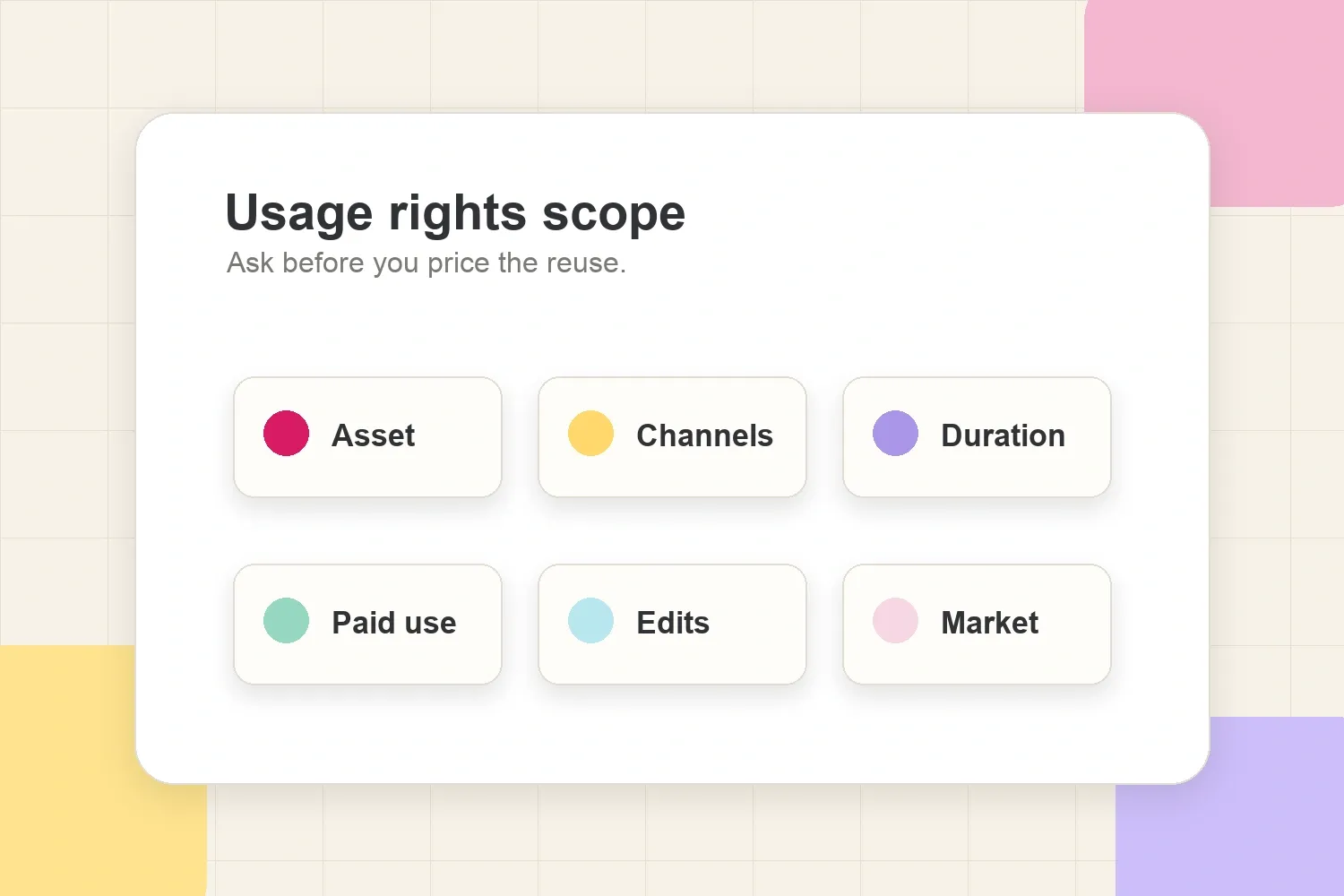
When a brand asks for usage rights, first ask for the scope. A short clarification can save a lot of confusion later.
Ask:
- Which content do you want to use?
- Which channels will it appear on?
- Is this organic reposting, paid ads, whitelisting, website use, email, retail, or something else?
- How long do you want to use it?
- Will you edit, crop, add text, translate, or combine it with other assets?
- Which markets or territories will it run in?
- Will the usage include the creator's name, likeness, voice, handle, or comments?
- Do you need exclusivity during the usage period?
That list may feel detailed, but it is normal business scope. A brand running one organic Instagram repost for 30 days is not asking for the same thing as a brand running paid ads across Meta, TikTok, YouTube, and email for a year.
Separate organic usage from paid usage
The main mistake is treating every usage request like the same permission.
Organic usage usually means the brand can repost, embed, or share the content on its owned channels without paid media behind it. That might include the brand's Instagram, TikTok, website, blog, newsletter, or product page.
Paid usage means the brand can use the content in ads. This is more valuable because the content can be shown to larger audiences, tested against other creatives, edited into new ad versions, and used to drive sales.
Paid usage can include:
- Meta ads.
- TikTok Spark Ads or paid amplification.
- YouTube Shorts ads.
- Paid social from the brand account.
- Whitelisted ads from the creator's handle.
- Paid display, landing pages, or email acquisition campaigns.
If the brand says "we just want to use it for marketing," ask what that means. Marketing can mean a harmless organic repost. It can also mean paid ads, landing pages, retargeting, and long-term creative testing.
Usage rights are not the same as ownership
Creators should also separate usage rights from ownership.
Usage rights mean the brand has permission to use the content within agreed limits. Ownership means the brand controls the content itself. Those are not the same.
A fair usage license might say:
- The brand can use one Reel.
- The usage lasts 90 days.
- The channels are Instagram and TikTok paid social.
- The content cannot be edited beyond captions, resizing, or light formatting.
- The creator keeps ownership of the original content.
A risky version would say:
- The brand owns all content.
- Usage is worldwide, perpetual, and unlimited.
- The brand can edit, sublicense, or reuse the content anywhere.
- No extra compensation is required.
The second version is much broader. It gives the brand long-term commercial value while removing future control from the creator.
Vamp's creator guide to selling content usage rights makes the same distinction: usage rights are what a brand pays for when it wants to use creator content beyond the original post. For creators, that means the contract or email needs specifics, not a blanket phrase.
What to ask before pricing usage rights
Before giving a fee, collect the information that changes the value.
Use this quick scope table:
| Question | Why it changes the price |
|---|---|
| Which assets? | One Story frame is not the same as three edited videos. |
| Which channels? | Organic social, paid ads, website, email, and retail have different value. |
| How long? | 30 days is different from six months or perpetual use. |
| Paid or organic? | Paid usage gives the brand more commercial leverage. |
| Can they edit it? | Editing, cutdowns, translations, and new versions expand the use. |
| Which markets? | Local use is narrower than worldwide use. |
| Is exclusivity included? | Category limits can block other paid work. |
If the brand cannot answer those questions, do not price yet. Say that the fee depends on the usage scope.
How to respond when the brand asks casually
Sometimes the brand asks after the post performs well:
This did great. Can we use it in ads?
That is a good sign. It means the content has value. But the response should still be professional.
Better reply:
Thanks, glad the content performed well. I am open to usage rights. Could you share which asset you want to use, the channels, whether it will be organic or paid, the usage length, and whether you need editing or whitelisting? Once I have that scope, I can send a usage option.
Why it works: the creator says yes to the conversation without giving away the rights. The brand gets a clear next step, and the creator keeps pricing tied to scope.
Fair options you can offer
Creators do not need one fixed usage-rights answer for every brand. Offer options that match the brand's ask.
Useful options:
- Organic repost only: brand can repost the content on owned social channels for a limited period.
- Website or email use: brand can use the content on a product page, blog, email, or landing page for a set period.
- Paid social usage: brand can use the content in ads on specific platforms for 30, 60, or 90 days.
- Whitelisting or creator-handle ads: brand can run ads through the creator's handle for a set period, with extra approval and reporting terms.
- Extended usage: brand can renew the same rights for another period if the asset keeps performing.
- Expanded usage: brand can add new channels, markets, or edits for an added fee.
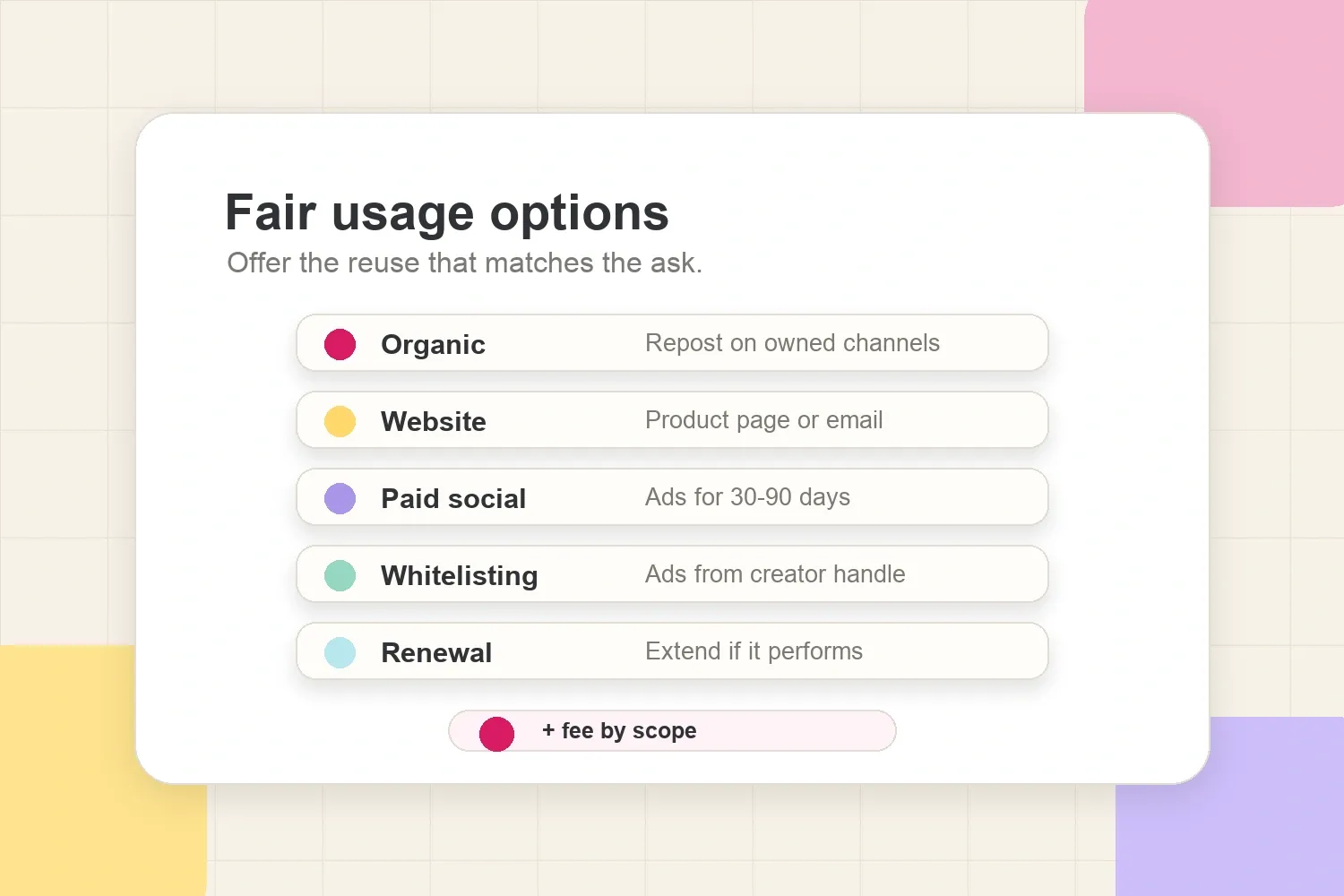
This keeps the conversation flexible. A brand with a small budget can choose organic usage. A brand that wants paid ads can pay for the larger commercial use.
What to avoid in usage-rights language
Some usage-rights phrases are too broad for a normal creator deal.
Be careful with:
- Perpetual: the brand can use the content forever.
- Worldwide: the brand can use the content in any market.
- Unlimited: the brand can use the content without practical limits.
- All media: the brand can use it across channels you may not expect.
- In perpetuity: another way of saying forever.
- Transferable or sublicensable: the brand may pass the rights to another company or partner.
- Boosting or whitelisting included by default: paid amplification should be named, scoped, and priced separately.
- AI edits or synthetic extensions: the brand may want to alter, extend, or generate new versions from the creator's content.
- Work made for hire: this can suggest the brand owns the work, depending on the agreement and jurisdiction.
Not every broad phrase is automatically bad, but broad rights should cost more and be reviewed carefully. If a brand wants forever, worldwide, all-media usage, that is not a small add-on. That is a major commercial license. If a contract asks for ownership, perpetual usage, AI edits, or sublicensing, get proper contract support before signing.
How to price without sounding difficult
Usage-rights pricing depends on the creator, content quality, campaign budget, channel, duration, paid media spend, and whether the brand needs exclusivity or editing rights.
The easiest way to explain it is:
My base fee covers creation and posting. Usage rights are priced separately based on channel, duration, and whether the content will be used organically or in paid media.
This sounds professional because it explains the logic. It does not make the creator sound defensive.
If the brand asks why there is an extra fee, keep it simple:
Usage rights extend the value of the content beyond the original post. If the brand is using the asset in ads, email, website, or other marketing channels, that creates additional commercial value, so I price it separately.
That sentence is often enough.
Response templates for usage-rights requests
Here are practical replies creators can adapt.
If the brand asks before the campaign
Happy to include usage rights as a separate line item. Could you confirm the channels, duration, whether usage is organic or paid, and whether you need editing, whitelisting, or exclusivity? I can price the usage once the scope is clear.
If the brand asks after the post goes live
Glad the content is useful. I am open to licensing it for brand use. Please send the asset, channel, usage length, paid or organic use, and any editing needs, and I can share a usage fee.
If the brand wants paid ads
Paid usage is separate from the original post fee. I can offer 30, 60, or 90 days of paid social usage for the agreed asset and channels. If the campaign needs whitelisting, additional platforms, or extended usage, I can price that separately.
If the brand asks for perpetual rights
I do not usually include perpetual usage in standard campaign rates. I can offer a fixed usage period, such as 30, 60, or 90 days, with the option to renew if the content continues performing.
If the brand has no extra budget
If there is no usage budget, I can keep the collaboration to the original post and standard organic visibility. If budget opens later, I would be happy to discuss licensing the content for brand channels or paid media.
Put usage rights in writing
Do not rely on a casual DM if the brand will reuse the content commercially. Even a simple email is better than unclear verbal agreement.
The written agreement should include:
- The exact asset or assets covered.
- The allowed channels.
- The usage period.
- Whether usage is organic, paid, or both.
- Whether whitelisting is included.
- Whether editing, cutdowns, subtitles, translations, or resizing are allowed.
- Whether AI edits, synthetic extensions, or new generated versions are allowed.
- Whether boosting, Spark Ads, whitelisting, or creator-handle ad access is included.
- Whether the creator's name, handle, likeness, voice, or comments can be used.
- Territory or markets.
- Exclusivity, if any.
- Renewal terms.
- The fee and payment timing.
This is also where a creator's business assets matter. If your media kit already separates your collaboration options, UGC, usage rights, and paid amplification, the brand has fewer reasons to assume everything is included.
How usage rights connect to campaign reporting
Usage-rights conversations often happen after a post performs well. A brand sees useful saves, clicks, comments, or sales signals and wants to turn the creator asset into a paid ad.
That is why campaign reporting matters. When a creator sends clean results after a sponsored post, the brand can see which content might be worth licensing. The guide on what to send a brand after sponsored content goes live is useful here because it shows how to package live links, screenshots, performance results, and next steps professionally.
If the brand wants to reuse the content after seeing results, the creator can treat that as a new commercial request instead of a casual favor.
Final take
When a brand asks for usage rights, do not just say yes. Ask where, how long, paid or organic, which asset, which markets, and whether editing, whitelisting, or exclusivity are included.
The best response is calm and businesslike: the original post fee covers creation and publishing, while usage rights cover the brand's extended use of the content. Clear scope protects the creator's value and gives the brand fair options to keep using content that works.