
Gifted collaborations can be useful at the beginning of a creator journey, but they should not become the default forever. At some point, free products stop being an opportunity and start becoming unpaid labor, especially when a brand expects content, posting deadlines, usage rights, reporting, or exclusivity.
The practical answer is simple: creators should stop accepting gifted collaborations when the product no longer gives enough value to justify the work, or when the collaboration could reasonably be paid. A free product can be part of a relationship, but it should not replace payment when the creator is delivering real marketing value.
What counts as a gifted collaboration?
A gifted collaboration is a brand partnership where the creator receives a product, service, trip, experience, or sample instead of a cash payment. Sometimes the brand only asks for feedback. Other times, the brand expects a Reel, Story, TikTok, YouTube mention, blog feature, review, usage rights, or a full campaign deliverable.
That difference matters. A no-obligation PR gift is not the same thing as a content brief with deadlines and approval notes.
| Situation | Best response | Why it matters |
|---|---|---|
| No required post, strong product fit | Consider accepting | It can build relationship value without forcing unpaid work. |
| Required post or campaign brief | Ask for payment | The creator is producing marketing work, not just receiving PR. |
| Usage rights, ads, or exclusivity | Quote a paid rate | The brand is asking for reusable business value. |
| Weak audience fit | Decline politely | Audience trust is worth more than a free product. |
A gifted collaboration can look like:
- A skincare brand sending products with no required post.
- A fashion brand offering clothes in exchange for one Instagram Reel.
- A hotel offering a free night in exchange for Stories, photos, and a recap.
- A food brand sending samples and asking for UGC videos.
- A startup offering free software access in exchange for a LinkedIn post.
The more specific the ask becomes, the less it feels like a gift. When there is a content requirement, the creator is doing production, distribution, and brand work. That has value.
When gifted collaborations still make sense
Gifted collaborations are not automatically bad. For newer creators, they can be a useful way to build proof, test brand workflows, practice content production, and collect examples for a portfolio.
The problem starts when creators keep saying yes long after the exchange stops making sense.
A gifted collaboration can still be worth considering when:
- The product is genuinely useful, expensive, or hard to access.
- The brand is highly relevant to the creator's niche.
- There is no required post, only an optional share if the creator likes it.
- The creator wants examples for a media kit, portfolio, or pitch.
- The brand has a realistic path to paid work later.
- The collaboration gives access to a strong event, relationship, or case study.
A simple way to separate PR from a gifted collaboration is to look for the obligation, but the contract matters too. Gifted work can be useful when a creator is learning the collaboration process, but usage rights, reshoots, exclusivity, duties, taxes, or even unpaid gratuity on an experience can turn a free product into unpaid client work. If any of those appear in the ask, the creator should push back, remove the clause, or quote a paid rate before accepting.
For example, a small fitness creator might accept free workout gear from a brand they already use because the content feels natural and the product saves them money. A beauty creator might accept PR from a skincare brand if there is no obligation to post and the products fit their audience.
That is different from accepting a detailed campaign brief, filming three videos, posting on a deadline, sending analytics, and giving the brand permission to reuse the content, all for a $30 product.
The real cost of free product
Free products can feel exciting because they create a visible sign that brands are paying attention. But the cost is not only the retail price of the product.
The real cost includes:
- Time spent emailing the brand.
- Time testing the product.
- Planning the creative angle.
- Filming, editing, writing, and posting.
- Responding to revision requests.
- Sharing analytics or screenshots.
- Giving up feed space, Story attention, or audience trust.
- Possibly blocking other brands in the same category.
This is why creators need to treat gifted collaborations as business decisions, not compliments.
A creator with a small but engaged audience may still create real value for a brand. The audience might trust their recommendations, ask questions in DMs, click links, save posts, or buy from niche recommendations. If the brand benefits from that trust, the creator should not assume payment is only for larger accounts.
Stop accepting gifted collaborations when there is required content
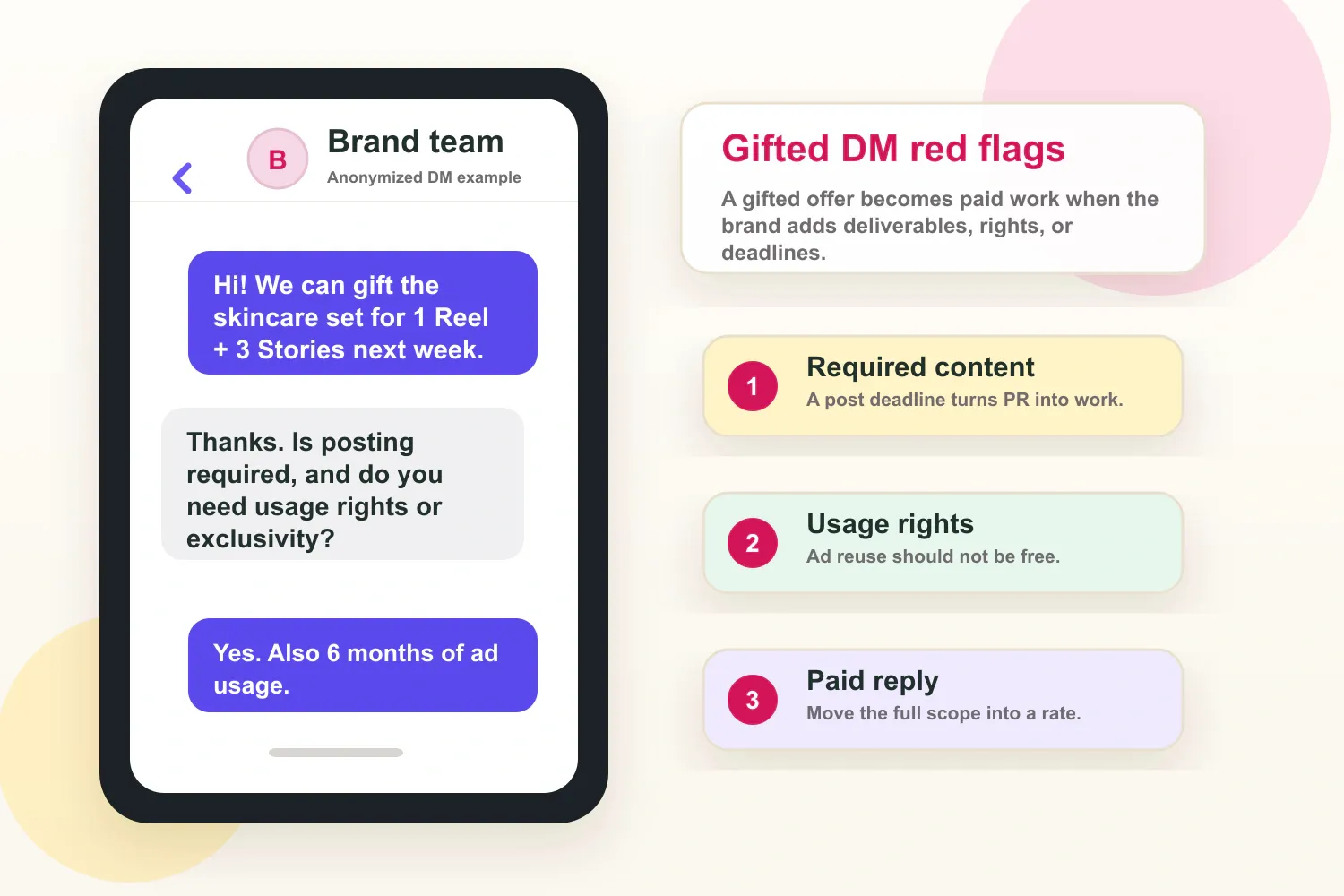
The clearest line is required content. If the brand says the creator must post, submit drafts, follow talking points, hit a date, tag the brand, include a link, or send performance screenshots, the collaboration is no longer casual gifting.
At that point, the creator is producing marketing work.
This does not mean every required post must be expensive. It means the creator should pause and ask whether the exchange is fair. A small creator may still choose to do one gifted post for a brand they love, but it should be a choice, not a default response.
A useful rule: if the brand is giving instructions like a paid campaign, it should be treated like a paid campaign.
Stop when the product does not match the audience
Some gifted offers look good at first because the product is free. But if the product does not fit the audience, posting it can create more damage than value.
Audience trust is one of the main assets a creator has. If every gifted item becomes content, followers can start to feel like the creator is posting anything that arrives in the mail.
Before accepting, the creator should ask:
- Would this product make sense if it was not free?
- Would the audience expect this recommendation from this creator?
- Does the product fit the creator's niche, values, and content style?
- Would posting this make future paid brand deals easier or harder?
A student creator promoting a productivity app can feel natural. A student creator suddenly promoting a random supplement with no connection to their content may feel forced. Brands notice that too.
Stop when the brand asks for usage rights
Usage rights are one of the biggest signs that a gifted collaboration should become paid.
When a brand asks to use the creator's photos or videos on its website, ads, emails, product pages, social accounts, or paid media, the creator is not only posting to their own audience. They are creating an asset the brand can reuse.
That has a separate value.
Even if the creator has a small following, the content itself may help the brand sell. A clean product demo, strong testimonial, or natural UGC-style video can be useful in ads or organic brand content. If the brand wants that asset, it should usually pay for it.
This is also where disclosure matters. In the United States, the FTC says creators should clearly disclose a material connection with a brand, including free or discounted products, when posting an endorsement. The FTC's Disclosures 101 for Social Media Influencers is worth reading because gifted products still count as a relationship that may need to be disclosed.
Instagram also has branded-content rules and tools for paid partnerships. Meta explains its branded content requirements in its branded content policies, which can matter when a collaboration involves compensation, gifts, or business relationships.
Stop when gifted work blocks paid opportunities
One gifted collaboration rarely hurts a creator. A pattern of too many unpaid collaborations can.
If a creator fills their feed with unpaid product posts, brands may assume they do not need to pay. Worse, the creator can train their own workflow around doing brand work for free: free posting, free reporting, free revisions, free usage rights, free exclusivity.
That makes paid negotiation harder later.
It can also create category conflicts. If a creator accepts free products from several skincare brands in the same month, a paid skincare brand may see the account as crowded or less credible. If a fitness creator promotes five gifted supplement brands, the sixth brand may question audience trust.
This is where it helps to think like a brand. Before offering a deal, brands look at fit, professionalism, audience quality, and previous content. This guide on what brands look for in an influencer before offering a deal is useful context because free collaborations can either strengthen or weaken those signals.
Stop when the brand has budget signals
Some brands genuinely cannot pay. Others can pay, but start with gifting because many creators accept it.
Budget signals are not always obvious, but creators can look for clues.
A brand may have budget if:
- They are asking for multiple deliverables.
- They want content approval before posting.
- They mention usage rights, paid ads, whitelisting, or exclusivity.
- They have run influencer campaigns before.
- They ask for analytics, audience demographics, or a media kit.
- They have a launch, campaign calendar, agency contact, or formal brief.
- They want the content by a specific deadline.
A brand that has a full brief, deadline, and content usage request is not just sending a gift. It is sourcing marketing work.
Creators do not need to be rude about it. A simple response can move the conversation into paid territory:
"Thanks for thinking of me. This sounds like a good fit, but because the campaign includes required content and reporting, I handle this as a paid partnership. I can send over a simple package and rate if helpful."
That kind of answer keeps the door open without agreeing to unpaid work automatically. If the brand asks for rates next, this guide on how to respond when a brand asks for your rates can help shape the reply.
How to decide if a gifted collaboration is worth it
Creators do not need a complicated scoring system. A simple decision check is enough.
Before saying yes, ask:
- Is the product actually valuable or useful?
- Is the brand a strong fit for the audience?
- Is posting required or optional?
- How much time will the content take?
- Is the brand asking for usage rights?
- Could this create proof for future paid work?
- Would accepting this make the creator look more professional or more available for free work?
If most answers are positive, the gifted collaboration may be worth it. If most answers point to required work, low product value, weak fit, and no future upside, it is probably time to say no or ask for payment.
How to turn a good gifted collaboration into paid work
When a gifted collaboration is worth accepting, the creator should use it strategically. The goal is not to collect more free products. The goal is to create proof that supports future paid work.
That proof can include:
- Screenshots of Story views, link clicks, replies, or saves.
- A short recap of what performed well.
- Comments or DMs from the audience.
- Clean examples of the content created.
- Notes on what could be improved in a paid campaign.
- A simple package for the next collaboration.
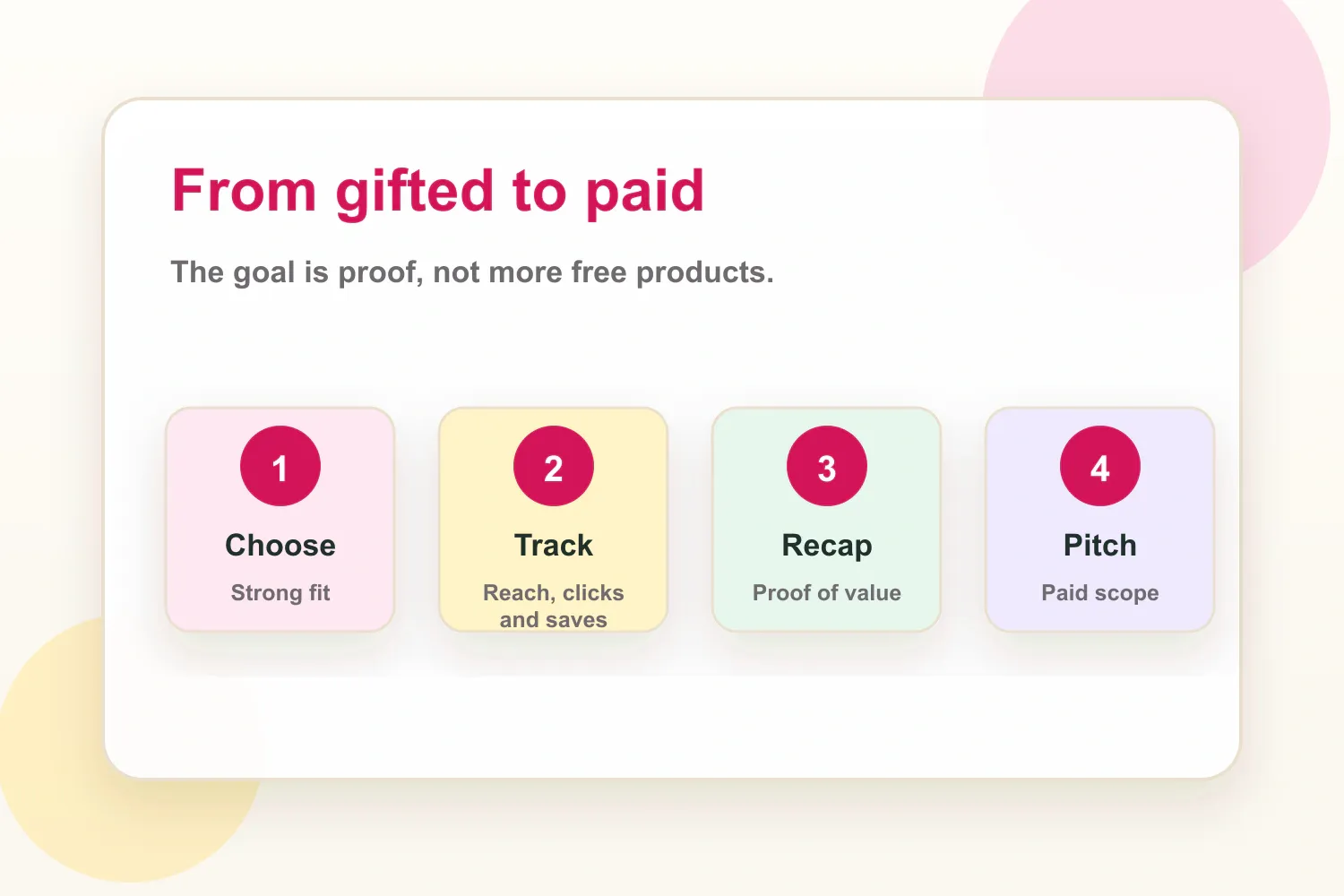
After the post goes live, creators can send a short recap to the brand. It does not need to be dramatic. The point is to show that the creator takes partnerships seriously.
A simple recap could say:
"Thanks again for sending the product. The Story set reached 3,200 accounts, received 42 replies, and drove 86 link taps. The audience responded especially well to the demo angle. If you run another campaign, I would be happy to put together a paid Reel and Story package."
That message changes the relationship. Instead of waiting for the brand to decide whether the creator is worth paying, the creator gives the brand a reason to think about a paid next step.
For creators who are building a broader collaboration system, this brand deal playbook for content creators explains how pitching, pricing, delivery, and reporting fit together.
How to say no without burning the relationship
Saying no to a gifted collaboration does not need to sound harsh. Most brands understand that creators have limited time and cannot accept every unpaid offer.
The best response is short, polite, and clear.
For a weak-fit product:
"Thanks so much for reaching out. The product looks interesting, but it is not the right fit for my audience, so I will pass on this one."
For required content with no budget:
"Thanks for thinking of me. Since this includes required content, I handle this as a paid collaboration. Happy to share rates if a paid campaign becomes possible."
For a brand the creator likes but cannot prioritize for free:
"I appreciate the offer. I am being more selective with gifted collaborations right now, but I would be open to discussing a paid partnership if you have budget for creator content."
This protects the relationship without giving away work. It also signals that the creator understands their value.
What gifted collaborations should never include for free
Some requests should almost always trigger a paid conversation.
Be careful with gifted collaborations that include:
- Paid ad usage.
- Whitelisting or creator licensing.
- Exclusivity that blocks competitors.
- Multiple rounds of revisions.
- Long-term content rights.
- Raw files.
- Professional product photography.
- Multiple deliverables across platforms.
- Detailed reporting requirements.
- A strict approval process.
These are normal paid-campaign terms. A brand may still start by offering product, but the creator does not have to accept the first structure.
The more the brand controls the content, the more the creator should treat it as paid work.
Final thoughts
Gifted collaborations can help creators at the right stage, but they should have a purpose. They can help build proof, test brand relationships, and create portfolio examples. They should not become the default way brands access a creator's time, audience, and content skills.
The easiest way to decide is to separate a true gift from a campaign. If there is no obligation and the product is genuinely useful, accepting may make sense. If there are deliverables, rights, reporting, deadlines, or brand control, the conversation should usually move toward payment.
Stopping gifted collaborations is not about acting too big for opportunities. It is about protecting the creator's time, trust, and ability to turn attention into a real business.