
Pricing UGC videos is tricky because brands are not only buying a final video file. They are buying your product research, creative angle, filming time, editing, revisions, and sometimes the right to use that video in ads.
That is why UGC video pricing should start with scope, not follower count. A creator with a small audience can still charge well for UGC if the brand needs strong creative, clean product shots, usable ad variations, or a fast turnaround.
This guide is not a universal rate card. It is a practical way to build a quote so you can explain what is included, what costs extra, and when a brand request moves from a simple UGC video into a larger commercial asset.
What counts as a UGC video?
A UGC video is content that looks and feels creator-made, but is usually produced for the brand to use on its own channels, product pages, emails, or paid social ads. The creator may not post it on their own account at all.
Common UGC formats include:
- Product unboxing videos.
- Testimonial-style videos.
- Problem-solution hooks.
- Product demos or tutorials.
- Short ad variations for TikTok, Instagram Reels, YouTube Shorts, or paid social.
- Raw footage bundles for the brand’s editing team.
This matters because UGC is often closer to creative production than influencer posting. If the brand does not need your audience, the value comes from your ability to create a believable video that can help the brand test angles, build trust, or improve ad performance.
Start with a base UGC video rate
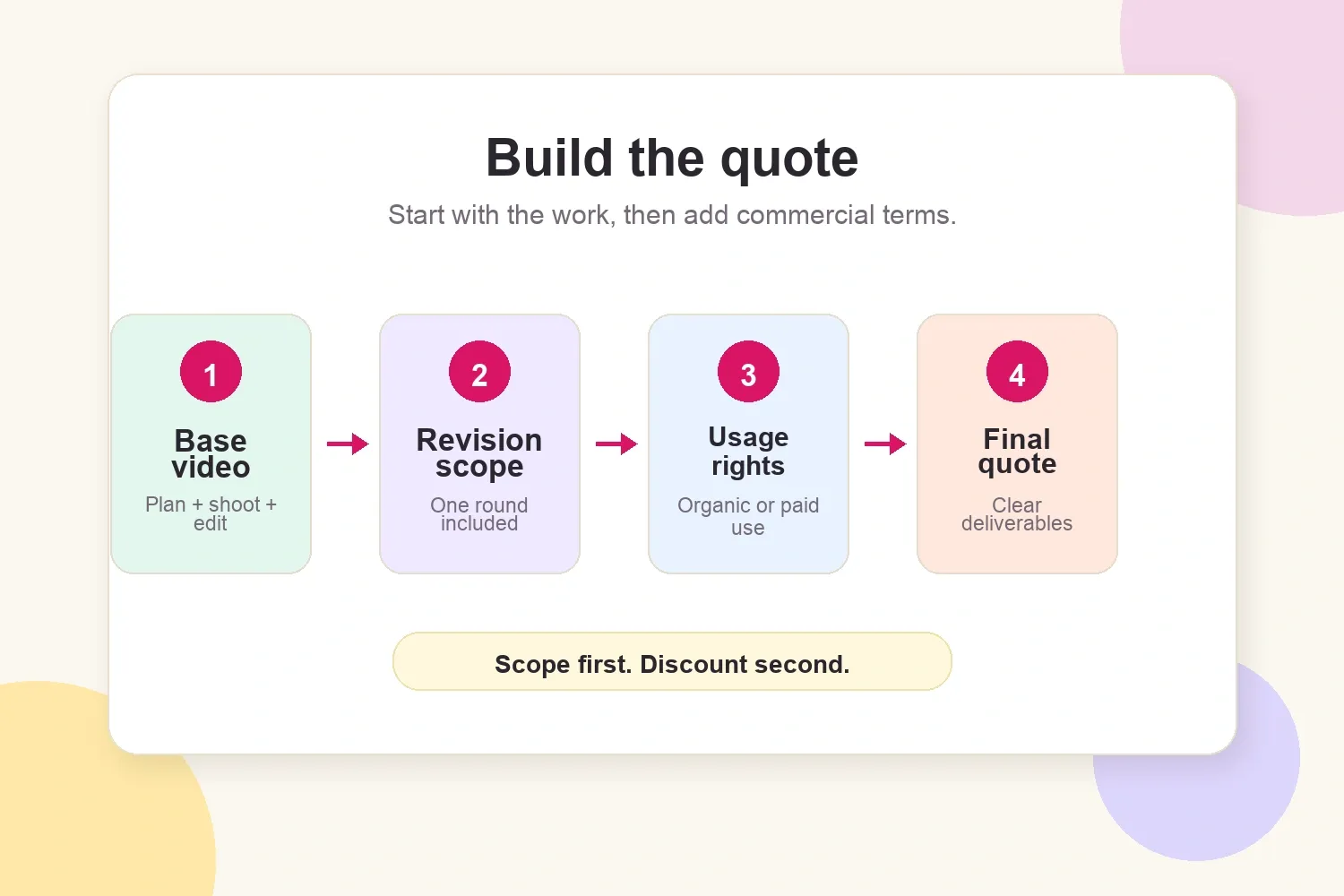
A base rate is the minimum price for one defined video before usage rights, rush timing, raw files, extra hooks, or extra edits. It should cover the normal work required to deliver the agreed asset.
For many newer creators, a simple UGC video often lands somewhere around $150 to $500 depending on production quality, niche, turnaround, and portfolio strength. Billo’s UGC rate guide points to a similar creator-market reality: basic UGC can start in the low hundreds, while experienced creators and more complex deliverables can command higher fees: Billo UGC rates guide.
Use those numbers as a starting reference, not as a rule. A skincare demo shot in natural light is not the same workload as a scripted app walkthrough, a recipe video, a multi-location shoot, or a polished ad with multiple hooks.
A simple base-rate formula:
- Planning and product research.
- Script or talking points.
- Filming time.
- Editing time.
- One revision round.
- Delivery in the agreed format.
Price by deliverable, not by vague effort
A brand should be able to understand exactly what it gets for the price. Instead of saying “one UGC video,” define the deliverable clearly.
A clean quote might say:
- One 30-second vertical UGC video.
- One hook and one final edit.
- One round of revisions.
- 30 days of organic usage on brand-owned channels.
- Delivery as a 9:16 MP4 file.
That scope is much easier to price than “a video.” It also gives you room to charge more when the brand asks for more versions, more hooks, raw files, paid usage, or a faster deadline.
Cohley’s creator team explains this through portfolio stage: beginner creators are still reducing risk for brands, intermediate creators are selling reliability, and advanced creators are expected to understand hooks, consumer awareness, conversion intent, and ad usage. That is why the reel places beginners around the $100-per-video range, intermediate creators around $100-$500, and advanced creators at $500+ or retainers when the work is closer to marketing strategy.
Use pricing ranges by complexity
A stronger UGC pricing range combines portfolio stage with deliverable complexity. Cohley’s reel is useful here because it separates creators by how much risk the brand feels it is taking.
- Portfolio-building UGC: gifted work, product reviews, or low-paid tests used to prove delivery. Cohley frames many beginner creators around $100 per video because the main goal is building proof, not maximizing the fee.
- Starter UGC video: simple product demo, testimonial, or unboxing with light editing. Often around $150-$300 when the creator already has samples and the scope is narrow.
- Standard UGC video: stronger concept, clean filming, captions, product research, one revision round, and basic ad-readiness. Often around $300-$750, with Cohley’s intermediate range sitting around $100-$500 depending on difficulty.
- Advanced UGC package: multiple hooks, multiple final edits, stronger production, raw footage, problem-aware scripting, or ad-ready creative. Often $750-$2,000+, especially when the creator is contributing marketing thinking rather than only filming.
- Retainer or batch package: several videos per month, usually priced as a package instead of one-off videos when the brand wants consistent testing volume.
These are pricing anchors, not fixed rules. A newer creator with a strong portfolio can charge more than a beginner range, and a simple one-shot brief can cost less than an advanced package even if the creator is experienced.
Platforms such as Influee also show how brands increasingly buy UGC as a content-production workflow, not only as influencer reach. That is the useful mindset: price the asset and the commercial use, not just the posting moment.
Add usage rights separately
Usage rights are where many creators undercharge. A video the brand posts once on its Instagram page is different from a video the brand runs as a paid ad for six months.
If the brand wants paid usage, ask:
- Which platforms will the video run on?
- Will it be used organically, in paid ads, on landing pages, in emails, or in marketplaces?
- How long does the brand want to use it?
- Can the brand edit the video, crop it, add text, or turn it into other ad variations?
- Does the brand want exclusivity in your niche?
A common practical structure is to include a short organic usage window in the base rate, then charge extra for paid usage. Some creators price paid usage as a monthly percentage of the base fee. Others quote a flat licensing fee for 30, 60, or 90 days.
The important point is simple: a UGC fee is not automatically unlimited ad usage.
Charge for add-ons that create extra value
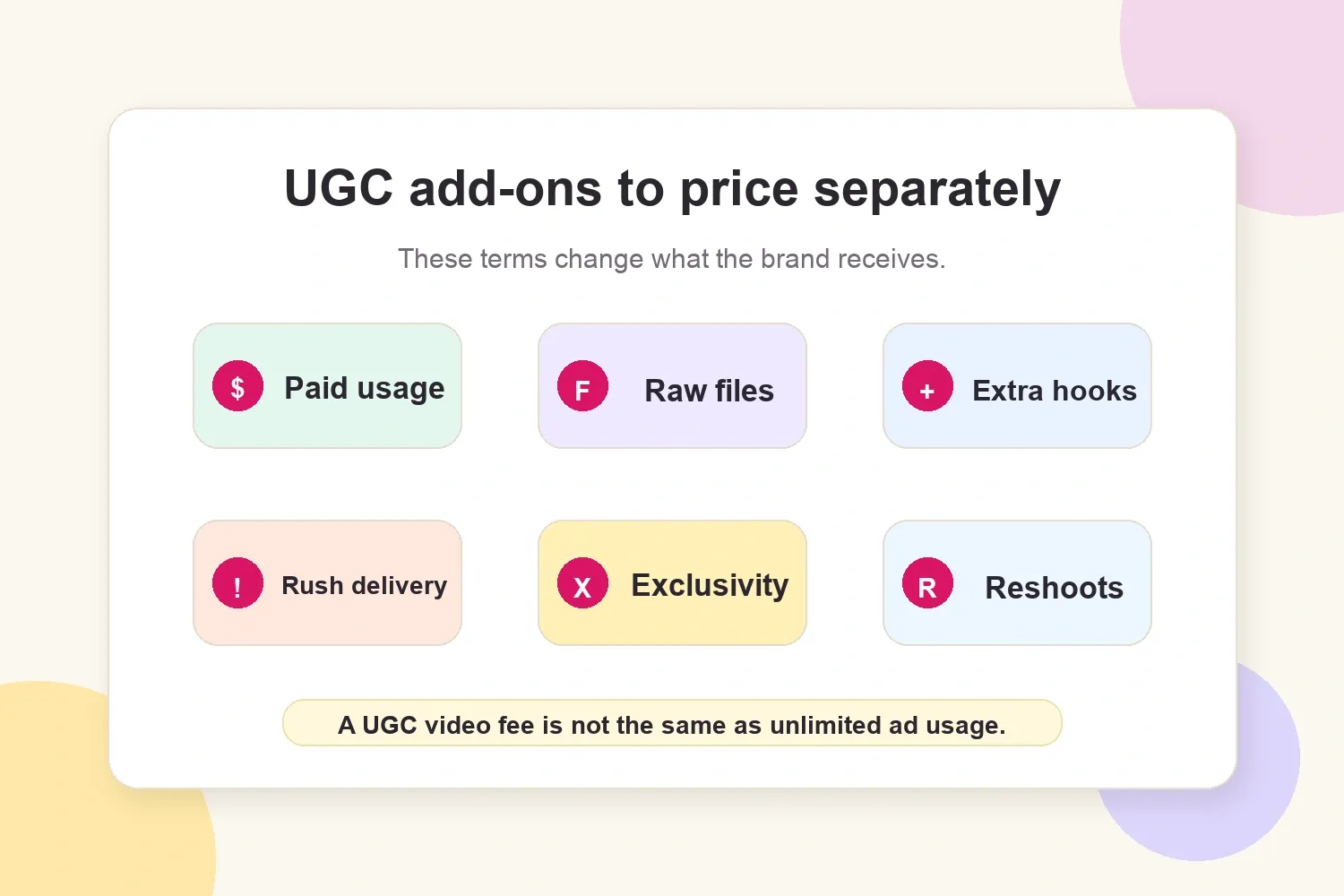
Add-ons are not small details. They change what the brand receives and how much work you do.
Common UGC add-ons include:
- Extra hooks or opening lines.
- Multiple final edits for A/B testing.
- Raw footage files.
- Scriptwriting beyond basic talking points.
- Rush delivery.
- Additional revision rounds.
- Paid usage rights.
- Exclusivity.
- Reshoots requested after the original brief changes.
For example, a $400 UGC video can become a $700-$1,000 project if the brand wants three hooks, raw files, 90 days of paid usage, and a 48-hour turnaround. That is not “being difficult.” It is matching the price to the scope.
Ask the right questions before quoting
Before sending a rate, ask enough questions to avoid guessing. A short discovery message can protect you from underpricing.
Useful questions:
- What product or service is the video about?
- How many final videos do you need?
- What length should each video be?
- Do you need hooks, scripts, captions, or raw footage?
- Will the content be used organically or in paid ads?
- How long do you need usage rights?
- What deadline are you working toward?
- How many revision rounds do you expect?
- Is there a budget range already approved?
If the brand cannot answer these questions, quote a narrow starter package first. Then explain that usage, extra edits, raw files, and rush delivery can be added once the scope is confirmed.
Package your UGC rates
Packages make pricing easier because they give brands options without forcing you to discount the same workload.
A simple UGC package menu could look like this:
- Starter: one 30-second UGC video, one hook, one revision, organic usage only.
- Growth: two UGC videos, two hook variations, one revision round, 30 days of paid usage.
- Testing: three hooks, two final edits, raw footage, 60-90 days of paid usage.
This structure helps the brand choose a budget level. It also keeps you from giving away paid usage, extra hooks, or raw files inside a basic fee.
If you already have an influencer media kit, add a small UGC services section with package examples, content samples, audience/niche context, and a note that usage rights are quoted separately.
How to reply when a brand asks for your UGC rate
The best response is specific without over-explaining. It should name the package, the fee, and the assumptions behind the fee.
Example:
“For one 30-second vertical UGC video with one hook, one final edit, and one revision round, my rate is $450. That includes 30 days of organic usage on your owned channels. Paid usage, raw files, extra hooks, or rush delivery can be added once the scope is confirmed.”
If the brand then asks for three hooks, raw files, and 90 days of paid ad usage, do not keep the same quote. Turn it into a revised package: “That moves the scope to $850: $450 for the base video, $150 for extra hooks and raw files, and $250 for 90 days of paid usage.”
That reply gives the brand a clear starting point. If the budget is lower, you can reduce the scope instead of discounting the same package.
For a deeper negotiation framework, the influencer rate negotiation guide explains how to separate the creative fee from usage rights, exclusivity, whitelisting, and payment terms.
Put the final UGC terms in writing
Do not start production from a vague DM. Before filming, confirm the exact terms in writing.
At minimum, include:
- Final deliverables and aspect ratio.
- Video length.
- Number of hooks and final edits.
- Number of revision rounds.
- Delivery deadline.
- Usage rights and duration.
- Paid ad permissions.
- Raw file access.
- Payment amount and payment deadline.
- Reshoot or cancellation terms.
UGC pricing gets easier when every quote has a reason. You are not charging for “a quick video.” You are charging for creative thinking, production, editing, licensing, and the commercial value the brand receives after delivery.