

An influencer brief, also called a creator brief or influencer campaign brief, is the document a brand or agency sends a creator before a paid collaboration. It explains what the campaign needs to achieve, exactly what the creator is delivering and when, which facts and messages must appear, how approvals work, how the partnership will be disclosed, where the content can be reused, and how payment works.
A good brief fits on one or two pages. It is specific about scope, dates, and rules, and deliberately open about the creative idea, because the creator knows how to talk to their audience better than anyone writing the brief.
This guide covers each section, gives you a free template to copy, and shows a filled-in example.
What an influencer brief is (and what it isn't)
The brief is the working document for one collaboration. Without it, the usual problems follow: the creator stresses the wrong feature, forgets the disclosure, misses the posting window, or delivers something the brand did not expect, and the fix costs a reshoot.
Two other documents are often confused with it:
| Document | What it does |
|---|---|
| Influencer brief | Explains the goal, deliverables, messages, rules, and process for one campaign |
| Influencer contract | Makes payment, usage rights, exclusivity, and liability legally binding |
| Creator script | Dictates what the creator says, line by line (usually a mistake for organic content) |
The brief and the contract should say the same thing about deliverables, dates, usage, and fees. Contracts often state that they take precedence over the brief if the two conflict, so keep the commercial terms in the brief short and identical to the signed agreement. The contract deserves its own read before anyone signs: this checklist of influencer contract clauses covers payment, usage rights, exclusivity, and kill fees.
Send the brief before the creator accepts the deal, not after. A creator can only price a collaboration properly once they can see the full scope, approval steps, and usage rights.
What to include in an influencer brief
Most briefs need the same ten sections. The order below follows the order in which a creator makes decisions: do they want this, can they deliver it, and how will it get approved and paid.
1. Campaign goal and the one KPI that matters
Write one sentence on what the campaign should achieve, then name the single metric you will judge it on. "Launch the new sunscreen" is context. "Drive first purchases of the new SPF stick from US shoppers aged 25 to 40, measured by code redemptions" is a goal.
One primary KPI changes how the creator builds the content. An awareness goal rewards a broad hook and a memorable moment. A sales goal rewards a clear demonstration, a reason to act right away, and a visible code or link. Asking one video to maximize reach, saves, clicks, and sales at the same time usually produces content that does none of them well.
Add the campaign window and any date that matters: a launch, a sale, a retail drop, or a holiday.
2. Brand and product facts
Give the creator what they need to talk about the product accurately, and nothing more:
- What the product is and who it is for
- The two or three benefits that matter for this campaign
- The questions or doubts customers raise most often
- Price, offer, and where to buy
- Approved claims, worded exactly as legal or compliance has approved them
- Claims the creator must not make, for example medical, before-and-after, or "best on the market" claims
Never assume the creator already knows the product. Ship it early enough that they can actually use it before filming, and put that date in the timeline.
3. Target audience
Describe the audience the campaign is trying to reach, then check it against the creator's actual audience. "Busy parents in the US who want faster weeknight dinners" is useful. "Women 18 to 65" is not.
If the creator was chosen for a specific audience segment, say so. It tells them which part of their audience to speak to.
4. Deliverables and specs
This is where vague briefs cause the most friction. List every asset, including the ones that are easy to forget:
| Field | Write it like this |
|---|---|
| Platform and format | One TikTok video and one Instagram Reel, vertical 9:16 |
| Video length | 30 to 60 seconds each |
| Extra assets | Three Instagram Story frames with the link sticker |
| Posting window | Live between May 12 and May 16, before 3 p.m. ET |
| Live period | Posts stay public for at least 6 months |
| Raw files | Raw footage and a version without text overlays, delivered by May 20 |
Raw footage, a version without music, or a cut for ads each cost the creator time and rights, so list them here and price them rather than assuming they are included.
5. Key messages and creative guardrails
Limit the brief to three key messages at most. More than that and the content starts to sound like a commercial. Write each message as an idea, not a line to read: "It goes on clear and doesn't leave a white cast on darker skin tones" rather than "Say: this is the invisible mineral sunscreen."
Then split the creative direction into three groups:
- Must include: product name, the offer, the code or link, required tags and hashtags, the disclosure, and any claim that has to be worded a specific way.
- Must avoid: competitor products in frame, unapproved claims, unsafe use of the product, topics the brand cannot be associated with, unlicensed music.
- Creator's choice: the hook, the format, the setting, the story, the wording, the edit, and music from the platform's commercial library.
Two or three reference posts help when each comes with a note on what to take from it: "the product appears in the first three seconds" or "this pace and tone." References without explanation tend to produce copies.
Add one line on tone if the brand has a clear voice, for example "friendly and practical, no medical language," and link to logos and visual guidelines instead of pasting them into the brief.
6. Timeline and approval process
Approval delays are a common reason content misses its live date. Write the whole sequence with dates and turnaround times:
- Brief sent, with a date for the creator to confirm and ask questions.
- Product delivered, with enough time to use it before filming.
- Concept approval: a short outline or hook idea, reviewed within two business days. Optional, but it prevents reshoots.
- Draft submitted, in the format you want (a private link or a file upload).
- Feedback from one person, consolidated, within two business days.
- Revisions: one or two rounds for factual, legal, or brief-compliance fixes. A new concept or product angle after approval is a new request, not a revision.
- Final approval and go-live. If the brand does not respond by the review deadline, say whether the draft counts as approved.
Name one person who approves the content. When feedback arrives from three stakeholders on three different days, the creator loses time and the brand loses the posting window.
7. FTC disclosure
In the US, creators must disclose any material connection with a brand they promote: payment, free or discounted products, an affiliate commission, or a family, personal, or employment relationship. The brief should say exactly how disclosure will be handled so neither side has to guess.
The FTC sums up the basics in its disclosure guide for social media influencers:
- The disclosure must be hard to miss: in the post itself, not only in a bio, behind a "more" link, or buried in a block of hashtags.
- Clear words work: "ad," "advertisement," or "sponsored." Vague terms like "sp," "spon," or "collab" on their own do not.
- In a video, the disclosure belongs in the video itself, ideally both said and shown on screen, not only in the description. In a live stream, it should be repeated periodically.
- A platform's built-in disclosure tool may not be enough on its own, so use it together with your own disclosure.
In the brief, name the platform tool to switch on and the wording you expect in the caption and in the video. On Instagram, that is the Paid partnership label:
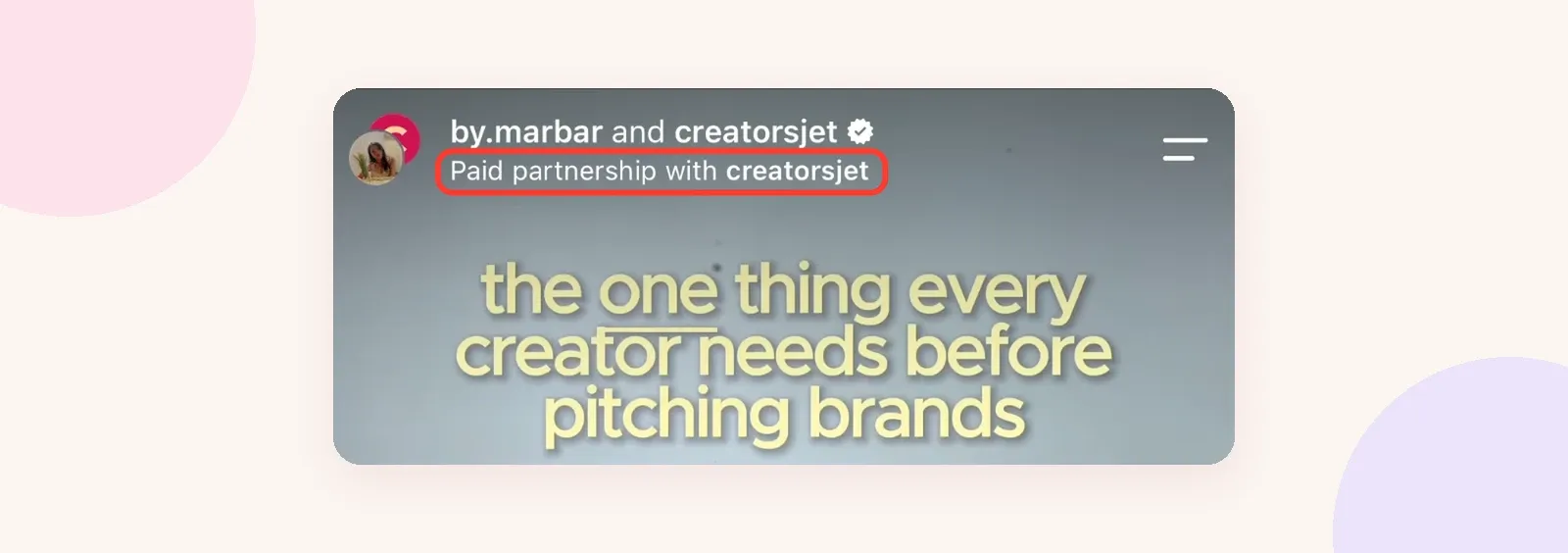
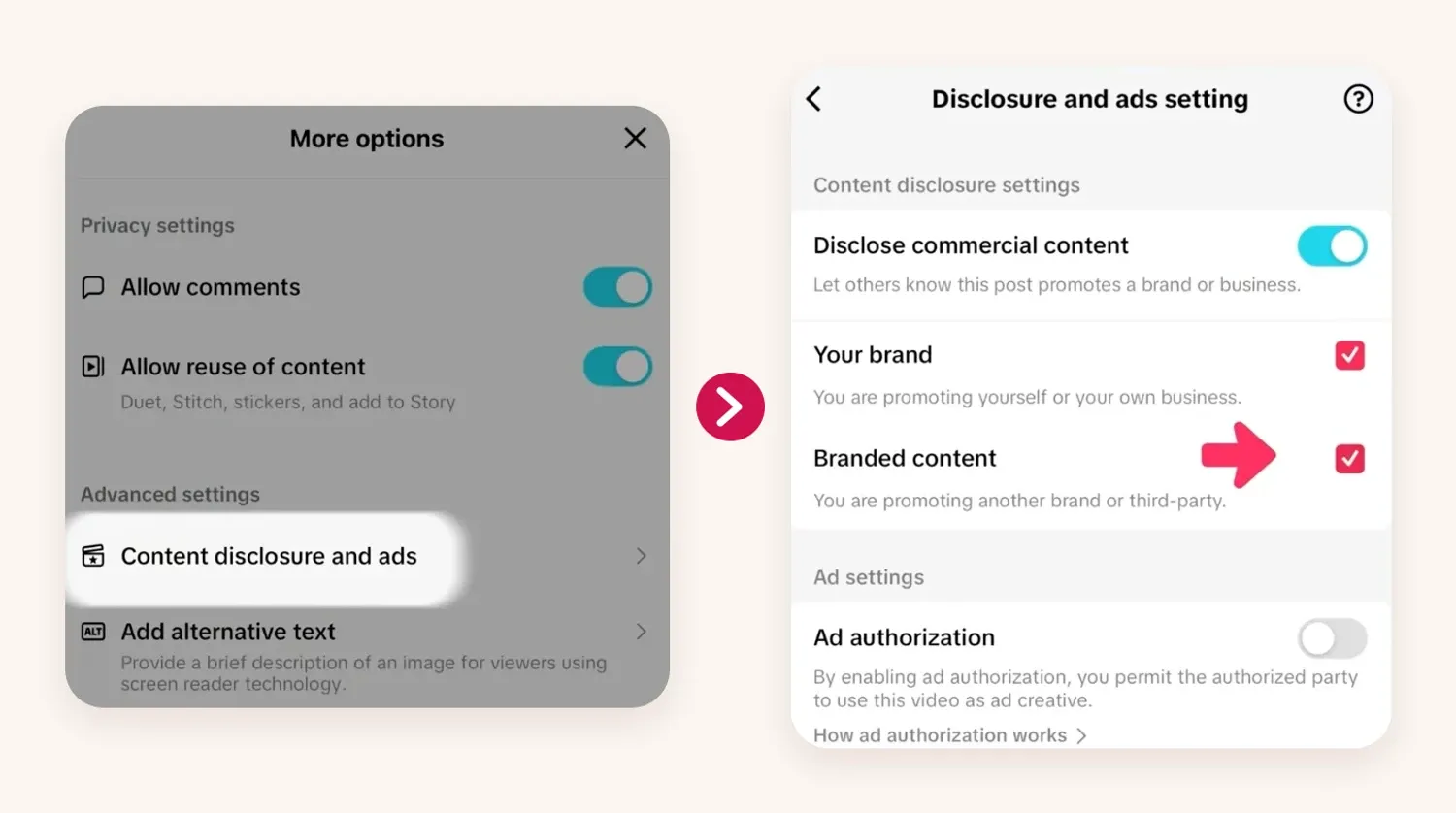
On TikTok, the creator turns on the content disclosure setting in the post's options and selects Branded content, which adds a Paid partnership label to the video:
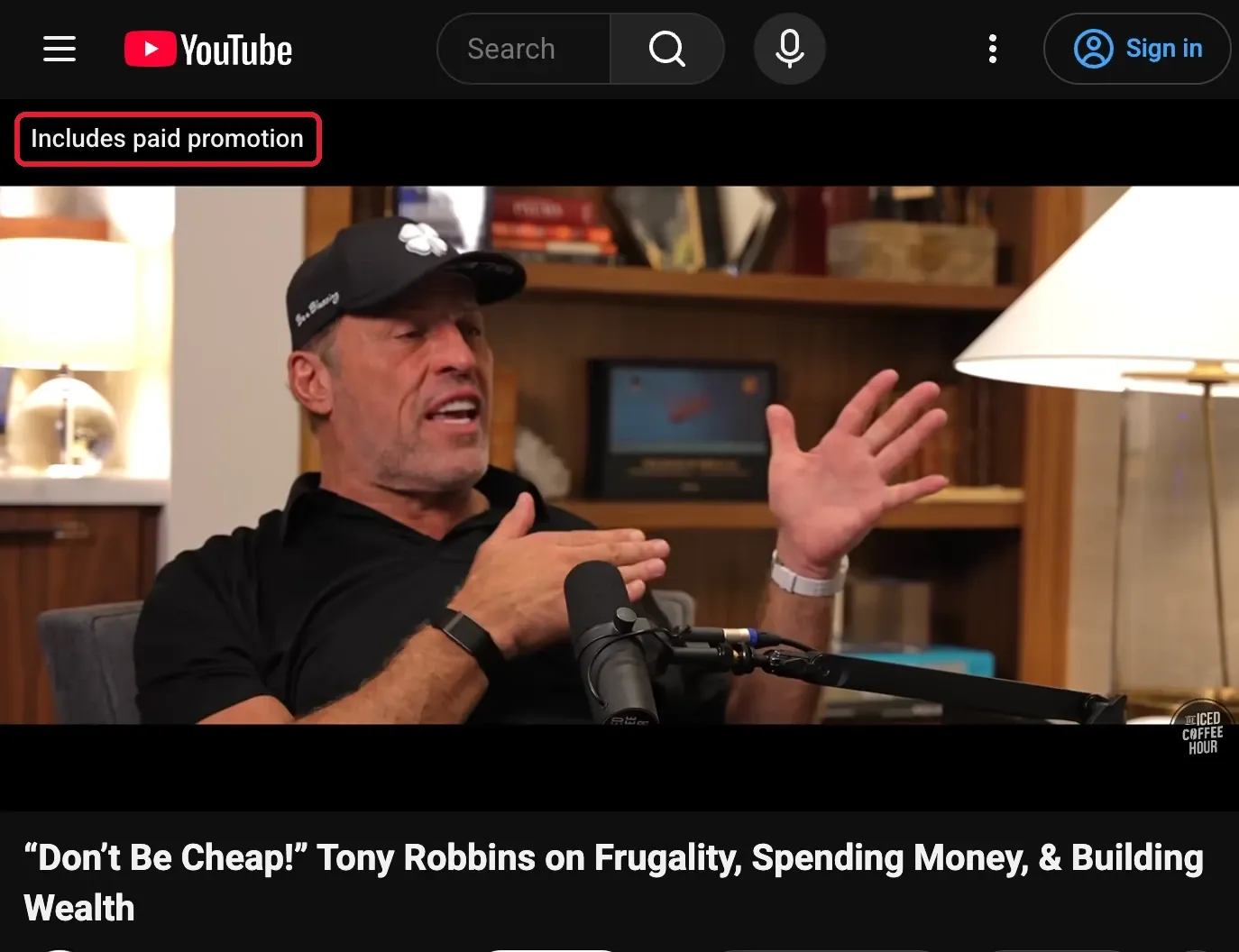
On YouTube, the creator turns on the paid promotion setting in YouTube Studio, under the video's details, and viewers then see a disclosure at the start of the video:
The label is a starting point, not a substitute for saying it in the content. Ask for both.
8. Usage rights, paid ads, and exclusivity
Posting on the creator's account and reusing the content elsewhere are separate permissions. State each one on its own line:
- Organic usage: whether the brand can repost the content on its own accounts or website, and for how long.
- Paid usage from the brand's account: whether the brand can run the content in its own ads, for how long, and in which countries.
- Partnership ads from the creator's handle: whether the brand can put ad spend behind the creator's post, and for how long.
- Exclusivity: which competitor category the creator cannot work with, and for how long before and after the campaign.
Partnership ads need the creator's permission on each platform. On TikTok, the creator turns on Ad authorization (visible in the screenshot above) and generates a Spark Ads code valid for 7, 30, 60, or 365 days, so the brief should say which duration you need. On Instagram, the creator generates a partnership ad code for the post and shares it with the brand. This guide to influencer whitelisting shows where to find that code in the app and what the brand can and cannot access once it has it.
Each of these rights adds value for the brand, so each should be agreed and priced. A fee for one organic post is not a fee for that post plus 90 days of paid ads and category exclusivity.
9. Payment and reporting
The commercial section should be short and match the contract exactly:
- The fee and currency, and whether it is flat, gifted, affiliate, or a mix
- When the creator can invoice (on signing, on approval, or after go-live) and the payment terms, for example net 30
- What happens if the brand cancels after work has started (a kill fee)
- Any performance bonus and how it is calculated
- What the creator reports, by when: for example, screenshots of views, reach, link clicks, and saves seven days after posting
A tracked link or unique code per creator makes results easier to compare than screenshots alone.
10. Contacts and assets
Close with the practical details:
- One day-to-day contact and one approval owner
- Product shipping details and a tracking number
- Links, codes, handles, and hashtags, ready to copy
- A shared folder with logos, product shots, and approved claims
How long should an influencer brief be?
One or two pages covers most single-creator campaigns. A gifting brief can fit in an email. A multi-platform campaign with several creators may need more, but the extra length should come from per-creator details, not from more background.
Long briefs hide the decisions that matter. Keep these out of the working document:
- The full brand deck. Link to it as optional reading if needed. The creator needs a few facts, not 40 slides.
- A word-for-word script. For organic content, a script removes the reason the audience trusts the creator. Give messages and guardrails instead.
- Internal targets and politics. The creator does not need quarterly goals or the history of the campaign.
- Locked PDFs. Send a document the creator can comment on and copy from.
A useful test: if a detail does not change the creator's idea, production, deadline, rights, or payment, it does not belong in the brief. If the creator keeps asking for clarification, the brief is too vague. If they push back on restrictions, it is too detailed.
Good vs. bad influencer brief
Most weak briefs are not wrong, just vague. Here is the same campaign briefed both ways:
| Brief section | Vague version | Clear version |
|---|---|---|
| Campaign goal | "Raise awareness of the new SPF stick" | "Drive first purchases before Memorial Day, measured by code redemptions" |
| Deliverables and dates | "A couple of posts on Instagram" | "One TikTok video, one Reel, and three Stories, live May 12 to 16, public for 6 months" |
| Key messages | Eight talking points and a script to read | Three messages written as ideas, wording left to the creator |
| Approval process | "Edits until we're happy with it" | "Feedback from one person within two business days, two revision rounds" |
| Disclosure rules | "Tag us and use the brand hashtag" | "Paid partnership label, #ad at the start, and said on screen" |
| Usage rights | "We may reuse the content" | "Reposts for 6 months, a 30-day Spark Ads code, US only" |
| Payment terms | "Paid after the campaign" | "$2,500 flat, invoiced after go-live, net 30, 50% kill fee" |
Every line in the clear version answers a question the creator would otherwise have to ask, or would discover too late.
Free influencer brief template
The quickest way to start is to make your own copy of the Google Docs version. It lays out each section as a table and includes the filled-in example from further down this page. Need a Word file or a PDF instead? In your copy, go to File > Download.
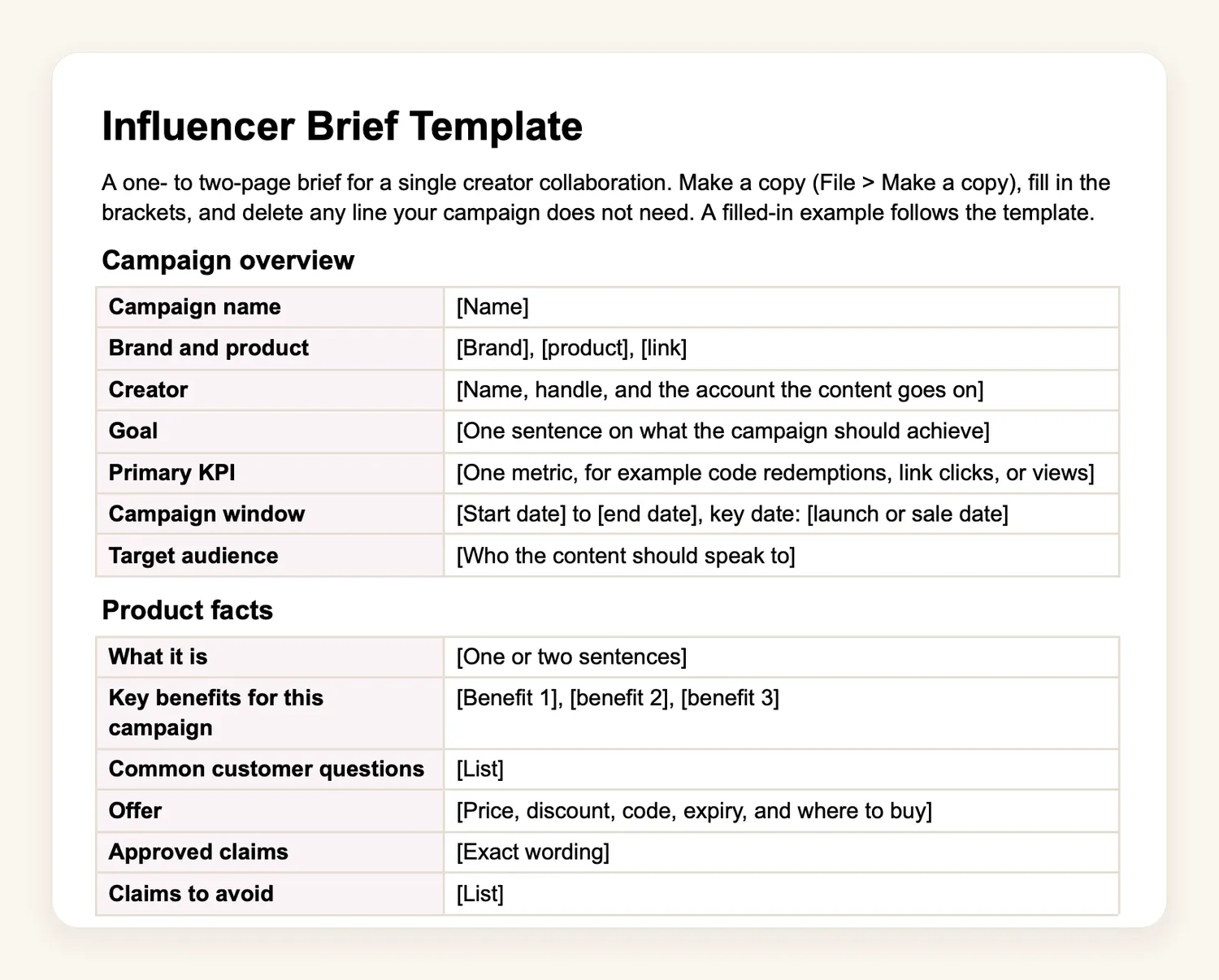
You can also copy the template below into Word, Notion, Canva, or an email and fill in the brackets. Delete any line that does not apply to your campaign.
Campaign overview
- Campaign name: [Name]
- Brand and product: [Brand], [product], [link]
- Creator: [Name, handle, and the account the content goes on]
- Goal: [One sentence on what the campaign should achieve]
- Primary KPI: [One metric, for example code redemptions, link clicks, or views]
- Campaign window: [Start date] to [end date], key date: [launch or sale date]
- Target audience: [Who the content should speak to]
Product facts
- What it is: [One or two sentences]
- Key benefits for this campaign: [Benefit 1], [benefit 2], [benefit 3]
- Common customer questions: [List]
- Offer: [Price, discount, code, expiry, and where to buy]
- Approved claims: [Exact wording]
- Claims to avoid: [List]
Deliverables
- Platform and format: [For example, one TikTok video and one Instagram Reel, 9:16]
- Video length: [Seconds]
- Extra assets: [Stories, link sticker, raw footage, ad cut, thumbnails]
- Posting window: [Dates and time zone]
- Live period: [How long posts stay public]
- Tags, handles, and hashtags: [List]
- Link or code: [Tracked link or code]
Key messages and guardrails
- Key messages (three maximum): [Message 1], [message 2], [message 3]
- Must include: [List]
- Must avoid: [List]
- Creator's choice: [What is fully up to the creator]
- Tone and brand guidelines: [One line on tone, plus a link to logos and visual guidelines]
- References: [Two or three links, each with what to take from it]
Timeline and approvals
- Brief confirmed by: [Date]
- Product delivered by: [Date]
- Concept due: [Date], feedback within [X] business days
- Draft due: [Date], submitted as [format]
- Feedback: consolidated, from [name], within [X] business days
- Revision rounds included: [Number], for [factual, legal, or brief-compliance fixes]
- If feedback is late: [What happens, for example the draft counts as approved]
- Go-live: [Date and time]
Disclosure
- Platform tool: [Instagram paid partnership label, TikTok Branded content disclosure, or YouTube paid promotion setting]
- In the caption: [For example, #ad at the start]
- In the video: [Spoken and on-screen disclosure, for example "This is an ad for [brand]"]
Usage rights and exclusivity
- Organic usage by the brand: [Channels and duration]
- Paid usage from the brand's account: [Channels, duration, and countries, or none]
- Partnership ads from the creator's handle: [Spark Ads, Instagram partnership ads, or none], [duration]
- Exclusivity: [Competitor category], [period before and after]
Payment and reporting
- Fee: [Amount, currency, and type: flat, gifted, affiliate, or hybrid]
- Invoicing: [When the creator can invoice], payment terms [net X]
- Kill fee: [Amount or percentage if the brand cancels after a given step]
- Bonus: [If any, and how it is calculated]
- Reporting: [Metrics and screenshots], due [X] days after posting
Contacts and assets
- Day-to-day contact: [Name, email]
- Approval owner: [Name, email]
- Shipping: [Carrier and tracking number]
- Asset folder: [Link]
Influencer brief example
Here is the same template filled in for a fictional US sunscreen brand, Coastline Skin, briefing a lifestyle creator. The figures are illustrative, not rate benchmarks.
Campaign overview
- Campaign name: Coastline SPF Stick launch
- Creator: Alex, a lifestyle creator posting on TikTok and Instagram
- Goal: Drive first purchases of the new SPF 50 stick from US shoppers before Memorial Day
- Primary KPI: Redemptions of the creator's code
- Campaign window: May 12 to May 31, launch day May 12
- Target audience: Active adults 25 to 40 who skip sunscreen because it feels greasy or leaves a white cast
Product facts
- What it is: A mineral SPF 50 stick that applies clear and fits in a pocket
- Key benefits: No white cast, not greasy, easy to reapply over makeup
- Common customer questions: Does it work on darker skin tones? Does it pill under makeup?
- Offer: 20% off with code ALEX20 until May 31, sold on coastlineskin.com
- Approved claims: "Broad spectrum SPF 50," "water resistant for 80 minutes"
- Claims to avoid: "Reef safe," "all day protection," any comparison with a named brand
Deliverables
- One TikTok video and one Instagram Reel, 9:16, 30 to 60 seconds each
- Three Instagram Story frames with the link sticker, posted the same day as the Reel
- Live between May 12 and May 16, posts stay public for at least 6 months
- Tag @coastlineskin, use #CoastlineSPF, link: coastlineskin.com/alex
Key messages and guardrails
- Key messages: It goes on clear with no white cast. It is easy to reapply over makeup. It fits in a pocket or gym bag.
- Must include: The stick being applied on skin, the code ALEX20, the disclosure
- Must avoid: Other sunscreen brands in frame, applying it to children, the claims listed above
- Creator's choice: Hook, setting, story, edit, and music from the commercial library
- Tone and brand guidelines: Upbeat and practical, no medical language; logos and product shots in the shared folder
Timeline and approvals
- Product delivered by April 25
- Concept (hook and outline) due April 30, feedback within two business days
- Draft due May 6 as a private link, consolidated feedback from Jamie by May 8
- Two revision rounds for factual or compliance fixes, each reviewed within two business days
- Go-live between May 12 and May 16
Disclosure
- Paid partnership label on Instagram, Branded content turned on for TikTok
- "#ad" at the start of each caption, plus "This is an ad for Coastline" said or shown on screen in the first seconds
Usage rights and exclusivity
- Coastline may repost both videos on its own accounts for 6 months
- Partnership ads: 30-day Spark Ads code on TikTok and an Instagram partnership ad code, US only, starting on the go-live date. Extensions are priced separately.
- No paid usage from Coastline's own ad account
- Exclusivity: no other sunscreen or SPF skincare partnerships from May 1 to June 15
Payment and reporting
- $2,500 flat fee, invoiced after both videos go live, paid net 30
- 50% kill fee if Coastline cancels after concept approval
- Screenshots of views, reach, link clicks, and saves for each post, seven days after posting
Contacts
- Day-to-day and approvals: Jamie, Coastline Skin partnerships
Notice what the example leaves out: a script, the brand's history, and lines to read word for word.
How to adapt the brief
UGC brief
A UGC creator makes content for the brand to post or run as ads, usually without posting on their own account. That changes the brief:
- Drop the posting window, live period, tags, and caption disclosure, since nothing goes live on the creator's account.
- Add detailed production specs: number of videos, length, hooks to test (for example, three different openings for the same video), raw footage, versions with and without captions or music, and the file format.
- Be more precise on usage, because the brand will run the content itself. State the channels, the duration, whether the brand can edit the content, and whether the creator's face and name can appear in ads.
A UGC brief can be more directive than an influencer brief, since the brand often has a specific ad format in mind. It still works best when the creator chooses the wording.
Gifting and affiliate brief
When the creator is not paid a fee, the brief should be shorter. Send the product facts, the code or affiliate link, the commission terms, and the disclosure requirement. Do not attach deliverables, deadlines, or approval steps to a gift: posting is the creator's choice, and turning it into an obligation makes it a paid deal without the fee.
Disclosure still applies. A free product is a material connection under FTC guidance, so a creator who posts about it should disclose it.
Briefing several creators for one campaign
Keep one master brief with the goal, product facts, key messages, guardrails, and disclosure rules. Then add a short section per creator with their deliverables, dates, code or tracked link, usage, and fee. The messaging stays consistent while each creator's commercial terms stay private.
How creators and talent managers should review a brief before saying yes
A brief is also where a creator, or the manager negotiating for them, spots problems before they become disputes. Check these points before accepting:
- The full scope against the fee. Count every post, Story, raw file, and ad cut, and check that paid usage, partnership ads, and exclusivity are priced, not bundled in.
- Approval rules. Check the number of revision rounds, the review deadline, and what happens if feedback is late and the posting window moves.
- Claims. Confirm you can say the approved claims honestly, and push back on anything you have not experienced.
- Payment terms. Know when you can invoice, the payment delay, and whether a kill fee applies.
Ask questions in writing before accepting. Clarifying scope at the start is normal. Renegotiating it after filming is much harder.
Keep the brief as the campaign's source of truth
Once the collaboration starts, the brief, feedback, files, codes, and results tend to scatter across DMs and email threads. For a single collaboration, one shared document and one email thread can be enough.
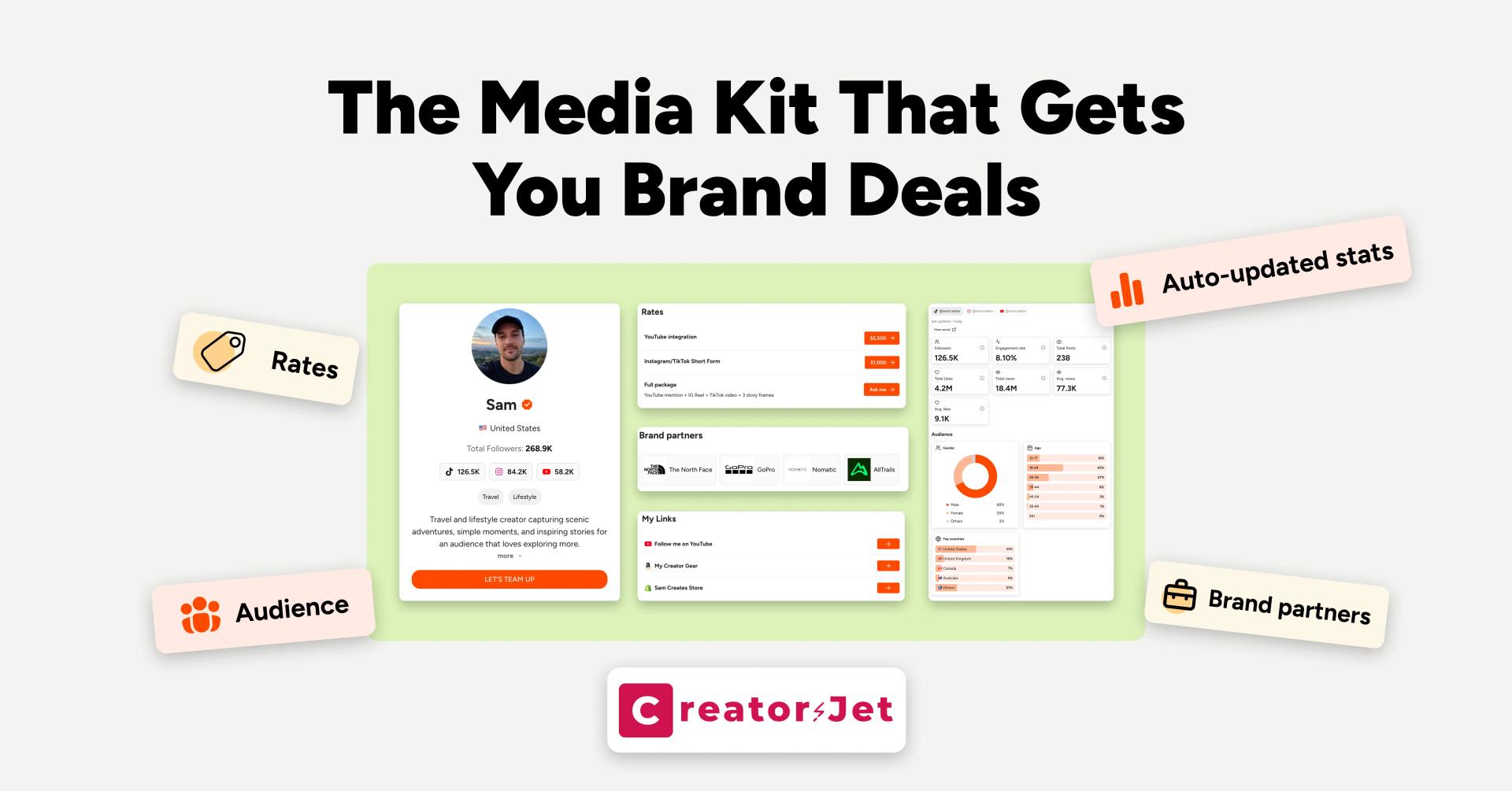
Agencies and talent managers often juggle briefs for several creators at once, and each one leads to a shortlist, a pitch, tracked links, and a results report. An influencer CRM like CreatorsJet keeps that work in one place: talent pitch decks built from a brand brief, links that track clicks by creator and campaign, and campaign reports that update automatically. If you are comparing tools, this roundup of the best influencer CRM tools for agencies covers the main options.
Whatever the tool, the principle is the same: when a question comes up mid-campaign, both sides should find the agreed answer in the brief.
Final takeaway
An effective influencer brief is short, specific about the rules, and open about the idea. State one goal and one KPI, list every deliverable and date, limit the key messages to three, write down the approval process and disclosure, and price usage rights and exclusivity separately. Then let the creator decide how to tell the story. Start from the template above and cut anything your campaign does not need.