
Most creators want one clean number for YouTube sponsorship rates. The honest answer is that brands usually do not pay from subscriber count alone. They pay from expected views, audience fit, niche value, content format, and how much they can reuse the video after it goes live.
For a normal sponsored integration, many creators start by pricing around a CPM, which means cost per 1,000 expected views. A creator who usually gets 50,000 views might price a YouTube sponsorship very differently from another creator with the same subscriber count but only 8,000 average views.
That is why the better question is not just “how much do brands pay YouTubers?” It is “how valuable is this specific video placement to this specific brand?”
The short answer: YouTube sponsorships are usually priced from average views
A simple starting point is:
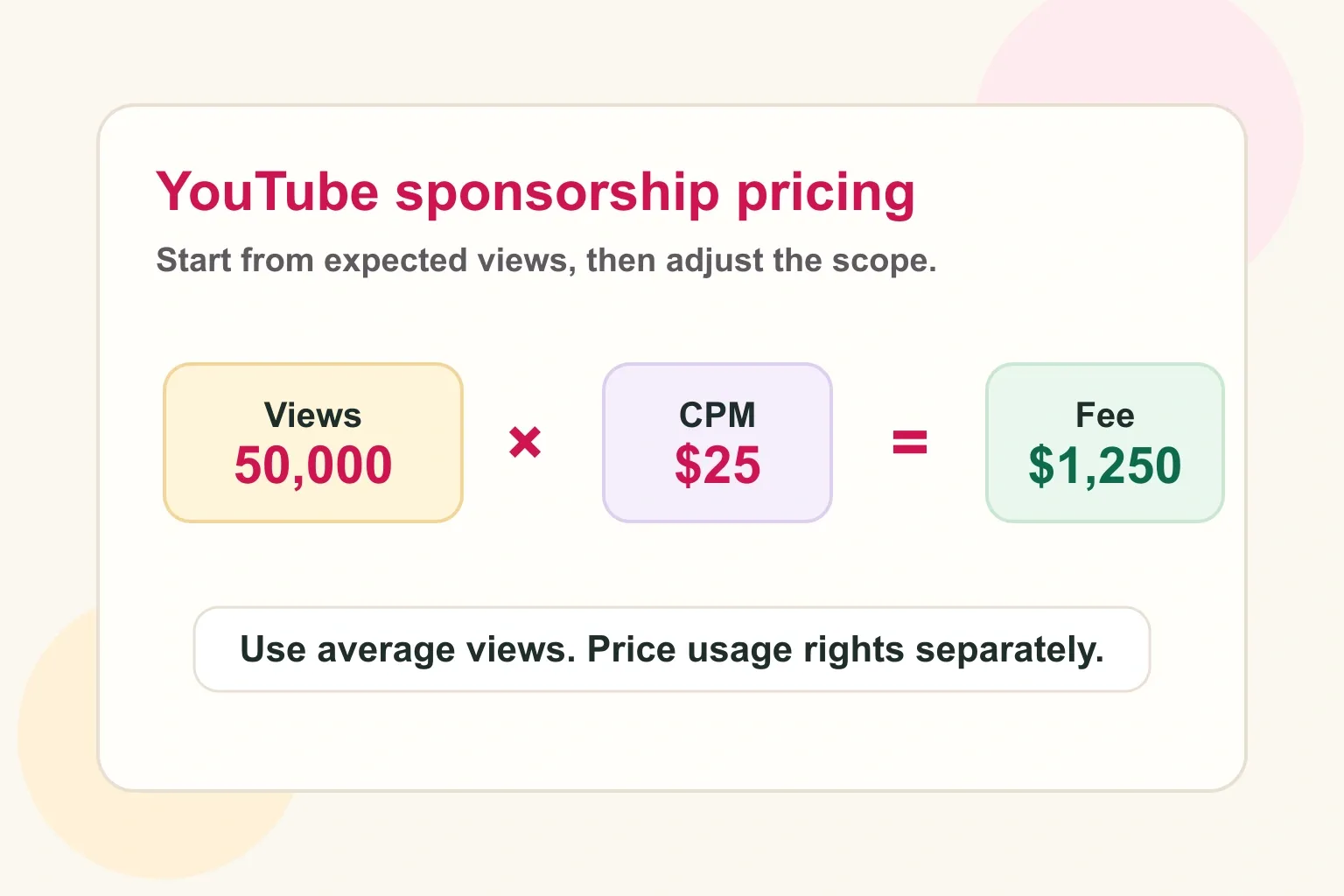
Average views × CPM ÷ 1,000 = estimated sponsorship fee.
So if a channel normally gets 50,000 views and the creator uses a $25 CPM, the starting price would be around $1,250 for one sponsored integration.
That number is not the final rate. It is the anchor. From there, the creator can adjust based on the niche, the placement, the amount of work, the brand’s usage rights, exclusivity, and whether the sponsor wants extra deliverables.
This is also why two creators with similar subscriber counts can charge completely different prices. A finance channel with 40,000 average views can sometimes charge more than a lifestyle channel with 120,000 average views because the advertiser value is different.
YouTube sponsorship rate benchmarks by channel size
Benchmarks are useful, but they should be treated as ranges, not fixed rules. A channel with loyal viewers, high watch time, and clear buyer intent can sit above the average. A channel with inconsistent views or a broad audience may sit below it.
| Channel size | Typical sponsored integration range | What usually matters most |
|---|---|---|
| Under 10,000 subscribers | $100-$500 | Niche fit, proof, and production quality |
| 10,000-50,000 subscribers | $500-$2,500 | Average views and audience trust |
| 50,000-250,000 subscribers | $2,500-$10,000 | Repeatable view performance and brand fit |
| 250,000-1M subscribers | $10,000-$40,000+ | Reach, niche, and campaign usage rights |
| 1M+ subscribers | $40,000+ | Scale, exclusivity, and full campaign value |
These ranges are broad because YouTube sponsorship pricing changes a lot by niche. According to Influencer Marketing Hub’s YouTube influencer rate benchmarks, creator size still matters, but campaign scope can move the price up or down quickly.
Another useful way to think about rates is CPM. Many YouTube sponsorships land somewhere between $15 and $50 CPM, while high-value niches can go above that. SponsorRadar’s sponsorship rate analysis shows how niche, format, and audience value can push rates higher than a simple average.
Why subscriber count is not the real pricing metric
Subscriber count is visible, so it gets used too often. Brands look at it because it is easy to understand. But it is not the best predictor of what a sponsorship is worth.
Average views are closer to the truth. If a channel has 200,000 subscribers but recent videos usually get 12,000 views, the sponsor is buying something closer to 12,000 expected impressions, not 200,000 subscribers.
Engagement matters too. Comments, saves, shares, click behavior, and audience sentiment all help a brand understand whether people actually listen to the creator. A smaller channel with useful comments and a clear niche can be more attractive than a bigger channel with passive viewers.
This is why creators should track recent video performance before sending a rate. A simple 30-to-90-day average view count is usually more useful than the lifetime subscriber number.
This video is a useful companion because it walks through the same practical pricing problem: how to think about sponsorship value without treating subscriber count as the whole answer.
For creators comparing pricing across platforms, this companion guide on influencer rates by platform and follower count can help put YouTube rates in context.
What changes a YouTube sponsorship rate
The base formula gives a starting point, but the real rate depends on what the brand is asking for.
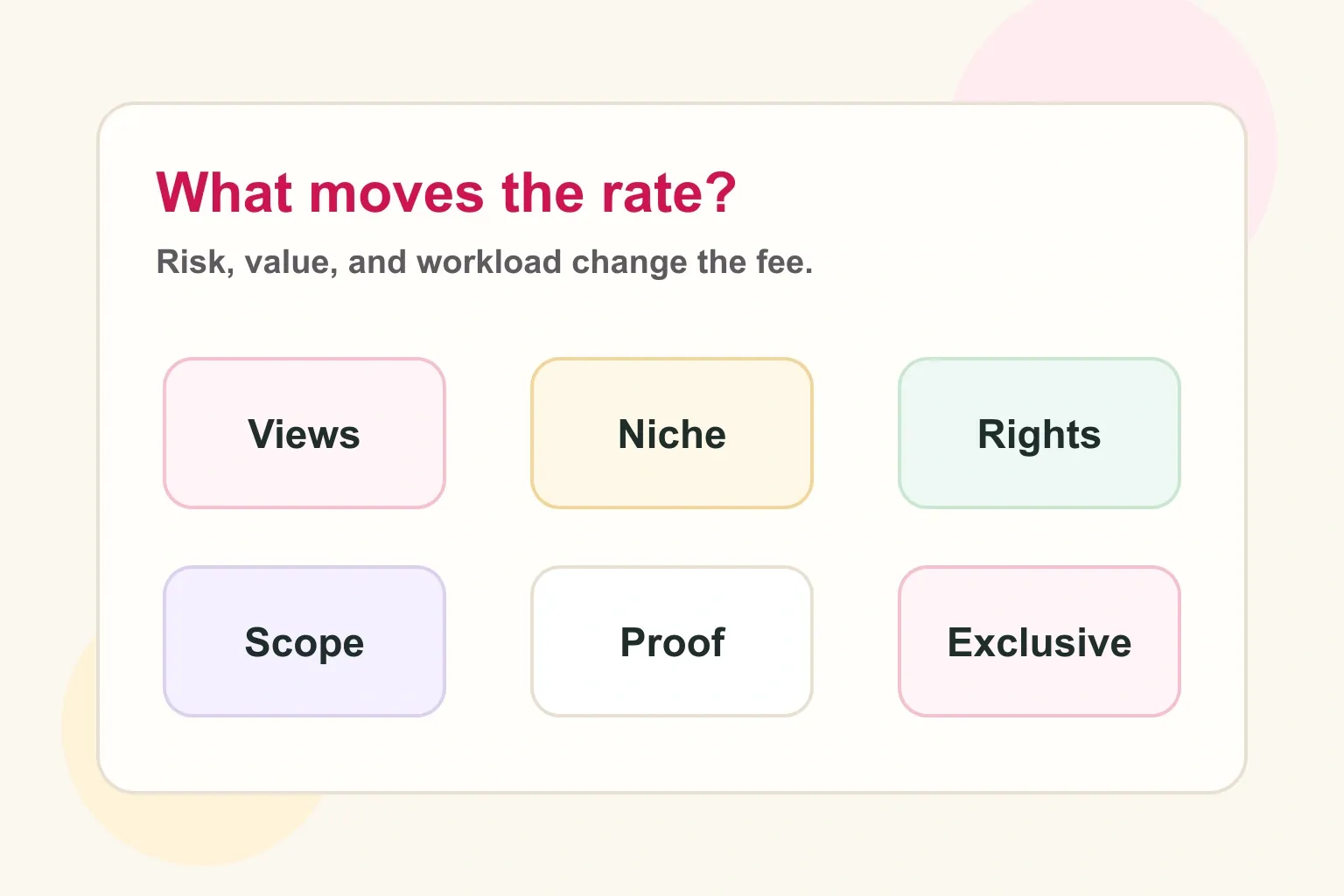
The biggest pricing factors are usually the following.
Average views: Recent average views are the cleanest pricing signal. A creator should not price from the best video ever unless the sponsor is buying placement inside that specific video.
Niche value: Some niches are more valuable because each customer is worth more to the brand. Finance, software, business, education, and B2B channels often command higher CPMs than broad entertainment content.
Placement: A 60-second mid-roll integration is not the same as a dedicated review video. A short mention, pinned comment, link in description, YouTube Short, and full tutorial all carry different value.
Audience fit: A brand wants to reach people who could actually buy. A smaller audience with the right problem can beat a larger audience that is only casually interested.
Usage rights: If the brand wants to reuse the video clip in ads, on landing pages, or across social channels, that should increase the price. The creator is no longer selling only organic reach. The creator is licensing content.
Exclusivity: If a sponsor asks the creator not to work with competitors for 30, 60, or 90 days, that blocks future income. Exclusivity should be priced separately.
Production work: Scripts, edits, product demos, revisions, analytics screenshots, usage cuts, thumbnails, and extra review rounds all add work. More work should mean a higher fee.
How to calculate a fair YouTube sponsorship rate
Start with the creator’s average views from the last 5 to 10 relevant videos. Remove unusual outliers if one video performed far above or below the channel’s normal level.
Then choose a realistic CPM range. For many channels, $15-$30 CPM can be a practical starting point. For higher-value niches or very specific audiences, $30-$60 CPM may be more realistic. Some premium deals go higher, especially when the sponsor is buying a dedicated video, paid usage rights, or access to a niche audience with clear purchase intent.
Here is a simple example.
A creator averages 40,000 views per video. The channel is about productivity software, so the niche has decent advertiser value. The sponsor wants one 60-second integration, a link in the description, and basic performance reporting.
At a $25 CPM, the starting fee would be:
40,000 × $25 ÷ 1,000 = $1,000.
If the brand also wants to use the clip in paid ads for 60 days, the creator could add a usage fee. If the brand wants exclusivity against other productivity apps for 90 days, the creator could add another fee. The final quote might become $1,500-$2,500 instead of $1,000.
A YouTube pricing calculator can help turn average views, engagement, and campaign scope into a more defensible starting point.
What brands usually pay extra for
A brand deal is not only a video slot. It can include several pieces of value.
Creators can usually charge more when the sponsorship includes:
- A dedicated product review or tutorial
- A longer integration inside a high-intent video
- A pinned comment and top description link
- Extra Shorts or cutdowns from the main video
- Paid ad usage rights
- Whitelisting or creator licensing
- Competitor exclusivity
- Fast turnaround
- Multiple revision rounds
- Detailed campaign reporting
The cleanest way to handle this is to separate the base sponsorship fee from add-ons. That keeps the conversation easier. Instead of defending one large number, the creator can show what each part of the campaign costs.
What smaller YouTubers can realistically charge
Smaller YouTubers often undercharge because they assume brands only care about big audiences. That is not always true.
A creator with 8,000 subscribers and 3,000 average views can still have value if the audience is specific. A channel about camera gear, skincare for sensitive skin, Notion templates, student productivity, or freelance finance can attract brands even before the channel is large.
For smaller creators, the best sponsorship pitch is not “this channel has a lot of subscribers.” It is “this channel reaches exactly the kind of person the brand wants.”
A small creator can usually improve the rate by showing:
- Recent average views
- Audience location and demographics
- Engagement rate
- Comment quality
- Past brand examples
- Clicks or conversions from previous campaigns
- Content examples that match the sponsor’s product
A professional media kit helps here because it makes the creator easier to evaluate. If the rate discussion feels difficult, this guide on how to respond when a brand asks for your rates explains how to answer without underpricing.
How to negotiate YouTube sponsorships without sounding random
The easiest way to negotiate is to explain the rate in pieces.
Instead of sending only one number, creators can show the logic behind the quote:
- Average views: 45,000
- Sponsored integration CPM: $30
- Base integration fee: $1,350
- Usage rights for 60 days: +$500
- Category exclusivity for 30 days: +$300
- Total: $2,150
This makes the price feel less random. It also gives the brand room to adjust scope. If the budget is lower, the creator can remove usage rights, shorten exclusivity, or reduce extra deliverables without discounting the main video placement.
That is usually better than cutting the price with no change in scope. Discounts teach brands that the first rate was not real. Scope changes keep the pricing structure clear.
Common pricing mistakes creators should avoid
The first mistake is pricing from subscriber count alone. Subscribers matter, but average views and audience quality matter more.
The second mistake is giving paid usage rights away for free. If a brand can turn the creator’s video into ads, that has value beyond the organic YouTube upload.
The third mistake is accepting exclusivity without a separate fee. Even a small exclusivity window can block other deals in the same category.
The fourth mistake is copying another creator’s rate without knowing the views, niche, deliverables, and usage terms behind it. A rate without context is just a number.
The fifth mistake is being vague. A sponsor should know exactly what is included: placement length, video type, link placement, approval rounds, usage rights, exclusivity, timeline, and reporting.
Final thoughts
YouTube sponsorship rates are not fixed because every channel, audience, and campaign is different. Still, creators can make pricing much easier by starting with average views, choosing a realistic CPM range, and then adding fees for scope, usage rights, exclusivity, and extra work.
For most creators, the goal is not to find one perfect rate forever. The goal is to build a pricing system that can be explained clearly, adjusted when the campaign scope changes, and improved as the channel gets better results.
That is what brands usually respect most: a creator who understands the value of the placement and can explain the price without guessing.