

If a brand asks how much you charge for an Instagram Story, the worst answer is usually a random number copied from a rate card template. Stories are small on the surface, but brands use them for very specific jobs: getting link clicks, launching a product, reminding warm audiences, driving urgency, collecting replies, or adding trust around a larger campaign.
That is why Story pricing can look confusing. One creator might charge $75 for a short Story mention. Another might charge $2,000 for a three-frame Story set with a link, strong completion rate, and category authority. Both can be reasonable if the expected value is different.
The real question is not “what do creators charge for Stories?” It is “what is this Story package likely to do for the brand?”
What brands usually pay for Instagram Stories
Public influencer pricing benchmarks are not perfect, but they are useful as a sanity check. Many rate guides put Instagram Story pricing somewhere from small two-digit fees for nano creators to thousands of dollars for larger creators, especially when Stories are bundled with Reels, feed posts, paid usage, or exclusivity.
Instagram itself makes Story performance measurable through insights such as reach, replies, exits, and link activity, which is why Instagram Insights should be part of any serious quote. For market context, Influencer Marketing Hub explains Instagram influencer rates through audience size, platform, niche, and campaign value instead of treating follower count as the only pricing input.
A practical starting point for Instagram Story pricing often looks like this:
- Nano creators may charge around $10-$100 for a simple Story.
- Micro creators often land around $100-$500, especially for a multi-frame Story package.
- Mid-tier creators can move into the $500-$2,000 range when they have reliable Story views or clicks.
- Macro creators and celebrities can charge $2,000+ when the Story is part of a bigger campaign, includes usage rights, or reaches a high-value audience.
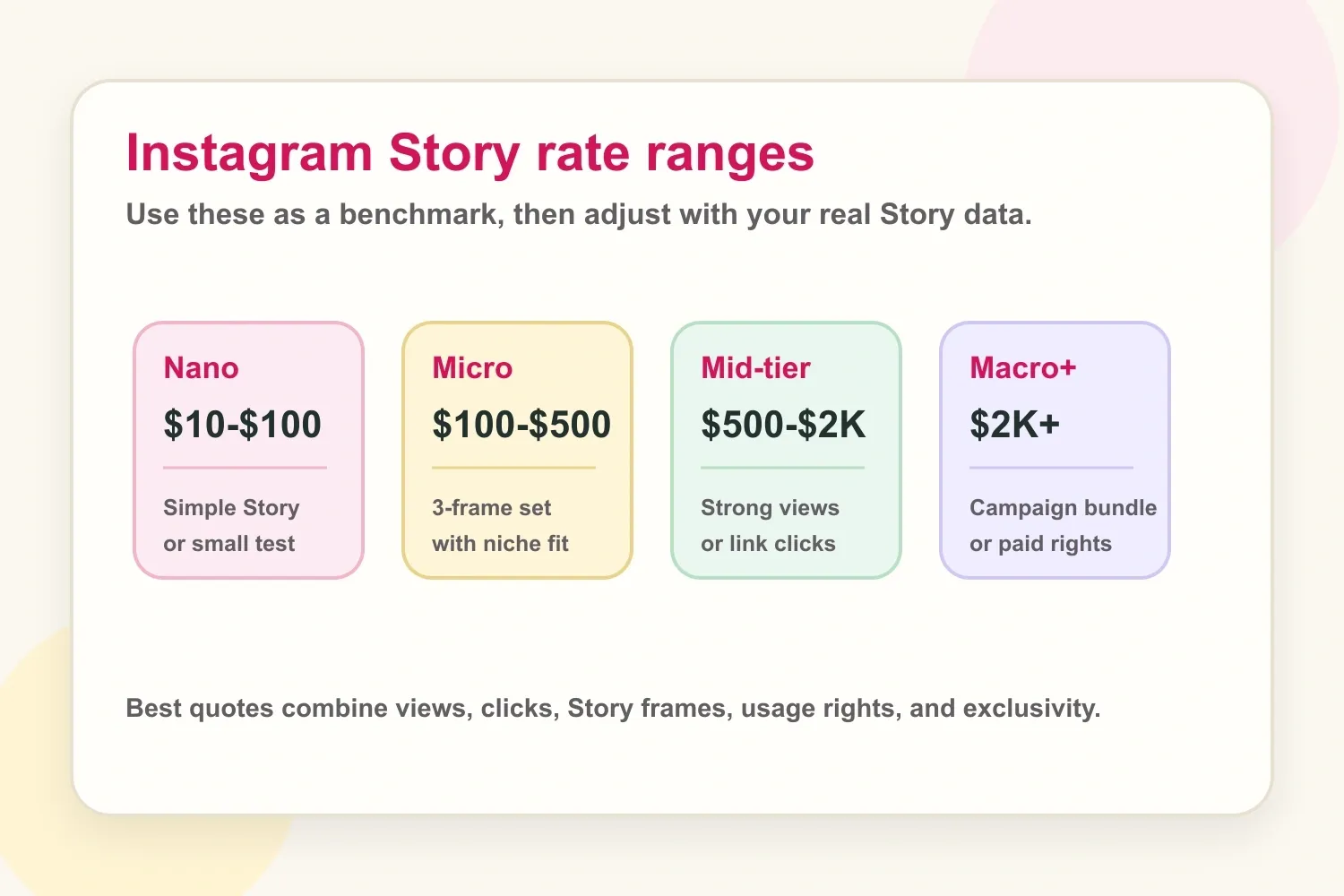
Those numbers are not rules. They are a starting range. A creator in personal finance, SaaS, beauty, travel, fitness, parenting, or luxury can price differently because the audience value is different. A Story that drives 400 qualified clicks to a product page is not the same as a Story that gets 400 passive taps with no action.
Why follower count is not the price
Follower count gives context, but it does not tell the brand what the Story is worth.
Stories are usually priced from the attention that actually shows up. A creator with 15,000 followers and 4,000 average Story views may be more valuable than a creator with 80,000 followers and 2,000 average Story views. The smaller creator has a tighter audience, better Story consumption, and possibly more trust.
Brands usually care about:
- Average Story views across the last 30 days
- Completion rate across a multi-frame Story set
- Link clicks or sticker taps
- Replies and DMs
- Audience country, age, and niche fit
- Past campaign results
- Whether the creator can explain the product clearly
If you want a simple way to sanity-check a starting number, an Instagram pricing calculator can help you compare follower count, engagement, and format. Then you still need to adjust the final quote with your real Story insights.
The pricing formula that makes Stories easier to quote
A cleaner way to price Stories is to start with expected views and then adjust for the parts of the deal that create extra value.
The basic formula is:
Expected Story views ÷ 1,000 × CPM = starting fee
For example, if a creator averages 50,000 Story views and uses a $25 CPM, the starting fee is $1,250. From there, the rate can move up or down depending on niche, link performance, deliverables, rights, exclusivity, and how much creative work the brand needs.
This is also why Story pricing should usually be a range, not a single fixed number. A one-frame mention is different from a three-frame explanation with a link, product demo, reply prompt, and 30 days of paid usage.
What changes an Instagram Story rate
A Story rate usually changes when the brand asks for more than a quick mention.
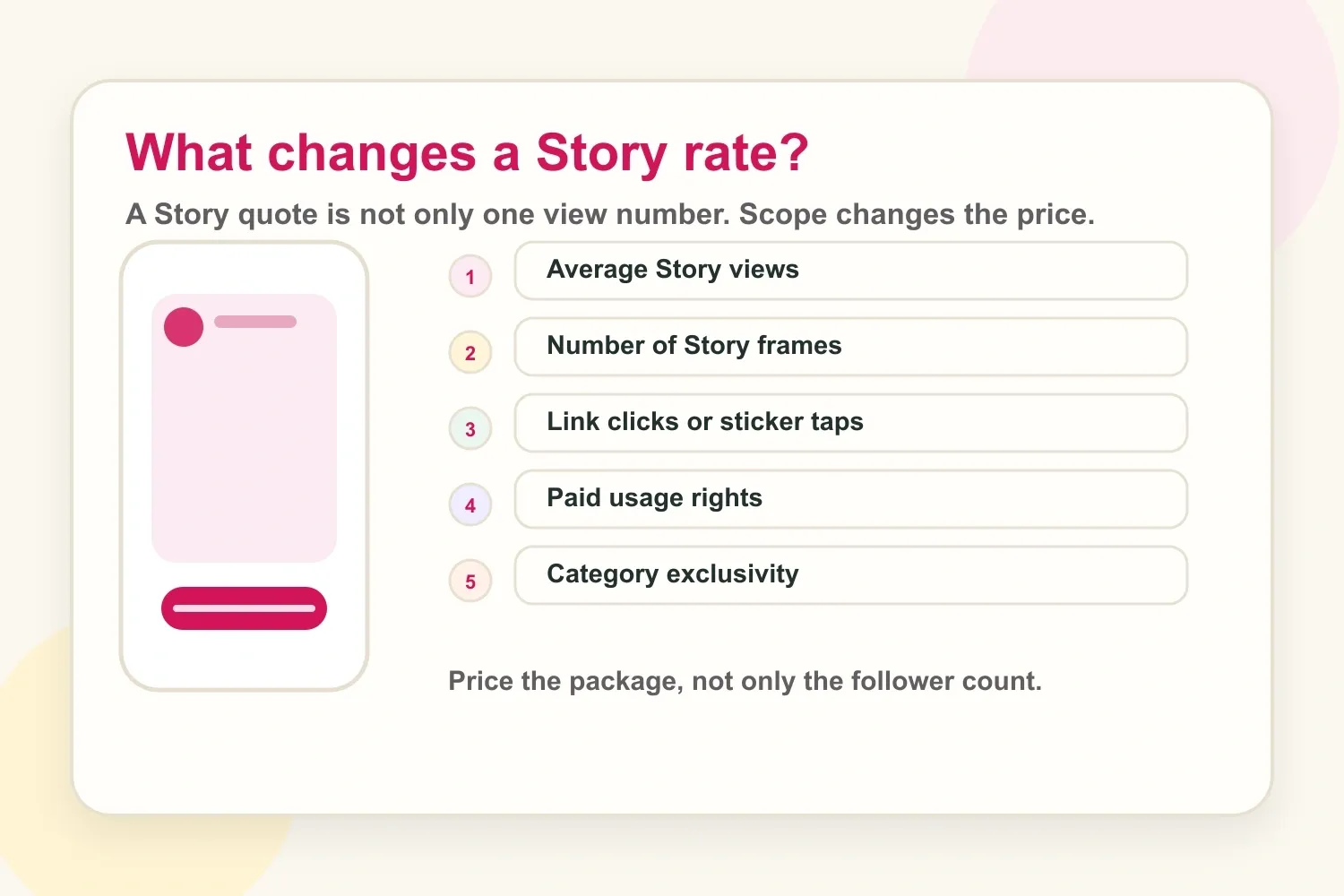
The biggest pricing factors are:
- Number of frames: One Story frame is cheaper than a three-frame sequence with a hook, explanation, and link.
- Average Story views: Use recent average views, not your best day ever.
- Link clicks: If your Stories drive clicks, you have stronger pricing power.
- Niche: Finance, B2B, software, beauty, wellness, parenting, and travel can all price differently.
- Usage rights: If the brand wants to reuse your Story in ads, email, landing pages, or organic social, charge more.
- Exclusivity: If you cannot work with competing brands for a period of time, that has a cost.
- Turnaround time: Rush work should not be priced like a relaxed campaign.
- Production effort: A casual talking Story is not the same as a scripted demo, product setup, or multi-take concept.
This is why two creators with the same follower count can have very different Story rates. The deliverable may look similar in the brand brief, but the value behind it is not the same.
How to price a three-frame Story package
Most sponsored Story deals should be quoted as a package, not as one isolated frame.
A simple three-frame package might include:
- Frame 1: the problem or hook
- Frame 2: the product, offer, or reason it matters
- Frame 3: link sticker, code, reply prompt, or next action
That structure gives the brand more room to communicate, and it gives the audience a more natural path from attention to action. A single Story frame can disappear too quickly, especially if the product needs explanation.
For example, a creator averaging 8,000 Story views might start with a $20-$30 CPM. That gives a base fee of about $160-$240. If the package includes three frames, a link sticker, a product demo, and usage rights, the final quote could reasonably move higher.
The cleaner way to present it is not “one Story costs $200.” It is better to say something like:
“My sponsored Story package starts at $250-$400 for three frames, depending on usage rights, exclusivity, and whether the campaign includes a link or product demo.”
That sounds more professional because the rate is connected to the scope.
What brands expect to see before paying more
Brands are more comfortable paying higher Story rates when they can see proof.
Useful proof can include:
- Screenshots of recent Story views
- Link clicks from previous campaigns
- Average completion rate across Story sequences
- Audience location and age range
- Examples of past sponsored Stories
- Testimonials or repeat brand collaborations
- A short explanation of why your audience fits the product
This does not mean you need a huge audience. It means you need to make the value easy to understand. A clear influencer media kit can help here because it puts your audience, platforms, content examples, and past collaboration proof in one place.
If your Story analytics are strong, do not hide them behind follower count. Lead with the metric that makes the brand feel safer.
When to charge more for Instagram Stories
Charge more when the brand asks for anything that creates extra business value or limits your future opportunities.
You should usually increase the rate when:
- The brand wants paid ad usage
- The brand wants whitelisting or creator licensing
- The brand wants category exclusivity
- The content requires several rounds of approval
- The product needs a detailed explanation
- The Story includes a strong link-click objective
- The campaign is urgent
- The brand wants you to keep the Story in highlights
- The brand wants raw files, screenshots, or detailed reporting
These details matter because they change the deal. A Story that lives for 24 hours is one thing. A Story that becomes paid ad creative is a different asset.
When to accept a lower rate
There are also moments when a lower Story rate can make sense.
A lower rate may be reasonable if:
- The brand is a perfect niche fit
- The product has high long-term relationship potential
- The campaign gives useful content for your portfolio
- The package includes affiliate commission or performance bonus
- The brand is easy to work with and likely to renew
The key is to know why you are lowering the price. Do not discount because you feel awkward. Discount because the deal has another clear upside.
Final thoughts
Instagram Story pricing is not about guessing what other creators charge. It is about proving what your Story can do.
Start with recent average views. Add a CPM range. Adjust for frames, link clicks, niche, rights, exclusivity, and production effort. Then present the final number as a package with clear deliverables.
That is the difference between sounding random and sounding like a creator who understands the business side of brand deals.