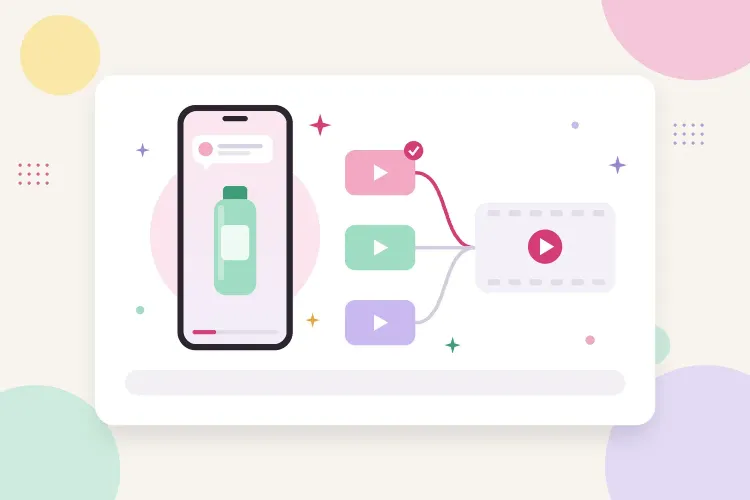


A UGC hook is the first one to three seconds of a brand video: the line you say, the text on screen and the first thing the viewer sees. It decides whether a stranger scrolling past an ad keeps watching long enough to see the product.
The 100+ UGC hooks below are grouped by type, so you can pick the angle first and the wording second. Each type starts with when to use it and ends with one filled-in example. Swap the bracketed parts for the brand's product and the customer's real problem, and keep the line short enough to say in three seconds.
100+ UGC hooks you can copy, by type
Problem hooks
Use these when the product fixes something the buyer already feels. The more specific the problem, the faster the right viewer sees themselves in it.
- "If your [problem] comes back every time you [situation], watch this."
- "I spent two years working around [problem] before I found [product]."
- "Nobody warned me that [problem] would start after [life event]."
- "This is for the people whose [thing] gives up by 3 p.m."
- "My [problem] was costing me [time or money] every week, so I tried [product]."
- "If you've tried three [category] and still have [problem], keep watching."
- "The reason your [routine] isn't working might be [cause], not you."
- "[Problem] at [time of day]? Same. Here's what I changed."
Filled in: "If your frizz comes back every time you step outside in July, watch this."
Product demo hooks
Use these when the product does something visible. Put the action in the first frame and say the line over it.
- "Watch what happens when I [action] with [product]."
- "This is [product] doing [task] in 10 seconds, no cuts."
- "I'm going to [stress test] this [product] and see if it holds up."
- "Here's how [product] works, start to finish, in under 30 seconds."
- "Look at the [texture, size or detail] on this."
- "Pour, press, done. That's the whole [task] now."
- "The box says it can [claim on pack], so I'm testing it on camera."
- "Let me show you the feature I actually use every day."
Filled in: "Watch what happens when I spill a full bowl of cereal and grab this vacuum."
Confession hooks
Use these when buyers are skeptical of the category. Admitting doubt first makes the recommendation that follows easier to believe.
- "I didn't want to like [product]."
- "Okay, I owe [brand] an apology."
- "I have to admit something about my [routine]."
- "I was the person who said [category] was a waste of money."
- "I've been keeping this one to myself for three months."
- "Embarrassing confession: I [bad habit] until last spring."
- "I bought this planning to return it. I didn't return it."
- "I kept quiet about this until I was sure it would last."
Filled in: "I was the person who said meal kits were a waste of money."
Curiosity hooks
Use these when the product has a surprising ingredient, feature or use. Open a question the video answers, and answer it in the video, not in the comments.
- "Nobody told me [category] could [unexpected benefit]."
- "The reason I stopped [habit] has to do with this [product]."
- "Wait until you see what's inside this [product]."
- "I found out why my [thing] kept [problem], and it wasn't what I thought."
- "There's one setting on this [product] most people never use."
- "Watch what happens in the last three seconds."
- "I tried this for a week expecting nothing. Day 5 changed my mind."
Filled in: "There's one setting on this air fryer most people never use."
Comment reply hooks
Use these when the brand gets the same questions in comments, reviews or support tickets. On TikTok and Instagram you can reply to a comment on your own video with a new video, and the comment appears on screen as a sticker. Use a real comment from the brand's posts or reviews, not one you invent.
- "You asked if it works on [type], so I tried it on mine."
- "Someone said this is overpriced. Let's break it down."
- "Replying to everyone who asked what's in my [bag or routine]."
- "[Name] asked how long it lasts. Here's my day 14 update."
- "A lot of you asked if [product] is worth it for [use case]. Honest answer:"
- "This comment made me test it again."
- "You asked which [shade, size or flavor] I use. Here it is."
Filled in: "You asked if this stroller fits in a small trunk, so I tried it in mine."
Contrarian hooks
Use these in crowded categories where most ads say the same thing. Challenge a habit or belief, then let the product be the alternative.
- "Unpopular opinion: you don't need a ten-step [category] routine."
- "Stop buying [category] based on [common criterion]."
- "The most expensive [category] isn't the one that works best."
- "Everyone says to [common advice]. I stopped doing it."
- "I think [popular product type] is overrated. Here's what I use instead."
- "[Category] isn't the problem. How you use it is."
- "You're not lazy. Your [tool] is just badly designed."
Filled in: "Stop buying running shoes based on how they feel in the store."
Skeptic and objection hooks
Use these for pricier products, new brands and subscriptions, where the buyer's doubt is the real obstacle. Name the objection and answer it in the video.
- "I thought this was another viral gimmick."
- "Is [product] worth $[price]? I used it for 30 days to find out."
- "Three things I expected to hate about [product]."
- "My biggest worry with [product] was [objection]. Here's what happened."
- "Don't buy [product] until you know this."
- "Here's who [product] is not for."
- "I read the one-star reviews before I tried it. Here's what they got right."
Filled in: "Is a $90 water bottle worth it? I used it for 30 days to find out."
Result-first hooks
Use these when the result is visible. Show the finished state first, then go back to how you got there. Only show results you actually got.
- "This is my [space] after two weeks with [product]."
- "Same [room or outfit], one change."
- "Day 1 vs day 30 with [product], no filter."
- "This used to take me 40 minutes. Now it takes 10."
- "Left is last month. Right is this morning."
- "The end result first, then I'll show you how."
- "Look how much [space, time or money] this freed up."
Filled in: "Same entryway, one change: 14 pairs of shoes off the floor."
Comparison and dupe hooks
Use these when the product competes with something the viewer already knows. Check with the brand before naming a competitor on camera. Many prefer "the one I used before."
- "[Product] vs the one I used for five years."
- "I tested the $[price] version and the $[price] version side by side."
- "Same task, two tools. Watch the difference."
- "If you like [well-known product], you'll want to see this."
- "I switched from [old method] to [product]. Here's what changed."
- "Store-bought vs [product]: the taste test."
- "Which one would you pick, left or right?"
Filled in: "I tested a $60 blender and a $400 blender on the same frozen smoothie."
Routine hooks
Use these for products people use every day. The routine gives the product a natural place in the video, which feels less like an ad.
- "Get ready with me for a 6 a.m. shift."
- "My 5-minute morning routine with two kids at home."
- "Everything I use on a travel day, in order."
- "Night routine for when you have zero energy left."
- "What I eat on a busy workday, realistically."
- "Pack my gym bag with me."
- "The three things I grab before every [activity]."
Filled in: "Everything I use on a red-eye flight day, in order."
Unboxing and first-impression hooks
Use these for launches, subscription boxes and products with packaging worth showing. They work best when your reaction is genuine.
- "Unboxing the [product] everyone keeps asking me about."
- "First impressions, filmed the second it arrived."
- "Let's see if [product] looks like the photos."
- "Here's everything in the box, and one thing that surprised me."
- "I ordered this on [day]. It's [day]. Let's open it."
- "Trying [product] for the first time, no edits."
- "The packaging alone told me something about this brand."
Filled in: "Let's see if this linen duvet cover looks like the photos."
Credential hooks
Use these when you have real experience that gives the recommendation weight: a profession, a hobby practiced for years or a demanding lifestyle. Never claim a credential you don't have.
- "As a [profession], this is the [category] I recommend."
- "I've been a [role] for [X] years. Here's what I look for in a [category]."
- "Nurse here. These are the shoes that made 12-hour shifts bearable."
- "I cook for a family of six, so I'm picky about [category]."
- "I've tested [X] [category] for my clients. This one stayed."
- "Former [role] here. This is what most people get wrong about [topic]."
- "I travel 20 weeks a year. This is the bag that survived."
Filled in: "As a dental hygienist, this is the water flosser I recommend."
Audience callout hooks
Use these when the product is made for one clear group. Naming the group makes the right buyer stop and lets everyone else scroll, which is fine for an ad.
- "If you have curly hair and live somewhere humid, this is for you."
- "Moms with toddlers, you need to see this."
- "If you work from your couch, watch this."
- "Runners over 40, this one's for you."
- "For anyone who hates [chore]."
- "If you've ever [relatable situation], keep watching."
- "Small apartment? This one's for you."
Filled in: "If your dog pulls so hard on walks that your shoulder hurts, this is for you."
Listicle hooks
Use these when the product has several distinct benefits. The number tells the viewer how long the video will take.
- "3 reasons I switched to [product]."
- "5 things I wish I knew before buying a [category]."
- "2 ways I use [product] that aren't on the box."
- "The 3 [category] mistakes I made so you don't have to."
- "4 things in my [bag or kitchen] I'd buy again tomorrow."
- "3 signs you need a new [category]."
- "Everything I like, and one thing I don't, about [product]."
Filled in: "3 reasons I switched to a budgeting app after 10 years of spreadsheets."
Offer and value hooks
Use these when price is the selling point, or when the brand has a confirmed offer. Only mention an offer the brand has given you in writing, because prices and codes change.
- "This is the cheapest way I've found to [outcome]."
- "Here's what $[price] gets you with [product]."
- "Cost per use: why [product] ended up cheaper than what I had."
- "[Brand] is running [offer] this week. Here's what I'd get."
- "I did the math on [category] so you don't have to."
- "If you've been waiting for [product] to go on sale, it's on sale."
- "One [product] replaced three things in my cabinet."
Filled in: "Cost per use: this $120 rain jacket is the cheapest one I've ever owned."
Visual hooks and on-screen text
A visual hook is what the viewer sees before you say a word. Pair one with any spoken hook above, and add on-screen text that works on its own when the sound is off.
- Start mid-action. The product is already in use in the first frame. On-screen text: "[Problem] fixed in 10 seconds."
- Extreme close-up. Texture, foam, a pour or a click, filmed close enough to fill the screen. Text: "Look at this [texture]."
- Drop into frame. The product falls or slides into an empty shot. Text: "The only [category] I kept."
- Handwritten note. A sticky note or whiteboard with the problem written on it. Text in your handwriting does the work.
- Split screen. Before on the left, after on the right, from the first frame. Text: "Same [space], one change."
- Screen recording first. For apps, open on the phone screen mid-task, then cut to your face. Text: "This app did [task] for me."
- Messy-to-clean reveal. A quick pan from the problem to the result. Text: "Took 5 minutes."
- Unusual camera position. Inside the fridge, under the sink, inside the bag. Text names the problem the angle shows.
- Point at the text. You stay silent, pointing at a review or comment on screen, then react.
- The pile. The product next to everything it replaces. Text: "This replaced all of these."
Which hooks fit which product
The product decides which hook types are worth testing first. The table below uses the same categories as this list of brands looking for UGC creators, so you can match any brand on it to its starting hooks.
| Product category | Hook types to start with | Why they fit |
|---|---|---|
| Beauty and personal care | Result-first, confession, routine | Buyers want to see texture and results and have been let down before |
| Wellness and supplements | Credential, skeptic, routine | Results are slow, so trust and daily habit matter more than a reveal |
| Food and drink | Product demo, comparison, routine | Taste is hard to film, so show the preparation, the swap and when you eat it |
| Home and cleaning | Problem, result-first, visual reveal | The mess and the fix are both visible in seconds |
| Fashion and accessories | Audience callout, comparison, routine | Fit and style depend on who's wearing it and where |
| Apps and software | Screen-recording demo, problem, listicle | The value is in the task the app removes, shown on screen |
| Pet products | Product demo, comment reply, result-first | The pet's reaction is the proof, and owners ask specific questions |
| Tech and gear | Unboxing, product demo, skeptic | Buyers compare specs and want to see it work before paying |
Health and supplement claims need extra care. Describe what you experienced, not what the product treats, and let the brand approve any claim.
How to write your own UGC hook from a brief
When a brief gives you a product and a goal but no script, build the hook in four steps.
- Find the customer's words. Read the product's reviews, the comments under the brand's posts and the FAQ on its site. Phrases customers repeat, such as "finally stays on" or "no more afternoon crash," make better hooks than marketing copy.
- Pick the hook type. Start from the table above, then check the brief. A brand fighting doubt needs a skeptic or confession hook. A brand with a visible result needs a demo or result-first hook.
- Keep the line short. Aim for about 10 words or fewer, and make sure it names the problem or points to the product.
- Plan the first frame and the text. Decide what's on screen in the first second and which on-screen text repeats the hook for muted viewers.
Then write a second and a third version from different hook types, so you're ready if the brand asks for variations.
How to send a brand several hook variations
Brands running UGC as ads often test several openings on the same video and keep spending on the one that holds attention best. Making those variations easy to use is part of what they pay for.
- Agree on the number before you film. Put "one video, three hooks" in the quote and the brief, not after delivery.
- Use different hook types, not three rewordings. A problem hook, a demo hook and a confession hook test three angles. Three versions of the same problem line test almost nothing.
- Film the body once. Every hook ends where the main part of the video begins, on the same shot or the same transition line, so the editor can swap openings cleanly.
- Export each full version. Hook A plus body, hook B plus body, hook C plus body, each as its own 9:16 file. If the brand bought raw footage, add the hook clips separately.
- Deliver clean versions when asked. Many brands add their own captions, so check whether they want versions without on-screen text.
- Name files so they can't be mixed up. For example:
Brand_Concept_HookA_Problem_9x16.mp4. - Add a hook sheet. A short table listing each hook's letter, type, spoken line and on-screen text, so the brand can report results by hook.
Many brands compare the versions on hook rate. On Meta, that's typically 3-second video plays divided by impressions, a custom metric advertisers set up in Ads Manager. Your hook sheet lets them match each rate to the line behind it.
The body that every hook leads into usually follows a standard format, such as a testimonial, a demo, an unboxing or a routine. If you want to see how each one is built, these 17 UGC video examples break them down.
How hook variations fit into your rate
Extra hooks are extra work: another script, another take, another edit and another export. Brands are used to paying for them, too: UGC platforms that sell videos to brands list extra hooks as a paid add-on on top of the base video.
- Include one hook in your base rate. Your base quote covers one video with one hook, one edit and one revision round.
- Price extra hooks by the work they add. A new opening line filmed in the same setup is a small add-on. A hook that needs a new location, props or a different outfit is closer to a new concept and should be priced like one.
- Make paid usage cover every version. If the brand runs three hook versions as ads, the usage period and price should apply to all three. Write that in the agreement.
- Offer a testing package. For brands running ads, a package with one body, three hooks and paid usage is easier to approve than three separate add-ons.
Here's an example quote: "$450 for one 30-second video with one hook and one revision round. Two extra hooks filmed in the same setup add $100. Paid usage for all three versions is quoted separately."
For the rest of the quote, a UGC rate calculator gives you a starting figure for the base video, paid usage rights and raw footage. Add extra hooks as a separate line under it, since the calculator doesn't price them.
Use hooks in your pitches and spec videos
A spec video that opens with a hook suited to the brand's product shows you understand ads, not only filming. When you pitch, mention which hook type you'd test first and offer two alternatives for their next round of tests.
Brands that already run UGC ads are the easiest to pitch this way, because they already test openings. Check their active ads in Meta Ad Library and look for gaps, such as the same hook in every ad. This guide on how to get UGC brand deals walks through that check and other ways to find brands like them.
UGC hook mistakes that get videos rejected
A UGC hook usually runs as an ad, in front of people who have never seen you and didn't choose to watch. Most of the mistakes below come from forgetting that.
- Claims you can't back up. "Cured my acne" or "lost 10 pounds" can get the video rejected by the brand or the ad platform. Describe your experience instead.
- Invented comments. A comment reply hook built on a fake comment misleads viewers. Use a real comment or a question the brand gives you.
- A hook the video doesn't pay off. If the hook promises a test, show the test. Viewers who feel tricked scroll away, and the brand loses the people the hook attracted.
- The product shows up too late. Viewers should see the product or the problem within the first few seconds, even if you name the brand later.
- A hook that only works with sound. Add on-screen text or a first frame that explains itself.
Final take
The most useful UGC hooks are the ones tied to the product. Pick the hook type that suits the category, write the line around the customer's real problem or doubt, and pair it with a first frame that works on mute.
When a brand asks for variations, film two or three hook types over the same body, deliver them clearly named, and price them as an add-on. That turns a single video into a set of ads the brand can test.