A creator can have a full camera roll and still feel completely out of ideas. The problem is usually not a lack of topics. It is trying to invent a brand-new concept every time instead of keeping a few useful formats ready to adapt.
The best TikTok content ideas give you a clear job to do: teach one thing, respond to a real opinion, show the work behind the result, answer a community question, or test a product or process. The list below focuses on sustainable formats that can fit different niches, production capacities, and audience relationships.
TikTok content ideas when you feel stuck
Before choosing a format, write down three things: what your audience is trying to do, what you can show credibly, and how much time you have today. A useful idea sits where those three answers overlap.
Do not judge an idea only by whether it sounds viral. A good post can earn a useful comment, answer a recurring question, create a series, or give a brand a clear example of your expertise. Those outcomes are often more valuable than a random spike in views.
Use the list by matching the format to the job: teach when the audience needs clarity, react when a topic already has attention, show the process when the result hides useful work, review when people need help deciding, and ask the community when you need a relevant prompt.
If the blank page is the real problem, TikTok’s official Creator Search Insights can surface topics people are searching for and content gaps worth exploring. Use it as a source of questions, not as a replacement for your own point of view.
1. Educational TikTok ideas
Educational videos work in almost any niche because they give the viewer a clear reason to stay. The lesson does not need to be advanced. It needs to be specific enough that someone can understand what changes after watching.
Try these ideas:
- Explain one common mistake: show what people do, why it causes a problem, and the small change that improves it. A fitness creator could correct one exercise setup; a photography creator could explain one exposure mistake.
- Break down a process: record the steps behind something your audience wants to do. Keep the video focused on one outcome instead of documenting every detail.
- Answer the question beginners are embarrassed to ask: simple questions often make useful videos because many people are searching for the same explanation quietly.
- Compare two approaches: show when method A makes sense, when method B is better, and what trade-off the viewer should understand.
- Define a term with an example: explain a niche word, tool, or metric, then show how it appears in real life. The example is what makes the definition memorable.
Educational content becomes easier to make when you keep a running list of questions from comments, DMs, search suggestions, and conversations with people who are newer to your niche. When the difficult part is finding the opening line, these TikTok hook templates can help you package the same lesson in several clear ways.
Make any TikTok content idea filmable
Once you choose an idea, give it a simple three-part structure:
- Hook: name the audience, problem, question, or result quickly.
- Example: show the mistake, process, comparison, reaction, or evidence that makes the idea concrete.
- Payoff: give the answer, verdict, next step, or question that keeps the conversation moving.
For example, “Explain a common mistake” becomes: “If your videos get views but no saves, check this first” (hook), a short screen recording of the issue (example), and one change to test in the next post (payoff). This structure keeps a useful idea from becoming a vague talking-head video.
2. Reaction and commentary ideas
Reaction content does not have to mean exaggerated facial expressions. The useful version adds context, analysis, a different experience, or a respectful disagreement to something people are already discussing.
Try these ideas:
- Respond to a claim in your niche: explain what is accurate, what is missing, and what a viewer should do with the information.
- React to a common piece of advice: say who the advice works for, where it breaks down, and what you would change.
- Review a public example: analyze a recipe, outfit, workout, edit, pitch, room setup, or campaign using clear criteria.
- Add context to a news or platform update: translate what changed into a practical consequence for your audience. Avoid repeating the headline without explaining the impact.
- Reply to a respectful disagreement: quote the idea briefly, acknowledge the reasonable part, and explain where your experience or evidence leads somewhere else.
The format works best when the creator is reacting to an idea, not using another person’s content as the entire value of the post. Make your contribution clear in the first seconds.
3. Behind-the-scenes TikTok ideas
Behind-the-scenes content makes expertise visible. It can also make a polished result feel more human without requiring a complicated story or a large production.
Try these ideas:
- Show the setup before the finished result: include the lighting, tools, workspace, ingredients, or planning board that normally stays off camera.
- Film a small decision: explain why you chose one hook, product, outfit, camera angle, recipe, or workflow over another.
- Show what changed after a failed attempt: keep the useful lesson and remove the unnecessary drama.
- Document a short work session: turn one focused task into a time-lapse, voiceover, or checklist that viewers can follow.
- Reveal the less glamorous step: cleaning equipment, organizing files, testing a product, editing captions, or preparing a pitch can be surprisingly relatable when it supports a clear point.
The goal is not to expose every part of your life. Choose the behind-the-scenes moments that help viewers understand the craft, effort, or decision behind the finished post.
4. Series and recurring-format ideas
When you are out of ideas, a series gives you a container. The topic can change while the structure stays familiar, which makes planning easier and helps viewers know what they will get from the next post.
Try these ideas:
- One small improvement per episode: fix one part of a routine, profile, room, recipe, workout, or creative process each time.
- Testing a method over several posts: define what you are testing, show the result, and state what the next episode will examine.
- Follower question of the week: choose one recurring question and answer it in the same recognizable format.
- Rating or reviewing one example per episode: use consistent criteria so the series feels useful rather than arbitrary.
- Progress toward a defined outcome: show the next step in a project, challenge, collection, or skill without making viewers wait for the only meaningful payoff.
A repeatable format should make production lighter, not trap you in a promise you cannot maintain. Choose a series name only after the structure has proved useful for a few posts.
5. Review, test, and comparison ideas
Reviews do more than announce whether you liked something. They help viewers decide, and they give you a natural way to explain your criteria, experience, and point of view.
Try these ideas:
- First impression versus later verdict: share what you noticed immediately, then return after using the product, tool, or method properly.
- Budget versus premium comparison: explain who benefits from paying more and when the cheaper option is enough.
- Three things worth knowing before buying or trying: focus on details that are easy to miss in a product description.
- Test one claim: verify whether a product, workflow, or popular tactic produces the result it promises in a realistic situation.
- Choose for a specific person: make the recommendation conditional on the viewer’s budget, skill level, goal, or constraints.
Name the criteria before giving the verdict. That makes the video more credible and gives the audience a reason to disagree productively in the comments.
6. Community-driven TikTok ideas
Your audience is already giving you prompts. Comments, questions, polls, and repeated objections can become a content pipeline that is more relevant than a generic trend list.
Try these ideas:
- Reply to a comment with a video: answer the question fully enough that the original commenter and the next viewer both learn something.
- Ask viewers to choose the next test: give two or three clear options, then follow up with the result.
- Collect audience examples: ask people to share a setup, problem, product, or attempt that you can analyze with permission.
- Correct a common assumption from your comments: frame the correction around the question, not around embarrassing the person who asked it.
- Turn a recurring request into a public resource: if several people ask for a checklist, script, example, or demonstration, make one that can keep helping future viewers.
Community formats create a feedback loop: the audience gives you a question, the video answers it, and the next comments reveal what needs clarification. That is a more sustainable idea source than waiting for inspiration.
Examples by niche
The format stays the same, but the example changes with your niche:
- Fitness: explain one form mistake, react to a workout claim, show your training setup, review a fitness app, or answer a beginner’s question.
- Beauty: compare two application methods, show a routine behind the scenes, review a product after one week, or respond to a skincare concern.
- Food: teach one technique, recreate a popular recipe with your own verdict, show the preparation, start a “one ingredient, three meals” series, or answer a cooking question.
- Business and marketing: break down a campaign, react to a marketing claim, show how you create content, review a tool, or reply to a strategy question.
- Lifestyle and travel: share a practical tip, compare two destinations, show the planning process, review a product or place, or answer a recurring audience question.
Turn one prompt into a week of TikTok ideas
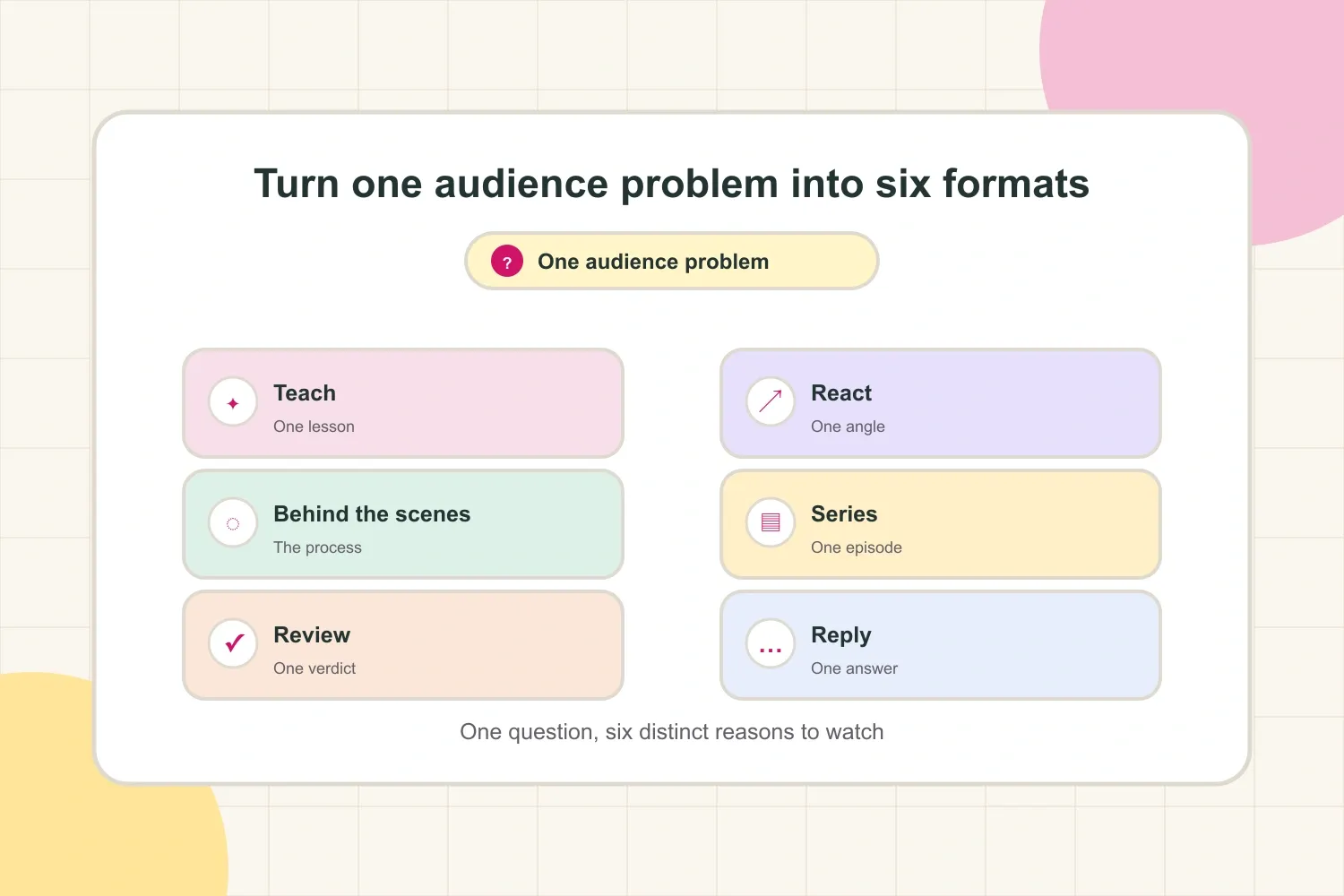
You do not need six unrelated ideas to plan a week. Start with one audience problem and change the format around it.
For example, a creator teaching home organization could turn “How to keep a small kitchen tidy?” into:
- An educational video explaining the first mistake.
- A behind-the-scenes clip showing the setup.
- A comparison of two storage approaches.
- A reaction to a popular but impractical tip.
- A comment reply answering a viewer’s specific kitchen layout.
- A short series showing one improvement per day.
The ideas are related, but they are not duplicate uploads. Each gives the audience a different way to understand the same problem.
A 10-minute reset for days with no ideas
When the blank page wins, use a short reset instead of scrolling for an hour:
- Write down the last three questions someone asked about your niche.
- Pick the one that can be answered with a visible example.
- Choose the simplest format: tip, reaction, behind the scenes, review, series episode, or comment reply.
- Write one sentence that describes the viewer’s problem and one sentence that states the payoff.
- Film a rough version before deciding whether it deserves a more polished edit.
If the idea still feels vague, narrow the audience or the outcome. “How to get better at cooking” is too broad for one TikTok. “How to stop your vegetables from turning soggy” gives the video a clear job.
Keep an idea bank you will actually use
An idea bank should reduce friction, not become another project to maintain. Keep four columns in a note or spreadsheet: audience question, format, example, and next step.
Add ideas immediately after a comment, conversation, failed attempt, useful observation, or surprising result. Mark ideas that need research or permission so they do not get mistaken for ready-to-film prompts.
Review the bank once a week and choose ideas that match your available time. A quick reaction may fit a busy day; a review or behind-the-scenes tutorial may need a block of filming time.
The practical answer
When you are out of TikTok content ideas, return to six reliable sources: teach something, react with a point of view, show the work behind the result, build a recurring series, review or compare something, or answer the community directly. Start with one audience problem, choose the simplest format that can solve it, and keep the best structures available for the next post.