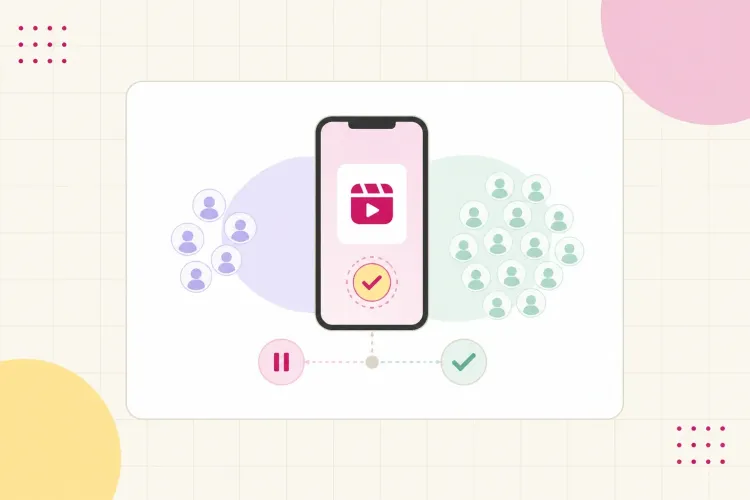


Instagram Trial Reels let you show a Reel primarily to people who do not follow you before deciding whether to share it with your followers. They are useful for testing a new topic, format, or message, but they are not a guarantee of reach, followers, or virality. The practical question is: what did this test teach you, and what will you change next?
Trial Reels at a glance
Use Trial Reels when you want to answer one specific content question. Choose the test based on what you are unsure about:
| If you are unsure about... | Test... | Keep the rest of the post... |
|---|---|---|
| Whether a subject fits your audience | Topic | Similar in format and delivery |
| Which production style communicates it best | Format | Similar in topic and promise |
| Why someone should keep watching | Message | Similar in topic and format |
The goal is not to find a universal winning format. It is to learn which version deserves another test or a share with a wider audience.
How Instagram Trial Reels currently work
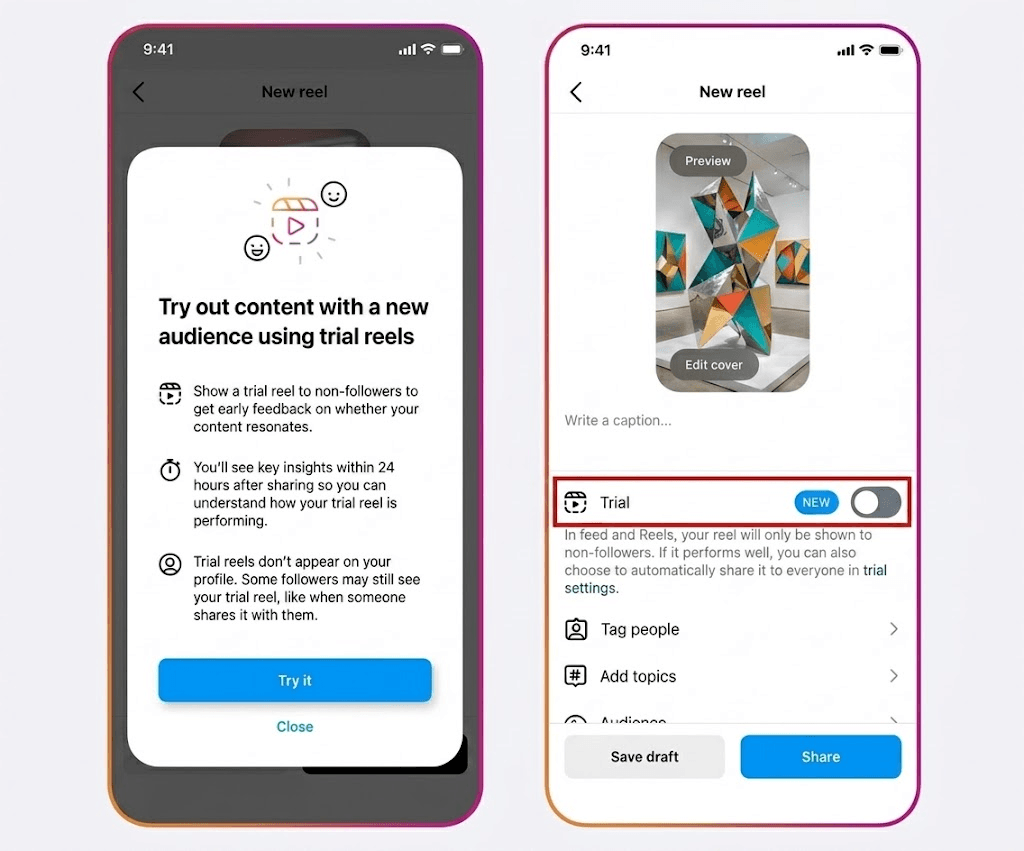
You create a Trial Reel through the normal Reels workflow. Before sharing, turn on the Trial option. The Reel is then shown primarily to non-followers first. While it remains a trial, it does not appear on your main profile grid or Reels tab for other people, and followers should not see it in their feed or Reels tab.
That does not make the post completely invisible to followers. Someone could still receive it in a direct message, or find it on a page connected to the same audio, location, or filter. Treat Trial Reels as a lower-pressure test, not a private folder.
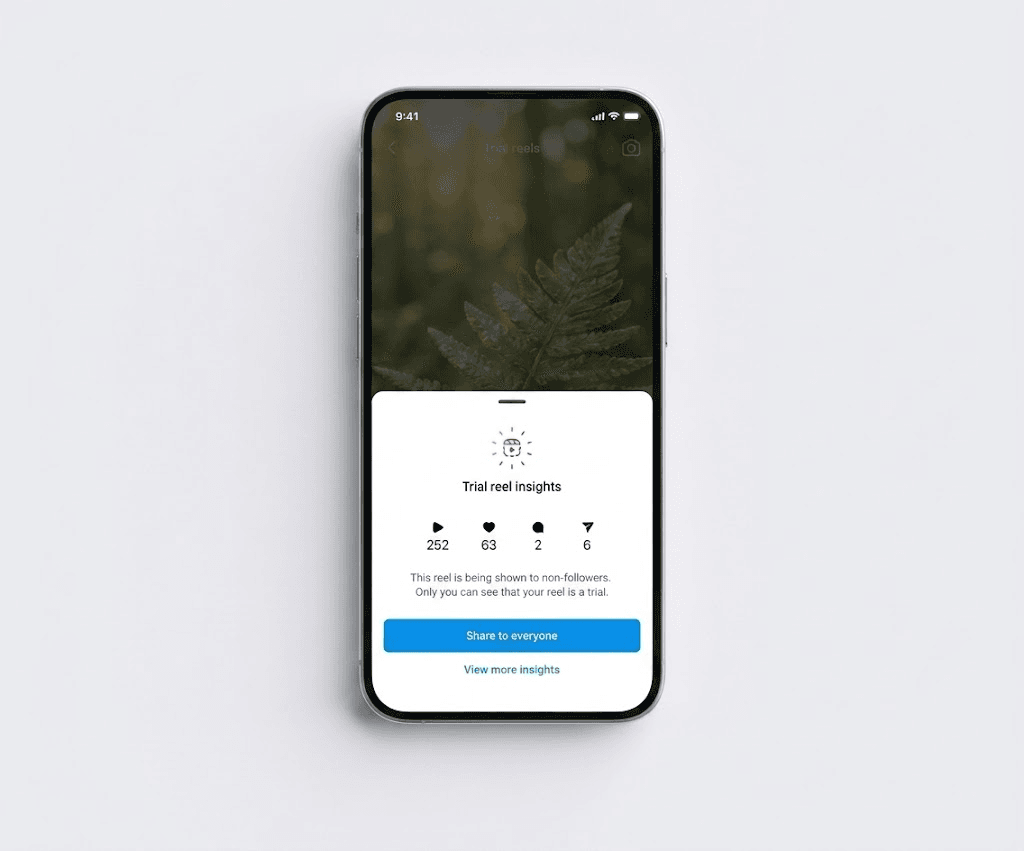
Instagram says that roughly 24 hours after sharing, creators can view key engagement signals in the Reels viewer, including views, likes, comments, and shares. The app can also show how a trial compares with previous trials. If the result supports your hypothesis, you can choose Share with everyone. Once shared, the Reel can appear on your profile and reach followers across Instagram.
You can also enable automatic sharing. Instagram says this option uses the views a trial receives during its first 72 hours to decide whether to share it with followers. You can change that setting when creating the trial. Availability, labels, and controls can vary by account, app version, or region, so use the controls that actually appear in your account. For the current details, see Meta’s explanation of Trial Reels.
How to set up a Trial Reel
- Create the Reel as you normally would.
- Before sharing, turn on the Trial option if it is available on your account.
- Publish the Reel and leave it in the trial audience while the first signals accumulate.
- Review the available metrics after about 24 hours and compare them with a relevant baseline.
- Choose Share with everyone, revise the idea for a later test, or leave it as a learning result.
If you do not see the Trial option, do not assume that your account is being penalized. Feature access and labels can vary, so check the latest controls in the Instagram app before changing your strategy.
The simplest mental model is a short experiment with a decision point. You publish a test, wait for the first useful signals, compare it with a relevant baseline, and then decide whether to share, revise, or leave the idea behind.
What Trial Reels are useful for
Trial Reels are most useful when you have a clear uncertainty. You might be unsure whether your audience will respond to a new subject, whether a different production format fits your niche, or whether the value proposition is clear enough for someone who has never seen your account.
They can help with three decisions:
- Explore a new topic. Test an adjacent question, audience problem, or theme before making it part of your regular content mix.
- Compare production formats. Try a talking-head explanation, voiceover with B-roll, demonstration, screen recording, or green-screen treatment when the idea can work in more than one form.
- Clarify the message. Present the same broad subject through different problems, goals, or benefits, rather than uploading near-identical versions with tiny changes.
They are less useful when you expect one post to answer every strategic question. A Trial Reel cannot tell you whether an entire niche will work from one sample. It also cannot separate a weak topic from a weak opening if you change both at once. Use the feature to reduce uncertainty, not to outsource your editorial judgment.
If testing changes your normal publishing rhythm, keep the wider cadence in mind. Your account still needs a sustainable schedule, and the advice in this guide to Instagram posting frequency can help you fit experiments into the workload you can actually maintain.
The three things creators should test
1. Topic validation
The hypothesis is about subject fit: “People who do not follow me will care about this adjacent problem.” Keep the format and delivery reasonably familiar so the topic is the main change. For a cooking creator, that might mean testing meal planning instead of another recipe. For a finance creator, it could mean testing a beginner question beside an established investing topic.
Do not call a topic validated because one trial receives more views. Look for a combination of reach and meaningful response. Shares, comments that show intent, or profile actions can tell you whether the subject created curiosity beyond passive watching.
2. Format validation
Here the topic stays similar while the treatment changes. Compare a direct explanation with a voiceover, a product demonstration, a screen recording, or a green-screen reaction. The point is not to find one format that always wins. It is to learn which format makes a particular idea easier to understand and easier for you to produce well.
Make the contrast meaningful. A talking head and a hands-only demonstration answer different viewer expectations. Two versions with the same opening, visuals, length, and delivery may be too similar to produce a useful lesson.
3. Message validation
Message testing asks whether the audience understands the reason to care. One version might promise a faster process. Another might address a common mistake. A third might focus on a result, a feeling, or a specific audience segment.
Keep the underlying topic and format stable enough to interpret the result. If the message changes together with the topic, length, visual treatment, and call to action, you will not know which part mattered.
How to run a controlled Trial Reel test
A useful Trial Reel test has five parts:
- One clear hypothesis. Write what you believe will happen and why.
- One primary variable. Change the topic, format, or message. Do not redesign the entire post at the same time.
- One primary success metric. Choose the signal that matches the goal. Views may fit a discovery test. Shares or comments may fit a usefulness test.
- A reasonable evaluation period. Review the first signals after about 24 hours, then follow the relevant window shown in your account. Do not make an immediate decision because the first hour looked slow.
- A decision. Decide in advance what you will share, hold, revise, or stop based on the result.
Write the hypothesis before filming. “This topic will do well” is too vague. “A beginner checklist delivered as a voiceover will generate more shares than my usual talking-head explanation” gives you something to test. It also tells you what the next version should keep or change.
Avoid changing the hook, subject, format, duration, caption, and call to action all at once. That may produce a different post, but it does not produce a clean learning signal. If a post performs poorly, you will not know what to fix. If it performs well, you will not know what to repeat.
Which metrics matter beyond views
Meta’s official description says that Trial Reel reporting includes views, likes, comments, and shares after approximately 24 hours, along with comparisons to previous trials. These are the signals you can safely build the basic scorecard around.
- Views indicate how far the trial travelled among the people Instagram tested it with. They are useful for a discovery question, but they do not prove that the idea created lasting interest.
- Likes show a quick positive response. Compare them with views and with trials pursuing the same objective.
- Comments can reveal confusion, questions, agreement, or intent. Read them rather than treating the count as a simple score.
- Shares are often a valuable signal for practical or relatable content because they indicate that someone wanted another person to see it.
- Profile visits or follows should be recorded only if the current Trial Reel insights in your account expose them. Do not assume every account receives every metric.
If profile visits and follows are available, you can calculate follows per 1,000 views as follows ÷ views × 1,000. Label it as your own derived rate, not an Instagram metric. Watch-time or retention should be included only when the current insights screen makes that data available for the trial. The feature and reporting surface can change.
Compare trials with similar goals. A Reel designed to reach a new audience may be judged by views and profile actions. A Reel designed to explain a complex process may be more useful if it earns shares and thoughtful comments, even when its view count is ordinary.
Millie Adrian’s 15-day experiment
Creator educator Millie Adrian reported gaining roughly 2,600 followers after publishing around 75 Trial Reels over 15 days. However, she said approximately 90% of those followers came from only two talking-head videos that had already performed well organically.
That example is useful because it shows why totals need context. It was one creator’s informal experiment, not an independent or controlled study. She had an established account, a team, and an existing B-roll library, and several variables changed during the experiment. The figures are approximate, so “around 75” is more accurate than presenting the number as exact.
The result should not be treated as a benchmark for your account. It does suggest a practical lesson: many tests can generate useful information, but the results may still come from a small number of ideas. The goal is not to copy the number of posts. It is to identify which concepts deserve more production effort.
For the full context behind those numbers, read Millie Adrian’s original Trial Reels experiment and treat it as a case study, not a benchmark.
A practical seven-day Trial Reels framework
You do not need to publish dozens of near-identical videos. Use seven days to move from a question to a decision.
- Day 1: Define the question. Choose one topic, format, or message hypothesis. Record the baseline from a few relevant recent Reels if you have it.
- Day 2: Publish one focused trial. Make the difference obvious enough to learn from, while keeping the production quality appropriate for your account.
- Day 3: Review the first signals. Check the metrics Instagram exposes after about 24 hours. Note what happened without declaring a universal winner.
- Day 4: Test a meaningful contrast. If Day 2 tested a topic, test a different format or message next. Keep the comparison understandable.
- Day 5: Read the response. Look at comments and shares, not only totals. Record whether the result supports or weakens the hypothesis.
- Day 6: Decide. Share a trial that fits your goal and has enough evidence, hold one that is unclear, or revise the concept with a genuinely different treatment.
- Day 7: Apply the learning. Publish the next regular Reel or prepare the next trial using one lesson from the week. Update your notes so the result remains useful later.
This framework is deliberately modest. A creator with limited production capacity may run one trial per week. Another creator may test more often. The right pace is the one that leaves enough time to interpret the result and make the next piece well.
A simple Trial Reel scorecard
Keep the scorecard small enough that you will actually use it:
| Test setup | Primary metric | Supporting signals | Decision |
|---|---|---|---|
| Hypothesis, topic, format, and hook | Views, shares, or comments based on the goal | Likes, comments, shares, profile visits or follows if shown | Share, hold, revise, or stop |
Copy this template into your notes after each test:
Hypothesis: ...
Topic: ...
Format: ...
Hook: ...
Views: ...
Likes/comments/shares: ...
Watch-time or retention if shown: ...
Profile visits/follows if shown: ...
Follows per 1,000 views if available: ...
Final decision: ...
The scorecard is not meant to turn creative work into a perfect experiment. It is a way to keep the question, evidence, and next action connected.
Common Trial Reels testing mistakes
- Treating the feature as guaranteed distribution. Trial Reels are tested with non-followers, but Instagram does not promise a particular number of impressions.
- Publishing excessive repetitive variations. Test genuinely different creative treatments rather than flooding the system with near-duplicates.
- Changing too many variables at once. If topic, hook, format, length, and message all change, the result is difficult to interpret.
- Judging only by views. A view can show exposure, not whether the idea helped, interested, or converted anyone.
- Comparing different objectives. A reach test and a saveable tutorial should not use the same success definition.
- Drawing conclusions from one post. One trial can be affected by timing, audience mix, or chance. Treat it as evidence, not a verdict.
- Copying old viral hooks without audience fit. A familiar opening can still be wrong for your subject, voice, or current viewers.
- Reposting without meaningful creative value. Reusing an idea is fine when you add a new explanation, example, viewpoint, or treatment. Repetition without a reason teaches you little.
- Testing without deciding what happens next. A result has value only when it informs a later creative or publishing decision.
How to decide whether to share a Trial Reel
Share a trial with everyone when the result supports the original hypothesis, the content fits your followers, and you can explain why it deserves wider distribution. The decision does not require the highest view count of the week. It requires enough evidence for the goal you chose.
Hold a trial when the signals are weak or unclear, when the content feels off-brand for your current audience, or when you need more context before making it part of your regular feed. Holding is not failure. It can prevent you from turning an uncertain test into a permanent promise.
Revise the idea when the topic seems relevant but the treatment did not communicate it. Change one meaningful element and test again later. If you use automatic sharing, remember that Instagram bases that choice on early views during the stated window. Use it only when you are comfortable with that rule and the possibility that a trial will reach followers without a manual review.
Final takeaway
Instagram Trial Reels are most valuable when they turn a vague content question into a small decision. Choose one hypothesis, change one meaningful variable, track the signals Instagram actually provides, and record what you will do next. That approach gives you a repeatable way to explore topics and formats without treating every trial as a promise of viral growth.