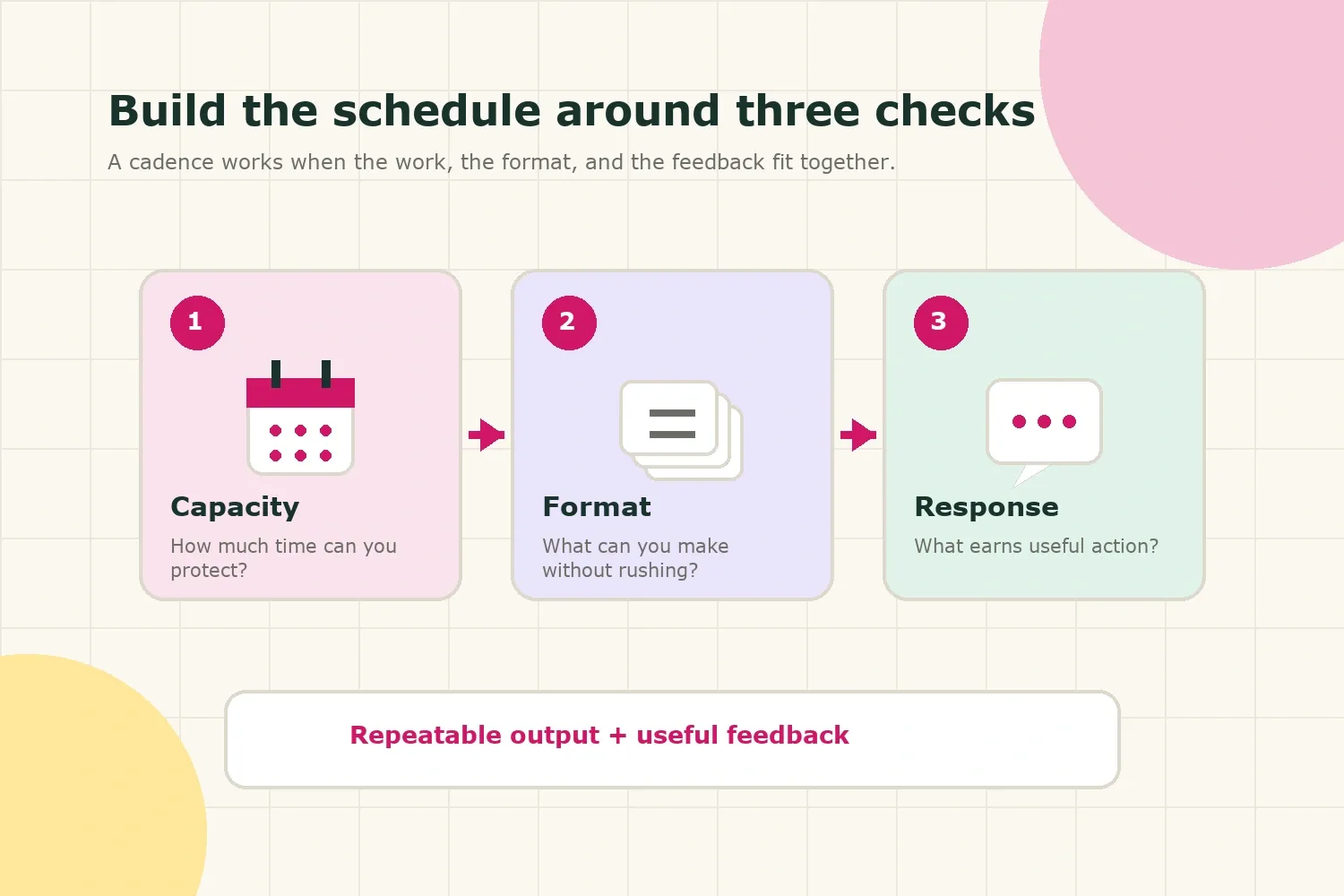
A creator can post every day and still be posting too often if the schedule leaves no time to make useful work, read audience signals, or recover. For most creators, a practical starting point is around three feed posts per week. One to two can work for high-production formats, while four to five makes sense when the workflow is repeatable. The right answer depends on the format, the creator’s production capacity, and how the audience responds. This guide covers how often to publish, not the best time of day, which should be tested separately against audience activity. Once you have chosen a sustainable cadence, use our guide to find the best time to post on Instagram and improve each post’s chances of being seen.
There is no universal number that Instagram rewards forever. Even Instagram’s own creator education treats posting frequency as one part of a wider set of recommendations, alongside attention, engagement, and understanding performance. Its Best Practices hub is designed to give creators personalized guidance, while Instagram Insights lets professional accounts review reach, interactions, accounts engaged, and performance by media type. Instagram’s Best Practices guidance is a useful reference, but it does not replace a cadence that fits the person making the content.
A practical Instagram posting frequency by format
If a creator needs a starting point, use this baseline for a 30-day test:
Benchmark versus sustainable baseline
| Situation | Feed cadence | Practical interpretation |
|---|---|---|
| Broad industry benchmark | 3–5 posts per week | A useful reference point for growth-focused accounts. |
| High-production creator | 1–2 posts per week | Reasonable when each Reel, tutorial, or photo set takes significant time. |
| Repeatable content system | 4–5 posts per week | Appropriate when formats, ideas, and production time are predictable. |
For context, Buffer’s analysis of more than 2 million Instagram posts identifies three to five feed posts per week as a practical growth range, with diminishing returns at higher volumes. That is a benchmark, not a requirement: a creator should use the range only when the extra posts do not reduce usefulness or consistency.
- Reels: 1–3 per week, depending on filming and editing time.
- Carousels or feed images: 1–2 per week when the format supports teaching, storytelling, or a clear point of view.
- Stories: several times per week or most days when there is something worth sharing, asking, or showing.
- Live: once or twice per month when a longer conversation adds value.
This is a planning range, not a promise of reach. A creator with a fast, repeatable Reel format may publish more. A photographer, educator, or specialist with a research-heavy process may publish less and still build a clearer body of work.
The practical rule is simple: increase frequency only when quality, audience response, and personal capacity can support it. If one of those drops sharply, the schedule is probably too ambitious.
Adam Mosseri, Head of Instagram, makes the same point in this Reel: quality comes first, but creators can increase volume gradually without surprising their audience or burning out. If you move from one or two posts a week to several a day, Trial Reels can help you test the change with non-followers first.
Match frequency to the format you can produce well
Different Instagram formats carry different production costs. Treating a quick Story update and a carefully edited Reel as identical “posts” makes cadence planning harder than it needs to be.
Reels are useful for discovery, but they can be expensive
Reels can help a creator reach people who do not follow the account, especially when the idea is easy to understand quickly. But a Reel may involve scripting, filming, lighting, editing, captions, music selection, and cover design.
For a solo creator, one reliable Reel per week can be a sensible baseline. Move toward two or three when the format is repeatable: a recurring tip, behind-the-scenes process, reaction, tutorial, or answer to a common question. More volume is not automatically better if every post feels rushed or disconnected from the creator’s niche.
Carousels work well when the idea deserves structure
Carousels are a natural fit for checklists, step-by-step teaching, comparisons, and stories that benefit from multiple frames. They often take less production time than video, but a useful carousel still needs a clear first slide, logical progression, and a reason to save or share it.
One or two carousels per week is enough to test the format. A creator who publishes a detailed educational carousel on Tuesday may not need another feed post on Wednesday just to keep the grid active.
For format context, compare the decision factors in Instagram Reels, carousels, and images before copying someone else’s mix.
Stories are for continuity and conversation
Stories are lighter and more temporary, so they can support a higher frequency when they are genuinely useful. A quick studio update, poll, question box, product test, client-safe behind-the-scenes moment, or follow-up to a feed post can keep the account connected without demanding a full production cycle.
“Post Stories every day” is still not a useful rule if the result is repetitive filler. A few intentional frames that invite a reply can be more valuable than a long sequence that people tap through.
Live needs a reason to exist
Going Live is a higher-commitment format for both the creator and the audience. Use it for a topic that benefits from real-time questions, a guest conversation, a workshop, a launch discussion, or a community check-in. One Live session or two per month is a reasonable starting point for many creators, with the replay repurposed into smaller content where appropriate.
Let audience response decide what earns more volume
Posting frequency should be evaluated against the response that matters for the creator’s goal, not only likes. Instagram Insights can show whether content is reaching followers or non-followers and how people interact with different media types. Instagram’s Insights documentation explains the available views and metrics.
Look for patterns across several posts rather than reacting to one unusually high or low result. Useful signals include:
- Reach and non-follower reach for discovery-focused content.
- Watch time, views, and retention clues for Reels.
- Saves and shares for educational or reference-style content.
- Replies, sticker taps, and direct messages for community-building content.
- Profile visits, link clicks, and follows when the post is meant to move people deeper into the creator’s work.
A post with fewer likes but more saves, profile visits, or qualified messages may be doing more valuable work than a post with broad but shallow attention. For a practical explanation of how engagement metrics relate to reach, see engagement rate versus reach.
Use a 30-day test instead of changing the schedule every week
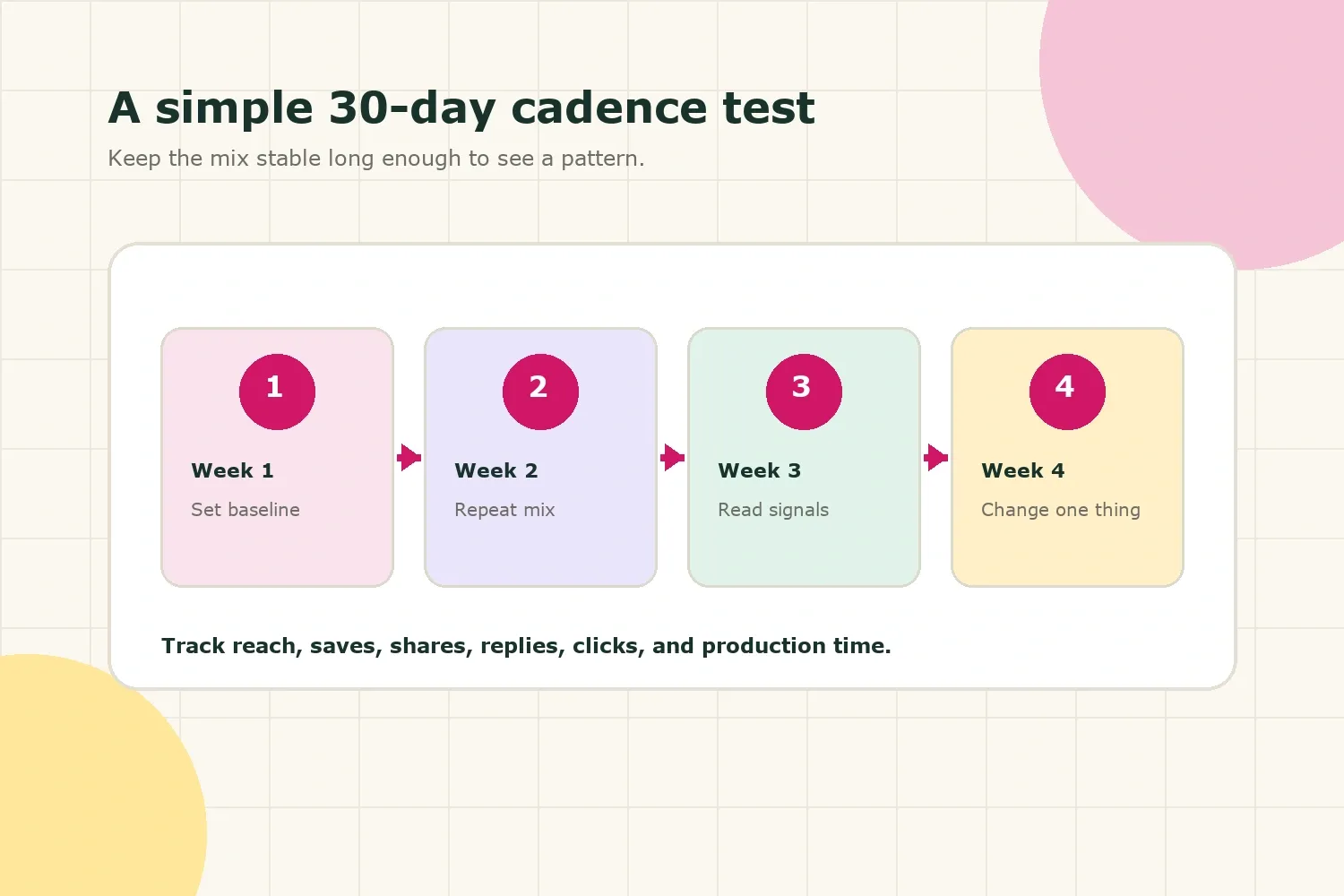
A cadence needs enough repetition to reveal a pattern. A simple test looks like this:
- Choose one baseline. For example, two Reels, one carousel, and Stories on three to five days each week.
- Keep the mix stable for four weeks. Avoid changing format, topic, posting time, and caption style all at once.
- Record the right signals. Note reach, non-follower reach, saves, shares, replies, profile visits, clicks, and the time spent producing each post.
- Review by format and topic. Identify which ideas earned useful action and which ones consumed more time than they returned.
- Change one variable. Add one post, remove one post, shift a format, or simplify production. Then run another test.
The time-cost note matters. If two Reels take eight hours and one carousel takes 90 minutes, the creator should evaluate the value of the work against the goal, not compare the posts as if they required the same investment.
Signs you are posting too often
A schedule is probably too aggressive when several of these appear together:
- Ideas are being published before they are clear.
- Captions and covers become rushed or repetitive.
- The creator stops replying to meaningful comments and messages.
- Content gets recycled without a new angle or useful context.
- Production work crowds out collaborations, outreach, rest, or other income-producing work.
- Audience response falls across several posts, not just one.
The fix is usually not to disappear. Reduce the highest-cost format, batch what can be batched, and keep a lighter channel such as Stories for continuity. A lower volume with a recognizable point of view is easier to sustain and easier for an audience to understand.
Signs you may have room to post more
A creator may be ready to add volume when the current schedule is repeatable, the content backlog is healthy, and the audience is responding without a noticeable drop in usefulness. Other signs include:
- A format can be produced from a repeatable template without feeling copied.
- The creator has enough ideas for several weeks, not only tomorrow’s post.
- Audience questions are generating natural follow-up topics.
- Production time is predictable and does not create regular late nights.
- Additional posts would serve a different job, such as discovery, teaching, or conversation.
Add only one additional unit at a time. Moving from two feed posts to five in a single week makes it difficult to know whether the higher volume helped or simply introduced more variables.
A sustainable weekly schedule for three creator profiles
The best cadence looks different depending on the work behind the account.
The part-time creator
- One Reel or carousel per week.
- Stories on two or three days, especially around the main post.
- One monthly review of content response and production time.
This schedule protects consistency without pretending content is the creator’s only responsibility.
The growing educator or niche expert
- Two feed posts per week, such as one Reel and one carousel.
- Stories on several days for questions, examples, and follow-ups.
- One Live or collaboration each month when it supports the topic.
This mix gives the account a discovery format and a depth format without requiring daily filming.
The full-time creator with a repeatable system
- Two to four feed posts per week across a defined format mix.
- Stories on most active days, with clear boundaries around what is worth sharing.
- A monthly review of audience response, production hours, and opportunities created.
More volume can make sense here, but only if the system leaves room for creative judgment. A content calendar should reduce decision fatigue, not turn every day into a deadline.
Choose a cadence that leaves room to improve
“How often should you post on Instagram?” is really a capacity and feedback question. Start with a manageable range, give it 30 days, and measure the signals connected to the goal. Then adjust the format mix or volume one step at a time.
For most creators, the sustainable answer is not daily posting. It is a repeatable rhythm that produces useful content, keeps the audience relationship active, and leaves enough time to learn from what happens next.