A 10,000-post Instagram analysis gives creators a more useful answer than just post Reels. Carousels generated the strongest overall engagement in that dataset, Reels remained the clearer discovery format, and single images still had a role when the message was simple or proof-led.
That matters because Instagram formats are not interchangeable. A Reel can introduce the account to people who have never seen it before. A carousel can hold attention long enough to teach something useful. A single image can show proof, announce something quickly, or keep a profile visually consistent.
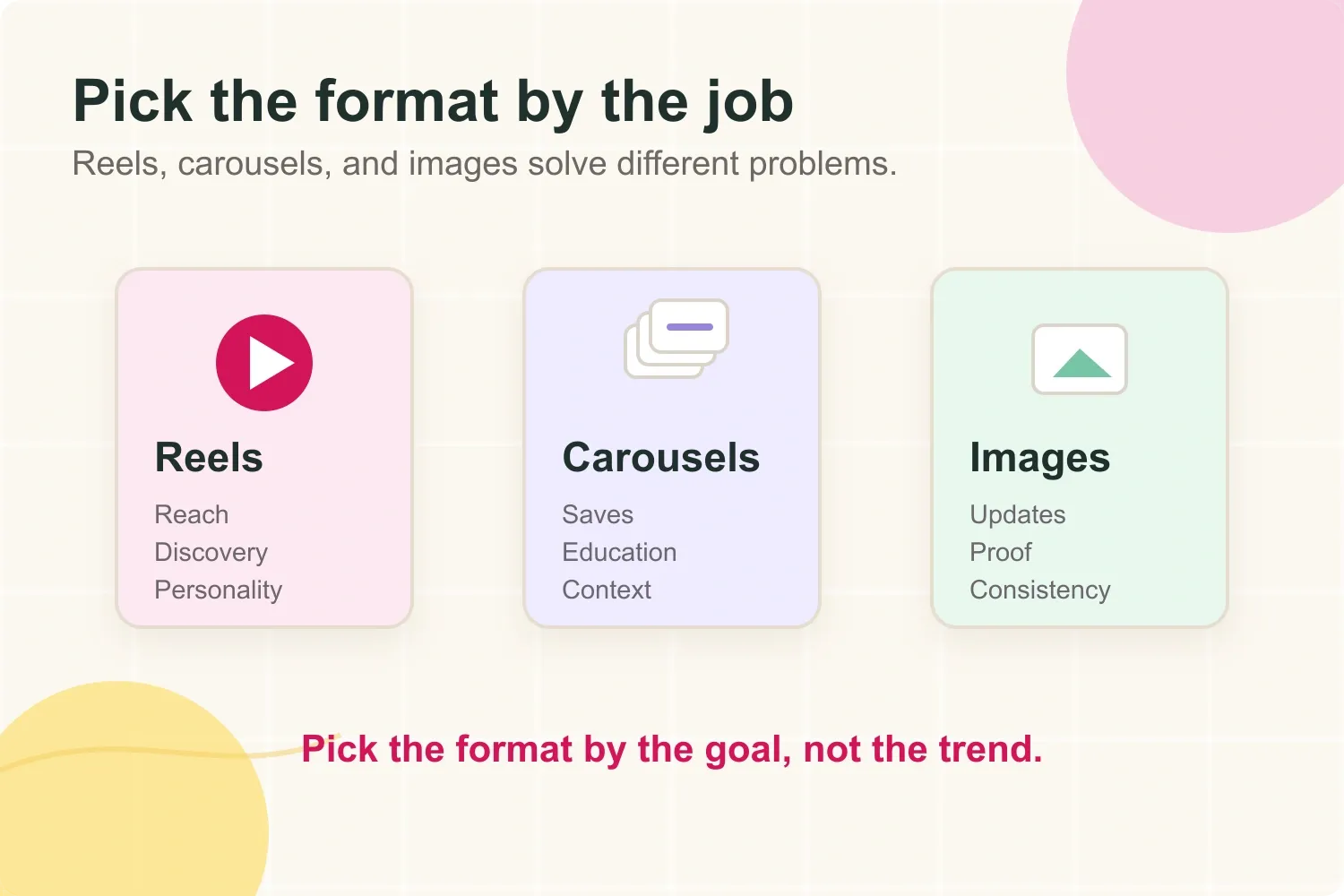
The practical question is not Are Reels better than carousels? It is: what does this post need to do? If the goal is reach, Reels usually deserve the first slot. If the goal is saves, education, or a deeper explanation, carousels often make more sense. If the goal is proof, simplicity, or a quick brand moment, images still have a place.
Recent benchmark data points in the same direction. Socialinsider's Instagram benchmarks and Metricool's Instagram study both show that format performance depends on account size, objective, and behavior, not just the format label. Reels tend to be the discovery engine, while carousels and images can still play important roles inside a healthy content mix.
What the 10,000-post analysis showed
| Finding | What it means for creators |
|---|---|
| Carousels had the strongest overall engagement | Use them when the idea needs saves, swipes, comments, or a deeper explanation. |
| Reels were stronger for reach and discovery | Use them when the goal is to reach non-followers, test hooks, or show personality. |
| Single images still had a place | Use them for proof, announcements, portfolio moments, and simple visual messages. |
The main takeaway is not that one format wins forever. The data is more useful when it changes how a creator plans content: use Reels to get discovered, carousels to deepen trust, and images to make proof easier to see.
Reels vs carousels vs images: the quick answer
| Format | Best for | Watch out for |
|---|---|---|
| Reels | Reach, discovery, personality, trend-led ideas | Weak hooks, unclear pacing, or posting video only because it is video |
| Carousels | Saves, education, step-by-step advice, comparisons | Too much text, no clear first slide, or slides that repeat the caption |
| Images | Proof, announcements, quotes, product moments, visual identity | Low discovery if the image does not create a strong reason to engage |
A creator does not need to turn every idea into a Reel. Some ideas need movement. Some ideas need steps. Some ideas need one clean visual that gets the point across in two seconds.
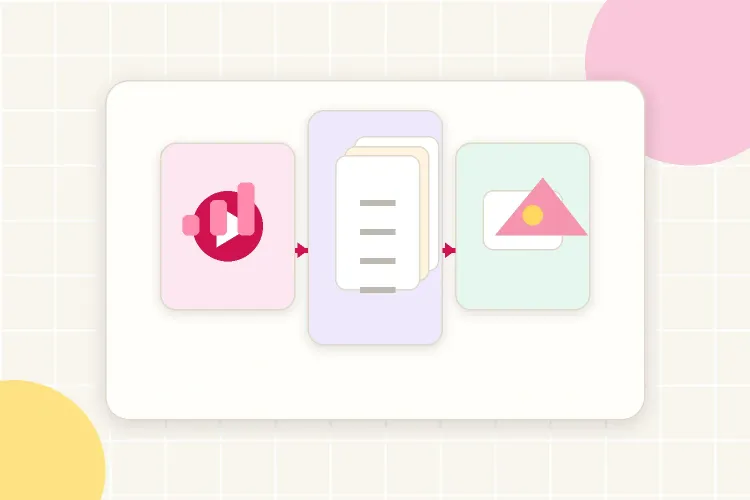
The practical filter is simple: Reels introduce the idea, carousels explain the idea, and images prove or reinforce the idea. A strong Instagram account usually uses all three instead of treating one format as the only path to growth.
When Reels are the best format
Reels are usually the best choice when the post needs reach beyond existing followers. Instagram can place Reels in the Reels feed, Explore-style surfaces, recommendations, and profile previews, which gives them more room to travel than a static post.
That does not mean every Reel performs well. A weak Reel can still disappear quickly. The first seconds matter because people decide fast whether to keep watching, scroll away, or send the post to someone else. If the idea needs motion, a visual demonstration, a before-and-after, a reaction, or a creator talking directly to the audience, Reels are usually the better format.
Good Reel ideas often include:
- A quick before-and-after
- A creator explaining a mistake or lesson
- A product or workflow demonstration
- A trend adapted to a specific niche
- A strong opinion that needs personality
- A process that is easier to show than describe
For creators trying to improve discovery, the hook matters as much as the topic. This guide to Instagram Reel hooks is a useful companion because a good format still needs a reason for people to stop scrolling.
Reels are also useful when the creator needs to build familiarity. A carousel can teach well, but a Reel can show voice, face, pace, humor, confidence, and taste. For brand deals, that matters because brands often want to know whether a creator can make content feel natural, not just whether the account has a certain engagement rate.
When carousels are the best format
Carousels are strongest when the topic needs more than one beat. If a creator wants to explain a pricing framework, break down a campaign example, compare options, or teach a checklist, a carousel gives the reader space to move through the idea at their own pace.
Carousels often work well for saves because they feel useful. A viewer may not need the advice immediately, but the post can become something to revisit later. That makes carousels especially useful for educational creators, business creators, fitness creators, coaches, consultants, and anyone who teaches through frameworks.
A carousel is usually a better choice than a Reel when:
- The idea has several steps
- The reader needs to compare options
- The content includes examples or mini templates
- The post should be saved for later
- The explanation would feel rushed in a short video
- The topic needs clarity more than personality
The first slide does most of the work. It should tell the reader why the carousel is worth opening. A vague first slide like Instagram tips is easy to skip. A sharper first slide like Why your Reel gets views but no followers gives the reader a reason to swipe.
When single images still make sense
Single images are not dead. They are just more specific now. A single image works best when the idea is already simple and the visual does not need more explanation.
For creators, images can still be useful for proof: a campaign result, a press mention, a behind-the-scenes moment, a clean product shot, a quote, a testimonial, or a portfolio-style post. They can also support brand consistency because the grid still acts like a quick trust signal when a brand checks the profile.
Images are a good format when:
- The post is mostly visual
- The message can be understood quickly
- The creator wants to show proof or credibility
- The image supports a bigger campaign
- The caption carries the nuance
- The account needs a cleaner profile moment between videos
The mistake is expecting a simple image to do the job of a discovery post. If the goal is new reach, a static image needs a strong reason to be shared, saved, or discussed. If it is just a nice photo with a generic caption, it may look good on the grid but do very little for growth.
How to build a balanced Instagram content mix
A useful Instagram mix usually starts with the goal, not the format. If the account needs new people, publish more Reels. If the account needs authority, add carousels that explain the creator's point of view. If the account needs proof, use images to make results, moments, and brand fit visible.
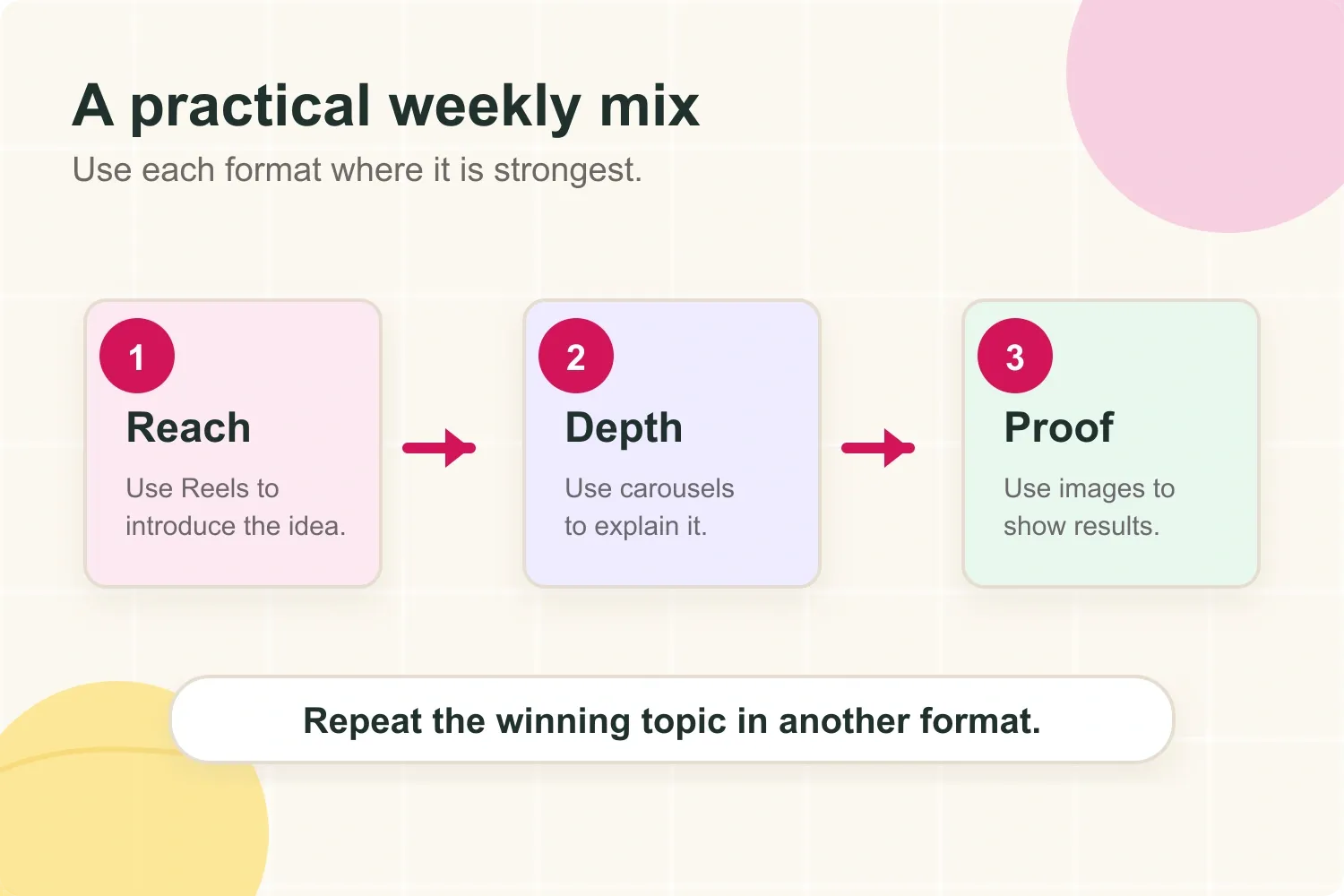
A practical weekly mix might look like this:
- Two Reels to test hooks, reach new viewers, or show personality
- One carousel to teach, compare, or explain a deeper idea
- One image post to show proof, a result, a product moment, or a simple update
The exact ratio should change by niche. A recipe creator may need more Reels because motion makes the food easier to understand. A finance creator may use more carousels because the audience needs step-by-step explanations. A fashion creator may still use images because visual taste is part of the product.
The smartest move is to repeat the winning topic in another format before moving on. If a Reel about pricing performs well, turn the same idea into a carousel with examples. If a carousel about brand outreach gets saved, turn one slide into a Reel. If an image with campaign proof gets comments, use the story behind it as a video topic.
How to decide what to post next
Before choosing a format, ask what the content is supposed to make the viewer do. The same topic can become three very different posts depending on the goal.
If the goal is discovery, use a Reel with a clear hook and fast payoff. If the goal is teaching, use a carousel with a useful sequence. If the goal is credibility, use an image or carousel that shows proof without making the reader work too hard.
A simple decision process:
- Choose the job: reach, saves, proof, trust, clicks, or community.
- Choose the format: Reel for movement and discovery, carousel for depth, image for simple proof.
- Choose the metric: reach for Reels, saves and shares for carousels, comments or profile actions for images.
- Repurpose the winner: turn a good idea into another format before inventing a new topic.
Creators comparing short-form platforms should also remember that Instagram and TikTok do not reward the exact same behavior. The article on Instagram Reels vs TikTok breaks down when to adapt the same idea instead of reposting it unchanged.
The mistake is judging every format by the same metric
A Reel with high reach but low saves is not always a failure. It may have done its job by introducing the account to new people. A carousel with lower reach but high saves can still be valuable because it builds authority with the right audience. An image with modest reach can matter if it helps a brand understand the creator's style or proof.
The real comparison is not which format gets the biggest number? It is which format moves the right number for this post?
Good metrics by format:
- Reels: reach, average watch time, replays, shares, profile visits
- Carousels: saves, shares, swipe-through, comments, follows
- Images: comments, profile actions, clicks, saves, brand-fit signals
For Reels specifically, length and pacing can change performance. This guide to the best Instagram Reel length can help when a video idea is good but viewers drop too early.
Final take
Reels, carousels, and images are not competing for the same job. Reels are usually the best format for reach and discovery. Carousels are better when the idea needs structure, education, or saves. Images still work when the post needs proof, simplicity, or visual trust.
The strongest Instagram strategy uses the format that matches the goal. Start with what the viewer needs to understand, feel, save, or do next. Then choose the format that makes that outcome easiest.