
A creator asking how often to post on TikTok usually wants one number. The practical answer is more useful: start with 2–5 posts per week, then adjust around the quality you can consistently produce, the time you have, and the response from recent videos.
Posting more creates more opportunities to test ideas, but frequency does not rescue weak hooks, unclear topics, or rushed editing. Posting less can work when each video needs research, filming, or careful storytelling. The right cadence is the highest repeatable output that still leaves room to make the next video better.
How often to post on TikTok: start with 2–5 per week
For many solo creators, 2–5 TikToks per week is a sensible starting range. Two posts can keep a creator active while leaving time for production. Five posts create more learning opportunities without automatically turning the week into a content factory.
That range is a baseline, not a platform rule. A creator making quick reactions may comfortably publish daily. A food creator testing recipes, a fitness creator filming demonstrations, or an educator researching claims may produce fewer videos and still build a healthy channel.
Recent Buffer research analyzed 11.4 million TikTok posts from more than 150,000 accounts. It found that moving from one post per week to 2–5 posts per week produced the most efficient lift, with up to 17% more views per post in the comparison. Posting more was associated with additional views, but the gain became less efficient as volume increased. For the methodology and limits, see Buffer’s full analysis of TikTok posting frequency.
The useful takeaway is not “post five times every week.” It is that moving from very low activity to a manageable rhythm can matter more than forcing a much higher volume before the workflow is ready.
A higher-volume point of view comes from Socially Speaking Media, which argues that creators serious about growth should post at least once a day and potentially three times a day when they can support several repeatable formats:
That approach is worth considering when a creator has a fast production system and wants to maximize experimentation. It does not mean that three daily posts are automatically better for every account. The useful question is whether the extra videos create more learning and reach without lowering the quality threshold or exhausting the creator.
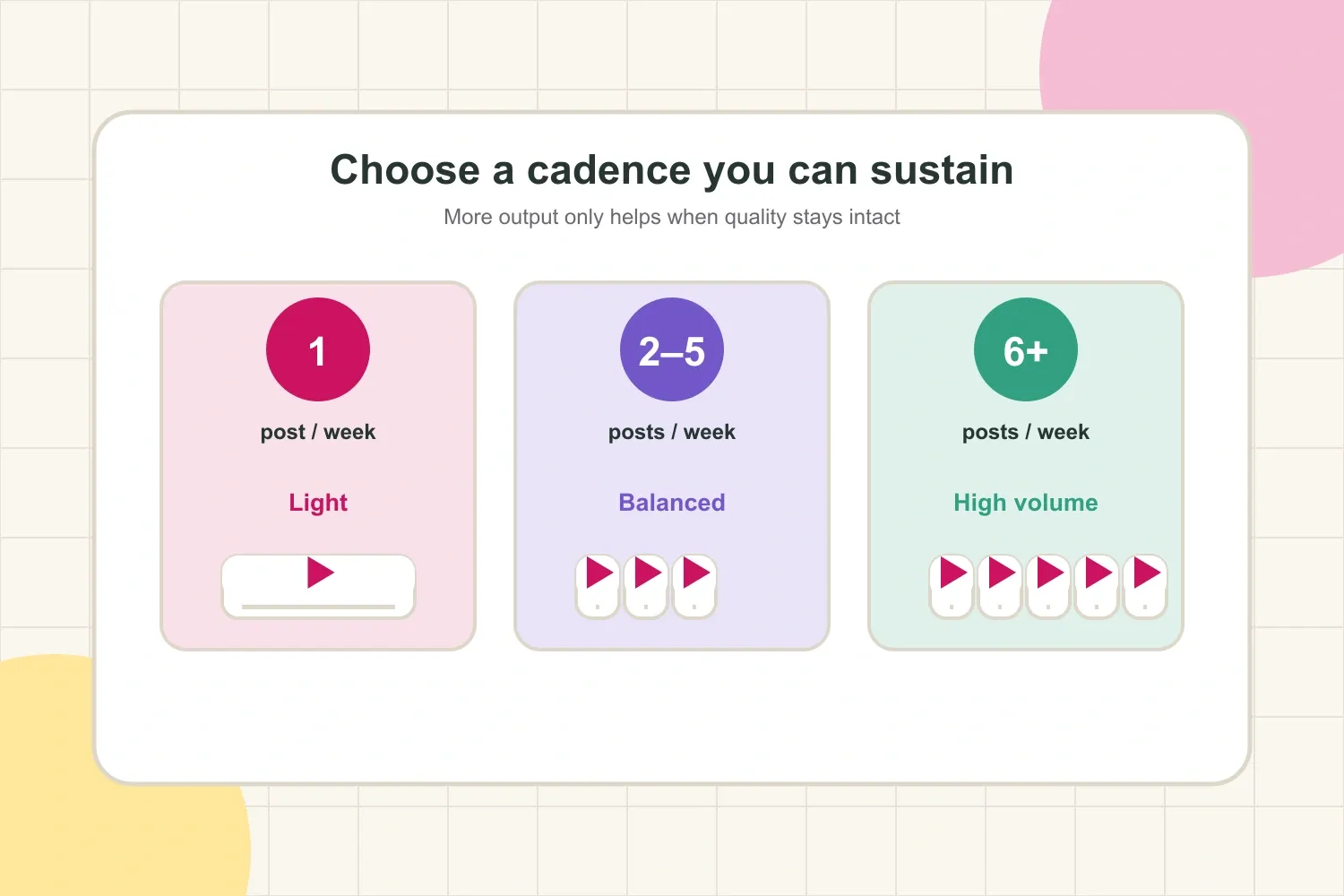
Let production capacity decide the starting cadence
Choose a frequency that fits the work behind the video, not just the time it takes to tap Publish. A TikTok may require scripting, research, filming, editing, captions, product testing, community replies, or brand approvals before it is ready.
Use the starting points below as a planning guide:
| Creator situation | Useful starting cadence | What to protect |
|---|---|---|
| New or part-time creator | 2 posts per week | Enough time to learn the format and finish each video properly |
| Creator with a repeatable workflow | 3–5 posts per week | Consistent topics, hooks, and editing standards |
| Full-time creator or team | 5–7 posts per week | Idea quality, audience clarity, and time to review performance |
| Research-heavy or sponsored content | 1–3 posts per week | Accuracy, trust, approvals, and the creator’s reputation |
The range should reflect your actual bottleneck. If filming is the constraint, batching can help. If ideas are the constraint, publishing more will usually expose the problem faster. If quality control is the constraint, fewer posts with a clearer review process may be the better growth decision.
Build a cadence around repeatable formats
Frequency becomes easier to maintain when every TikTok does not require a completely new creative process. Build a small set of formats that can carry different ideas without making the channel feel repetitive.
Examples include:
- One useful tip or mistake explained in under a minute.
- A response to a recurring audience question.
- A before-and-after, test, comparison, or demonstration.
- A recurring opinion or commentary format with a clear topic boundary.
- A longer explanation broken into several genuinely useful parts, rather than an artificial series that withholds the answer.
The point is not to publish templates mechanically. It is to reduce the energy spent reinventing the structure so more attention can go into the hook, example, pacing, and payoff.
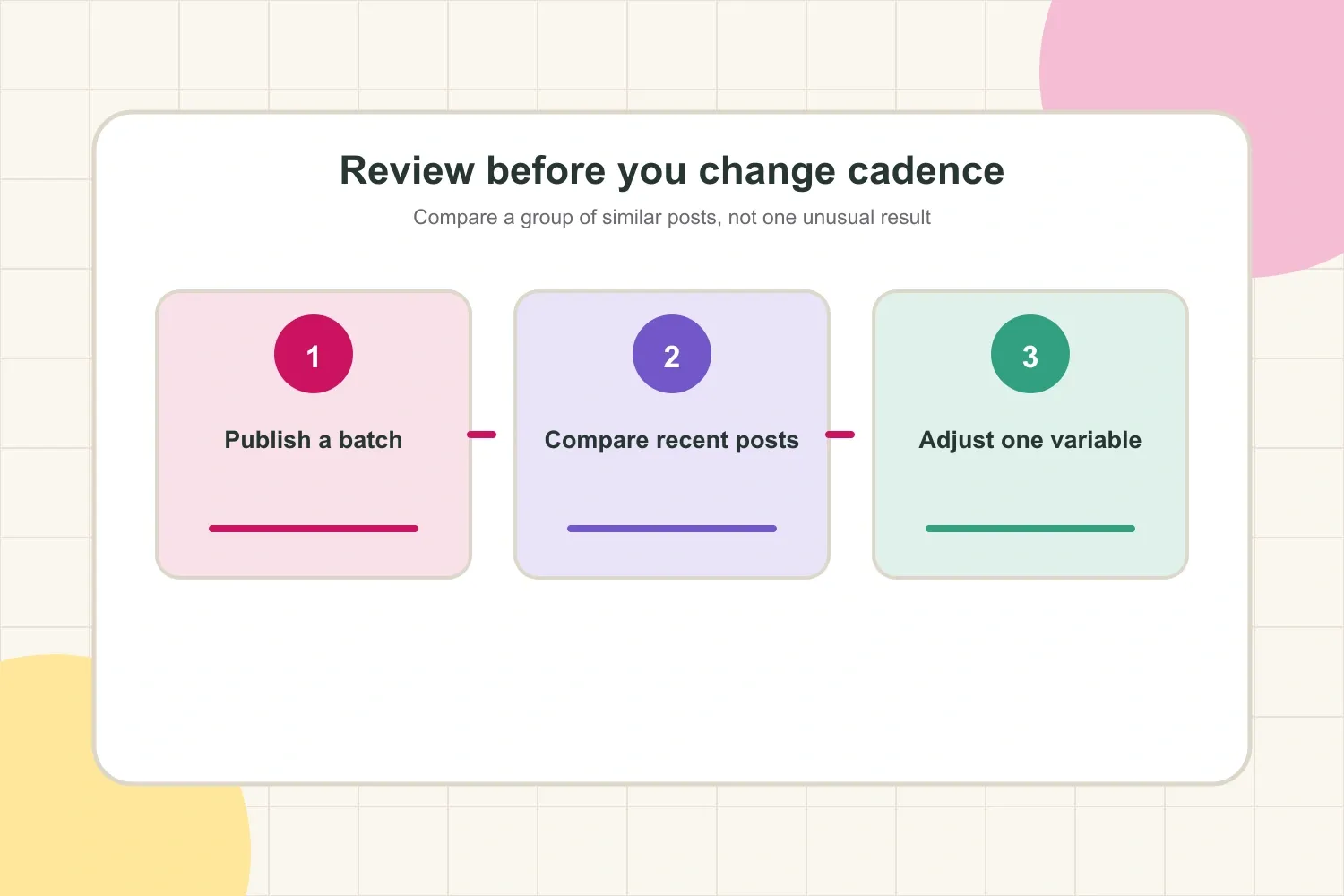
Review a group of posts before changing your frequency
One viral TikTok should not make you double your cadence. One weak post should not make you abandon a schedule that is otherwise working. Review a meaningful group of comparable posts, ideally recent videos covering similar topics or formats, before deciding whether frequency is helping.
Track signals that connect to the goal:
- Reach and discovery: views from the For You feed, profile visits, and new followers from recent posts.
- Viewer response: average watch time, completion or retention, rewatches, shares, saves, and meaningful comments.
- Business outcome: clicks, product interest, affiliate actions, inquiries, or campaign results when the channel has a commercial goal.
- Production health: time per video, missed publishing days, unfinished ideas, and whether quality is slipping.
Do not compare a carefully produced tutorial with a quick reaction as if frequency were the only variable. Compare like with like, and look for a pattern across multiple posts.
Increase your cadence only when the workflow is ready
Increasing frequency makes sense when you can publish more without lowering the quality threshold. Signs that you may be ready include:
- You have more finished ideas than available publishing slots.
- You can batch part of the work without making every video feel identical.
- Recent posts are holding their normal retention and audience response.
- You have enough time to read the results and improve the next batch.
- The extra videos serve the same audience promise instead of filling the feed with unrelated experiments.
If you move to daily or multiple-daily posting, give each upload enough breathing room to collect a meaningful response and avoid publishing near-identical videos back to back. The point is not to protect a fixed interval; it is to make sure the extra volume produces useful learning instead of a crowded, repetitive feed.
Increase in small steps. Moving from two posts to three per week gives you a clearer comparison than jumping immediately to multiple posts per day. Keep the new rhythm long enough to see a pattern, but do not turn the test into a permanent obligation if it damages the work.
Reduce your cadence when volume starts costing quality
Posting less is not automatically a failure. It can be the right move when frequency creates predictable problems:
- Hooks become less specific because ideas are being published too quickly.
- Videos are cut short before the explanation or payoff is complete.
- Editing, captions, or disclosures are rushed.
- The creator stops responding to useful comments or reviewing analytics.
- Sponsored content begins to feel disconnected from the channel’s normal standard.
A lower cadence can still be consistent. If three posts per week are exhausting, two reliable posts may produce better learning and a better audience experience than five rushed uploads.
Keep cadence separate from posting time
Frequency answers how many times you publish. Posting time answers when a specific video goes live. Solve the cadence question first, then use your audience activity and recent performance to refine timing. CreatorsJet’s TikTok best-time calculator is useful for that separate timing question, but it should not turn an unsustainable schedule into a better one.
Timing also should not become an excuse to delay a useful video indefinitely. A consistent, workable rhythm gives you more meaningful performance data than constantly moving uploads around a generic “best time.”
A realistic weekly TikTok workflow
Instead of treating every day as a new emergency, assign different jobs to different parts of the week:
- Plan: choose two to five ideas that fit the same audience promise and identify the hook for each.
- Batch: film related videos together when that saves setup time, while keeping the opening and payoff distinct.
- Publish: space posts according to your available capacity rather than forcing multiple uploads into one day.
- Review: compare recent videos after they have had time to collect meaningful response, then decide what to repeat or change.
This workflow makes consistency operational. It also leaves room for a timely response when a trend, comment, or creator collaboration is genuinely relevant, without making the entire content plan depend on constant trend chasing.
The practical answer
Start with 2–5 TikToks per week, choosing the lower end if your videos are complex or your time is limited. Increase only when your workflow, quality, and recent audience response can support the extra output. If more posts make the content less useful or leave no time to learn, publish less and improve the system around each video.