

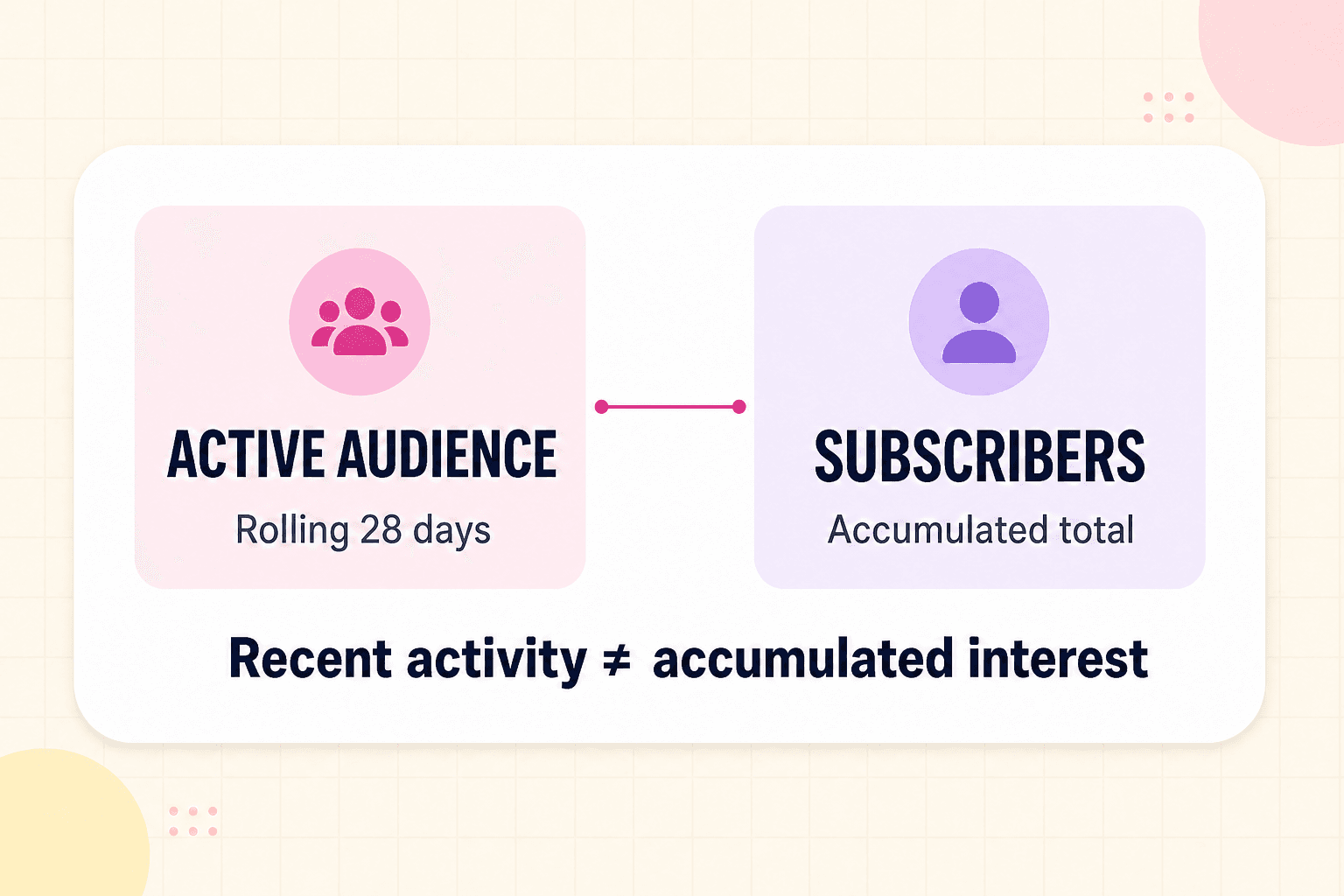
The subscriber count is easy to notice, but it is not the same thing as the number of people currently watching a channel. YouTube monthly audience estimates how many unique viewers watched your content during the previous 28 days. The subscriber count is the accumulated number of accounts that chose to subscribe. One describes recent activity; the other describes a historical relationship.
The short answer is: use monthly audience to understand your current active reach, and use subscribers to understand accumulated interest and conversion. Neither metric is a complete health score. A healthy channel usually turns relevant reach into repeat viewing and, over time, subscribers who continue to watch.
YouTube monthly audience vs. subscribers at a glance
| Question | Monthly audience | Subscribers |
|---|---|---|
| What does it measure? | Unique viewers who watched in a rolling 28-day period | Accounts currently subscribed to the channel |
| What does it tell you? | How many people are active now | How much interest the channel has accumulated |
| Can it include non-subscribers? | Yes, including viewers reached through discovery | No, this is the subscribed audience |
| Best use | Current reach and channel-health trend | Conversion, milestones, and audience context |
YouTube explains that monthly audience is calculated daily from the previous 28 days, so it is a moving estimate rather than a monthly reset. It can include people who watched Shorts, long-form videos, or live streams. The official YouTube explanation of the Audience tab is useful when checking how YouTube defines the metric in your Studio account.
Monthly audience is not the same as monthly views
Monthly audience counts estimated unique viewers, not total views. If one person watches five videos in the same 28-day window, that person still counts as one viewer in monthly audience, while the five plays contribute to views. This is why monthly audience is closer to an active-reach estimate than a monthly view total.
YouTube also groups viewers by how consistently they watch your channel:
- New viewers: people watching your channel for the first time in the selected period.
- Casual viewers: people who watched your channel at least once per month for one to five months during the past year.
- Regular viewers: people who watched your channel at least once per month for more than six months during the past year.
Read these groups alongside monthly audience. A high share of new viewers points to discovery; a growing casual or regular audience shows that more people are developing a repeat viewing habit. These are signals to monitor, not universal targets, so compare them with your own format mix and publishing rhythm.
Why the two numbers differ
Subscribers do not disappear when they stop watching. Someone may subscribe after one useful tutorial, then move on, change interests, stop using YouTube, or only return when a very specific topic appears. That account remains in the subscriber total even when it is not part of the channel’s current monthly audience.
The reverse also happens. A viewer can discover a video through search, recommendations, Shorts, a shared link, or a collaboration without subscribing. That person counts toward monthly audience if they watch during the rolling window, but not toward subscribers.
The metrics therefore have different units and time horizons. Comparing monthly audience directly with total subscribers can be helpful as a directional signal, but it is not a universal conversion-rate benchmark. A channel with a large back catalogue, several formats, or an old viral upload may have a very different relationship between the two numbers than a focused new channel.
Which number reflects your real audience?
If “real audience” means people who have been active recently, monthly audience is the closer answer. It gives you a current estimate of unique viewers, including people who have not subscribed. It is often more useful than subscribers when deciding whether a topic is reaching people now or when explaining recent channel activity to a potential partner.
If “real audience” means people who have explicitly chosen to follow the channel, subscribers matter. The total helps show accumulated trust, gives context to milestones, and remains relevant for platform eligibility or channel history. But it should not be treated as a forecast of how many people will watch the next upload.
For an individual video, neither headline number is enough. Look at views, watch time, returning viewers, traffic sources, and the share of views from subscribers and non-subscribers. A video can reach a large non-subscriber audience and still be healthy if it brings the right people into the channel’s next video.
How to read the gap between monthly audience and subscribers
Monthly audience is much higher than subscribers
This usually means discovery is working. Search, recommendations, Shorts, external sharing, or a collaboration may be bringing in viewers who have not yet decided to subscribe. That is not a problem by itself; it is an opportunity to make the next step clearer.
Check whether those viewers watch the topics you want to be known for. Then improve the path from one video to the next: make the channel promise easy to understand, create related follow-ups, use end screens where relevant, and give viewers a specific reason to subscribe. Do not ask for a subscription before explaining what the viewer will get from staying.
Monthly audience is close to subscribers
This can indicate that a substantial part of the active audience is already subscribed. Review whether the level is stable across several 28-day snapshots and across several uploads. A single event, launch, or viral video can make the relationship look healthier than it is for a short period.
Also check discovery. A channel can have a loyal base while reaching too few new viewers to grow. The useful question is not whether the numbers are close, but whether both the active base and the flow of relevant new viewers are moving in the direction the channel needs.
Monthly audience is much lower than subscribers
This often reflects dormant subscribers, an irregular upload schedule, a change in topic, or a format mix that attracted people who do not watch the current format. It does not automatically mean the channel is failing. Subscribers are an archive of past decisions, not a promise that everyone will return.
Compare recent videos with older ones and separate Shorts, long-form, and live performance. If the audience came from a different format or topic, the solution may be a clearer transition series rather than a desperate attempt to revive every inactive subscriber.
Subscribers are rising while monthly audience is flat
Look for one-off conversion events: a popular video, a giveaway, a collaboration, or a strong call to subscribe. The channel may be earning subscriptions without expanding its active reach. Review which videos produced the subscribers and whether those viewers watched again afterward.
If the pattern repeats, make the channel’s next-video path more visible. A subscriber should know what the channel will continue to deliver, not only what the last video delivered.
Monthly audience is rising while subscribers are flat
This is reach without enough conversion. The content may be discoverable, but the channel promise, series structure, or subscription moment may be unclear. Check whether viewers watch more than one video, which topics bring them in, and whether the channel page makes the next step obvious.
Avoid forcing a subscription request into every introduction. Improve the reason to subscribe: a repeatable series, a clear learning outcome, or a consistent point of view gives the request substance.
A practical channel-health review
Use the same review date and record a small set of metrics. You do not need to inspect every number in Analytics; you need enough context to explain what changed.
- Record the current baseline. Note monthly audience, subscribers, views, watch time, and returning viewers.
- Compare multiple snapshots. Look at at least three or four rolling 28-day periods instead of reacting to one day.
- Separate the format mix. Monthly audience combines Shorts, long-form, and live viewers. Check which format is responsible for the movement.
- Inspect recent uploads. Compare subscriber and non-subscriber views, watch time, traffic sources, and the videos that led people to subscribe.
- Choose one intervention. Adjust the topic, packaging, series bridge, upload rhythm, or subscription prompt, then give the change enough time to produce comparable data.
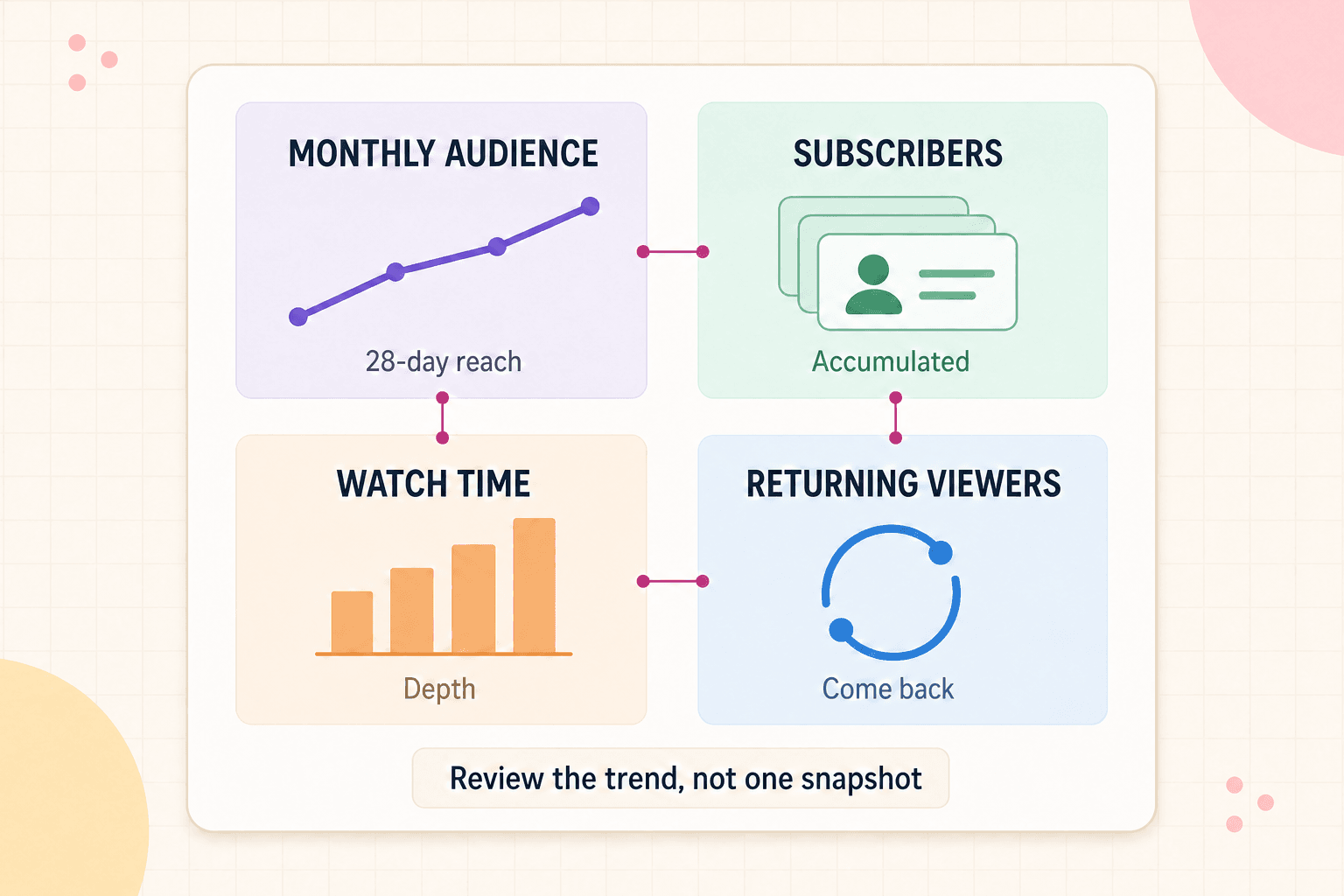
The official YouTube Analytics metrics reference is useful when a label in Studio needs a precise definition. The useful habit is consistency: compare like with like, annotate major uploads, and do not treat every fluctuation as a strategy verdict.
Use the right metric for the decision
| Decision | Metrics to prioritize | Why |
|---|---|---|
| Plan the next topic | Monthly audience trend, returning viewers, watch time | Shows what is active and worth developing |
| Improve discovery | Non-subscriber views, traffic sources, impressions, click-through rate | Shows whether relevant new people can find the content |
| Improve conversion | Subscribers gained by video, repeat viewing, channel-page behavior | Shows whether reach becomes an ongoing relationship |
| Prepare creator proof | Monthly audience, typical views, watch time, audience fit | Gives partners current context beyond a vanity number |
| Track a platform milestone | Subscriber count plus the relevant eligibility metrics | Subscriber total is useful here, but it is not a full health score |
When a topic is reaching new viewers but not building a repeat path, improve the content system rather than only adding a louder call to subscribe. A clearer topic promise and consistent packaging often make the next action easier. The related YouTube SEO guide for creators can help when the gap is connected to topic language, titles, and discovery.
What not to conclude from either number
Do not search for one ideal monthly-audience-to-subscriber ratio. The relationship changes with channel age, format mix, upload frequency, topic breadth, and how much traffic comes from one-off discovery.
Do not assume a high monthly audience is automatically loyal. A viral Short can create a large rolling audience without creating much long-form viewing. Do not assume a large subscriber base is inactive forever either; a timely topic can reactivate people who have not watched recently.
Finally, do not use subscribers alone to forecast an upload. Use recent comparable videos, current audience activity, returning behavior, and the content’s ability to reach non-subscribers. Subscribers show the relationship the channel has accumulated. Monthly audience shows who has been active lately. Channel health is the connection between those two signals and what viewers do next.