
Brands do not track influencer marketing KPIs because they want a pretty report. They track them because every campaign has a decision attached to it: keep spending, change the creator mix, reuse the content, negotiate usage rights, or stop the partnership.
The mistake is reporting every number with the same weight. A brand does not care about reach, saves, clicks, and conversions in the same way on every campaign. The useful question is which KPI proves the campaign goal.
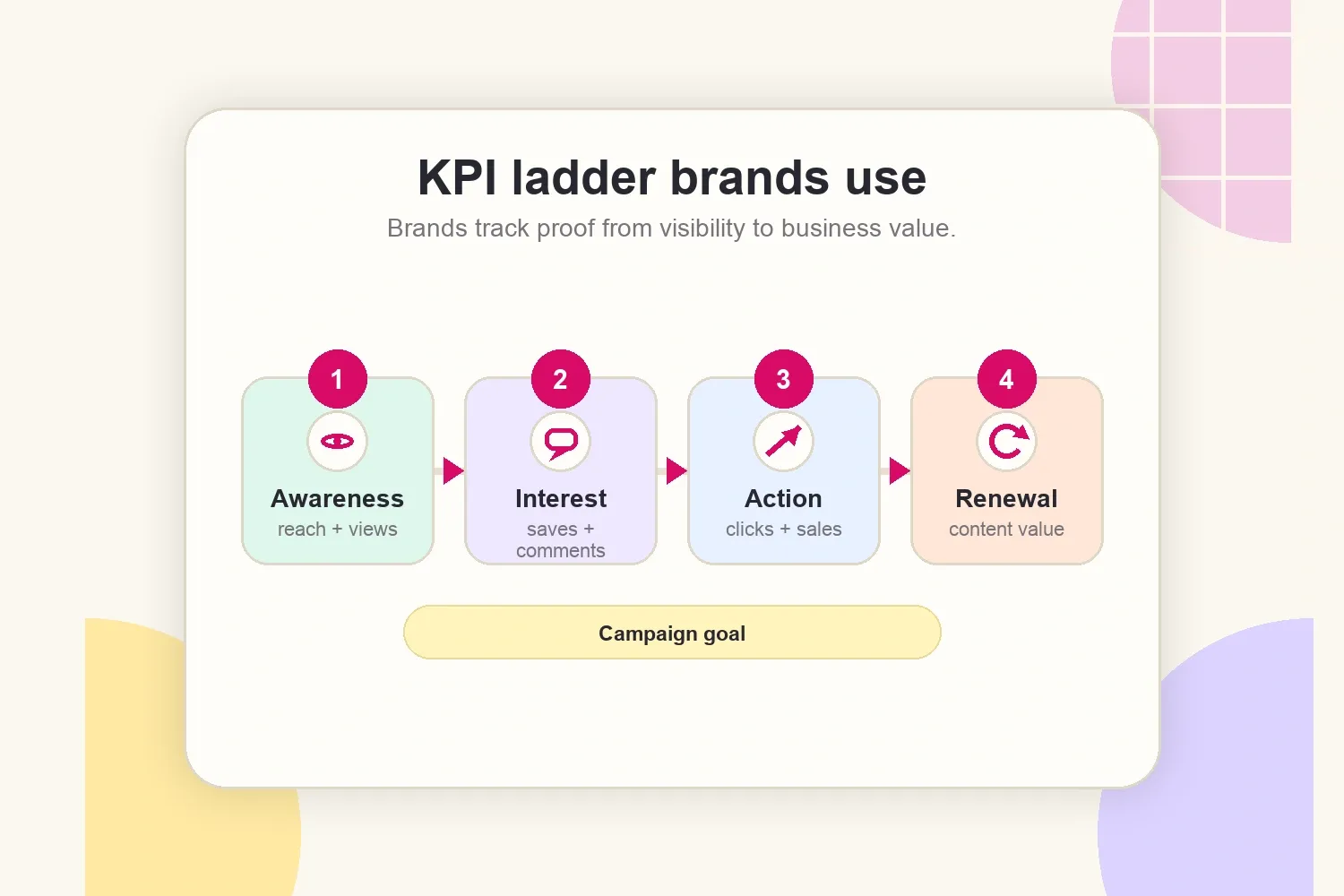
The KPI ladder brands actually use
Most influencer marketing KPIs sit on a simple ladder:
- Awareness: did the right audience see the content?
- Interest: did the audience respond in a way that shows attention?
- Action: did people click, search, use a code, submit a lead, or buy?
- Renewal value: did the creator produce content or proof worth using again?
This is why a single KPI rarely tells the full story. A creator can drive reach without purchase intent. Another creator can drive fewer views but better comments, clicks, and product questions. Brands compare these signals based on the campaign’s goal.
Awareness KPIs: reach, impressions, and views
Awareness KPIs answer one question: did the campaign get in front of enough relevant people?
Brands usually look at:
- Reach: how many unique people saw the content.
- Impressions: how many total times the content was shown.
- Views: how many times the video or post was watched, depending on platform definition.
- Audience fit: whether the creator’s audience matches the brand’s category, geography, age range, language, or buyer profile.
Reach and impressions are not the same. Meta describes reach as the number of accounts exposed to a message during a campaign, while impressions count exposure volume differently depending on placement and format (Meta reach metrics).
If the campaign goal is awareness, reach matters. But brands still care whether the reach is relevant. A beauty brand would rather reach 40,000 skincare buyers than 200,000 random viewers who never buy beauty products.
For a deeper breakdown of this distinction, use the guide on engagement rate vs reach.
Engagement KPIs: quality beats volume
Engagement tells the brand whether people cared enough to react. But brands increasingly look beyond the raw engagement count.
The useful engagement KPIs are:
- Likes, comments, shares, saves, replies, and profile taps.
- Comment quality, especially product questions, objections, buyer intent, or comparison comments.
- Save rate when the content teaches, lists, explains, or helps the audience decide later.
- Share rate when the content is useful enough for someone to send to a friend.
- Engagement rate compared with the creator’s normal baseline.
Not every engagement signal has the same value. A comment like “love this” is not the same as “does this work for sensitive skin?” The second comment gives the brand insight into purchase intent, product positioning, or friction.
That is why follower count is a weak KPI by itself. A creator with 20,000 followers, steady views, real comments, and repeat engagement can give a brand more useful proof than a larger account with one viral post. The brand-side perspective here matches the reporting logic: consistent engagement is a trust signal, not just a vanity metric.
Traffic and action KPIs: what happened after the view
When the campaign is meant to move people toward a purchase, brands track what happened after the audience saw the content.
Common action KPIs include:
- Link clicks.
- Landing page sessions.
- Add-to-cart events.
- Lead submissions.
- Coupon code uses.
- Affiliate revenue.
- Purchases.
Google Analytics documents standard dimensions and metrics, including conversion-related metrics, that brands can use to connect campaign traffic to site actions (Google Analytics dimensions and metrics).
This is where attribution gets messy. A creator may influence a sale even if the buyer does not click directly. Someone may watch a Reel, search the brand later, visit from Google, and buy three days after the post. Good reporting acknowledges that limitation instead of pretending every sale can be tied perfectly to one creator.
Conversion KPIs: when brands care about sales
Conversion KPIs matter most when the campaign has a direct response goal. They are also the easiest KPIs to overread.
Brands may track:
| KPI | What it tells the brand | What it does not prove alone |
|---|---|---|
| Coupon use | Direct attributed demand | Total influence of the post |
| Affiliate sales | Revenue through tracked links | Viewers who bought later elsewhere |
| Conversion rate | Traffic quality | Whether the creator built awareness |
| Cost per acquisition | Efficiency | Long-term customer value |
The important point is context. A creator with a small audience but high conversion quality may be more valuable for lower-funnel campaigns than a creator with huge reach and little buyer intent.
Content value KPIs: what brands can reuse
Brands do not only buy reach. They also buy content. If the creator produces a useful tutorial, product demo, testimonial, or ad-style video, the brand may track whether the asset is worth reusing.
Content value KPIs include:
- Hook quality.
- Watch time or retention.
- Product clarity.
- Number of usable cuts.
- Ad-readiness.
- Comments that reveal objections or buyer language.
- Whether the asset can support paid usage or whitelisting.
This is especially important for UGC-style campaigns. A video may not drive the most organic reach, but it may become a high-performing paid ad asset. In that case, the KPI is not just views. It is creative usefulness.
Brand awareness KPIs: when sales are not the immediate goal
Some campaigns exist to make a brand more familiar before the audience is ready to buy. For those campaigns, brands track lift-style signals rather than only sales.
Useful awareness KPIs include:
- Branded search lift.
- Follower growth during and after the campaign.
- Direct traffic changes.
- Mentions and tagged posts.
- Share of voice in a niche.
- Audience comments showing recognition or recall.
The guide on how to measure brand awareness in influencer marketing goes deeper on these signals. The key idea is that awareness reporting should show whether the brand became more recognizable, not just whether a post got views.
Renewal KPIs: what makes a brand book again
Renewal is one of the most overlooked influencer marketing KPIs. Brands often use the first campaign to decide whether the creator deserves another campaign, a retainer, affiliate deal, or paid usage package.
Brands look at:
- Was communication reliable?
- Did the creator follow the brief without becoming generic?
- Did the content require heavy revisions?
- Did the audience response match the campaign goal?
- Did the creator provide usable reporting on time?
- Did the content create learning the brand can use later?
This is why creators should report both numbers and context. A report that says “45,000 views” is less useful than a report that says “45,000 views, high saves, repeated product questions about shade matching, and better response from tutorial content than unboxing content.”
Example: matching KPIs to campaign goals
The cleanest KPI report starts with the goal. Here is a simple way to think about it:
| Campaign goal | Primary KPIs | Supporting KPIs |
|---|---|---|
| Awareness | Reach, views, audience fit | Follower growth, brand mentions |
| Education | Saves, watch time, comments | Shares, product questions |
| Traffic | Link clicks, sessions | CTR, landing page engagement |
| Sales | Code uses, purchases, revenue | Conversion rate, CPA |
| Content reuse | Retention, hook quality, usable clips | Comment insights, ad readiness |
The brand does not need every number. It needs the numbers that explain whether the campaign moved toward the intended outcome.
How creators should report KPIs to brands
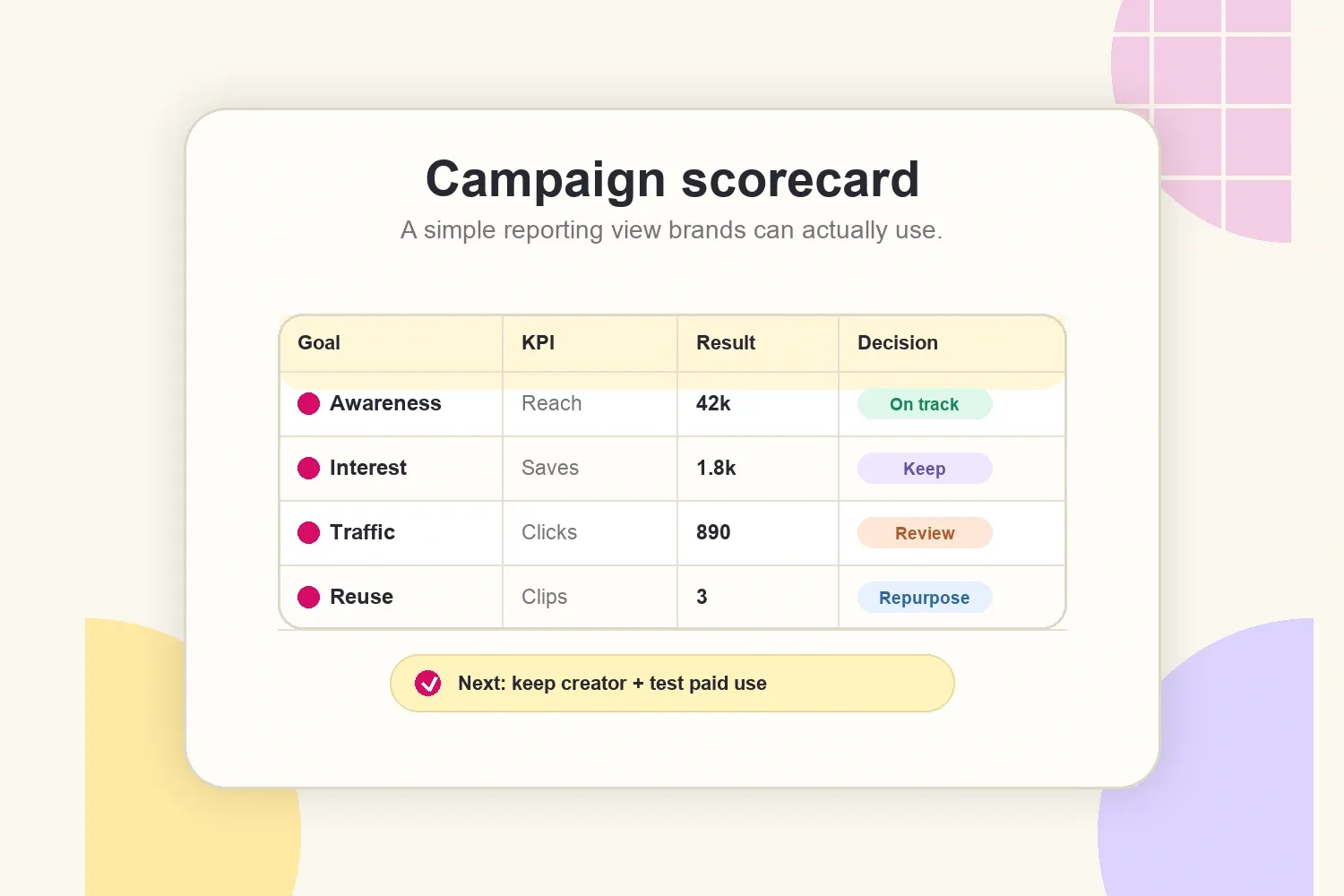
A good report should be short, structured, and decision-friendly.
Use this format:
- Goal: what the campaign was supposed to achieve.
- Primary KPI: the metric that best reflects that goal.
- Supporting signals: numbers that explain why the primary KPI did or did not work.
- Audience insight: what the comments, questions, saves, or clicks reveal.
- Recommendation: what the brand should do next.
For agencies and teams reporting to clients, the article on ROI tracking for agencies explains how to connect KPI reporting to business proof.
The bottom line
Brands track influencer marketing KPIs to make decisions. Reach shows visibility. Engagement shows attention. Clicks and conversions show action. Content value shows whether the asset can keep working after the post goes live. Renewal signals show whether the creator is worth booking again.
The best influencer reports do not drown the brand in data. They answer the practical question behind the campaign: what worked, why it worked, and what should happen next.