

A TikTok hook is the opening line, visual, or setup that makes someone stop scrolling long enough to understand why the video is worth watching. The best TikTok hook templates are not magic phrases. They are simple structures that make the promise clear fast.
Use them as starting points, then adapt the topic, viewer, and payoff to the video. A hook about skincare, brand deals, gym progress, or editing can use the same structure, but the wording still needs to feel specific to the audience.
What makes a TikTok hook work?
A good hook does three things quickly: it tells the viewer who the video is for, creates a reason to stay, and hints at the payoff. If the first seconds are too vague, even a useful video can feel easy to skip.
TikTok’s own Creative Center is useful for spotting recurring formats and creative patterns, but the goal is not to copy trending videos word for word. The goal is to understand why a format makes people watch.
A strong hook usually fits one of these intents:
- Curiosity: the viewer wants to know what happens next.
- Problem: the viewer recognizes a mistake, frustration, or blocked result.
- Proof: the viewer sees a transformation, result, test, or example.
- Identity: the viewer feels directly called out by age, niche, role, goal, or situation.
- Utility: the viewer understands that the video will save time, explain something, or give a usable template.
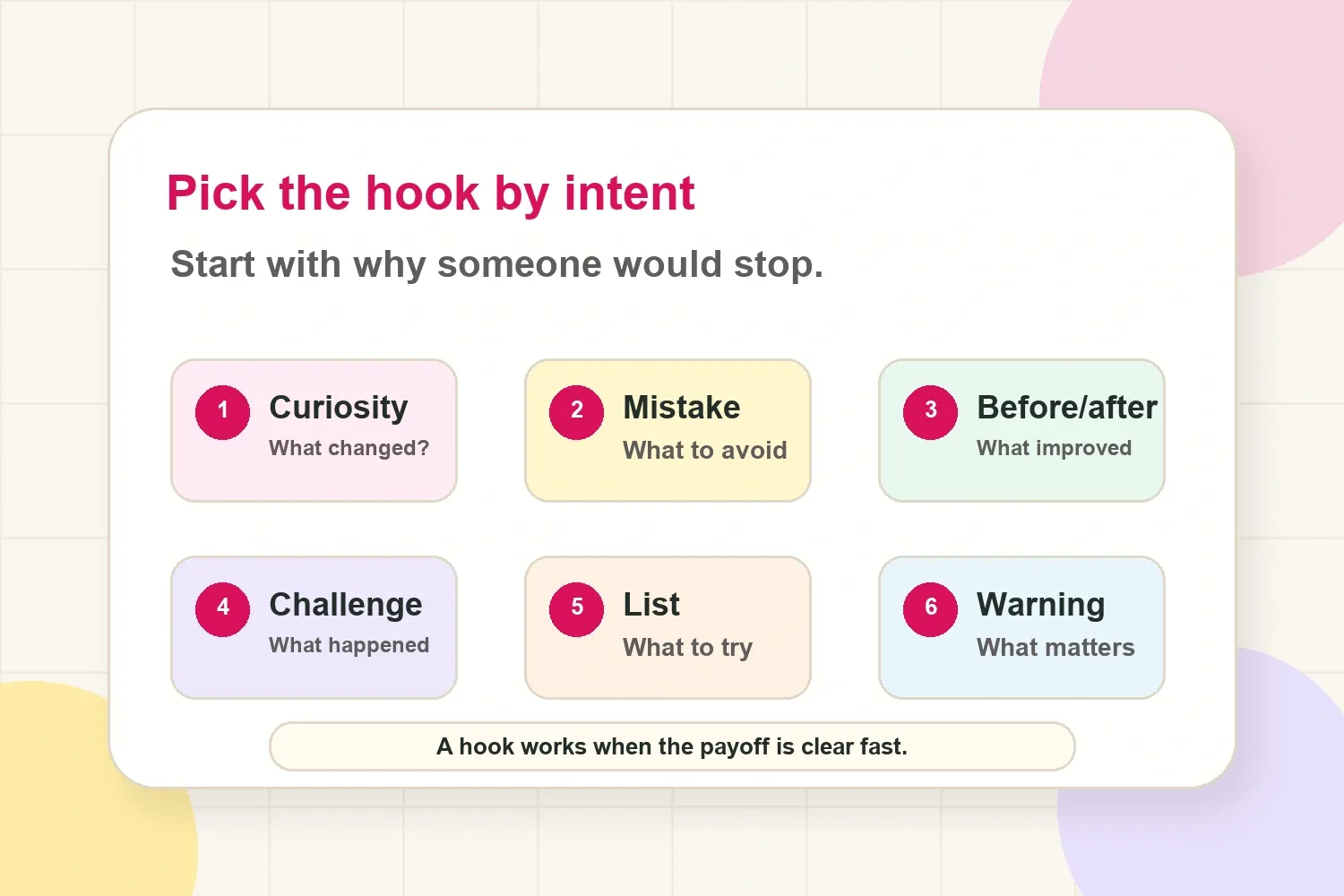
A quick way to choose the right hook
Before choosing a template, decide what the viewer needs to feel in the first three seconds. A tutorial needs clarity. A transformation needs contrast. A mistake-based video needs tension. A relatable video needs specificity.
| Hook type | Best for | Simple structure |
|---|---|---|
| Curiosity | Teasing a reveal | What most people miss about [topic] |
| Mistake | Fixing a common problem | Stop doing [habit] if you want [result] |
| Before/after | Showing transformation | From [before] to [after] in [time] |
| Challenge | Testing a behavior | Try [action] for [time] and watch [result] |
The cleanest hooks are usually short enough to understand without replaying the video. If the viewer has to decode the sentence, the hook is already doing too much.
15 TikTok hook templates you can adapt
1. “I went from [before] to [after]”
Use this when the video has a clear transformation. It works because the viewer instantly understands the starting point and the result.
Examples:
- “I went from 300 views to 40,000 views by changing one thing.”
- “I went from messy content ideas to a weekly posting system.”
- “I went from free collaborations to paid brand deals.”
The best version includes a specific before and after. “I improved my content” is weak. “I doubled my saves by changing the first slide” is much stronger.
2. “I tried [thing] for [time]”
This hook works for experiments, routines, platform tests, and creator challenges. The time frame gives the viewer a reason to stay for the result.
Examples:
- “I posted one TikTok a day for 14 days and tracked what happened.”
- “I tested three hook styles for a week.”
- “I changed my first sentence on every video for seven days.”
Use this format when the video can show a clear lesson, not just a diary.
3. “If you are [specific viewer], stop doing this”
This is useful when the topic targets a clear audience. The hook works because the viewer feels directly addressed.
Examples:
- “If you are a small creator, stop pricing brand deals from follower count alone.”
- “If your TikToks get views but no followers, check this first.”
- “If you are pitching brands, stop sending this sentence.”
Keep the viewer label specific. “If you want to grow” is too broad. “If your videos get views but no comments” is more useful.
4. “Nobody tells you this about [topic]”
Use this when the video explains an overlooked detail. It works well for creator education, platform behavior, pricing, and brand deal advice.
Examples:
- “Nobody tells you this about gifted collaborations.”
- “Nobody tells you this about TikTok hooks.”
- “Nobody tells you this about content that gets saved.”
The point after the hook needs to be genuinely useful. If the reveal is obvious, the hook feels like bait.
5. “Here is why your [result] is not happening”
This template is strong for troubleshooting videos. It turns a vague frustration into a specific diagnosis.
Examples:
- “Here is why your TikToks get views but no followers.”
- “Here is why brands are opening your email but not replying.”
- “Here is why your carousel gets likes but no saves.”
This format works best when the video gives one clear reason, not ten possible guesses.
6. “The biggest mistake with [topic]”
Mistake hooks work because they create urgency without needing fake drama. They also fit educational content well.
Examples:
- “The biggest mistake creators make with TikTok hooks.”
- “The biggest mistake in brand deal pricing.”
- “The biggest mistake with Instagram carousels.”
Make the mistake concrete. The viewer should know what to avoid by the end of the video.
7. “Do this before you [action]”
Use this when the video is about preparation, checks, or workflow. It creates a useful pause before a common action.
Examples:
- “Do this before you post your next TikTok.”
- “Do this before you send a rate to a brand.”
- “Do this before you accept a gifted collaboration.”
This is especially useful when the advice prevents a common mistake.
8. “[Number] things to check before [goal]”
Numbered hooks are easy to follow because they create structure. They work well for checklists and quick guides.
Examples:
- “3 things to check before posting a TikTok.”
- “5 things brands look at before offering a deal.”
- “4 things to fix before changing your content strategy.”
Keep the number realistic. If the video is short, three points are usually better than ten.
9. “POV: [specific situation]”
POV hooks work when the situation is instantly recognizable. They are strongest for relatable creator moments, brand conversations, client work, or niche-specific problems.
Examples:
- “POV: a brand asks for usage rights on a gifted collab.”
- “POV: your video gets views but nobody follows.”
- “POV: the first draft of your hook is too vague.”
The situation needs to be specific enough that the right viewer feels seen.
10. “This looks wrong, but it works because [reason]”
Use this when the advice goes against what people expect. It works because it creates a small contradiction.
Examples:
- “This hook looks too simple, but it works because it names the problem fast.”
- “This caption looks short, but it works because the video carries the context.”
- “This pitch looks direct, but it works because the value is clear.”
The reason matters. Without it, the hook can feel like a trick.
11. “Steal this [template/system/script]”
This hook is useful for practical content where the viewer leaves with something reusable.
Examples:
- “Steal this TikTok hook template.”
- “Steal this brand pitch structure.”
- “Steal this content planning system.”
Use it only when the video actually gives the template. Otherwise, it feels thin.
12. “You do not need [common belief] to [result]”
This template is strong when the viewer has a limiting belief. It works well for small creators because it challenges assumptions.
Examples:
- “You do not need 100,000 followers to land paid brand deals.”
- “You do not need a perfect setup to make useful TikToks.”
- “You do not need a new niche to improve retention.”
The best version replaces the belief with a better action.
13. “The fastest way to [outcome] is not [obvious tactic]”
This hook creates curiosity by rejecting the obvious answer. It fits strategy videos, growth lessons, and creator business topics.
Examples:
- “The fastest way to improve TikTok hooks is not using louder text.”
- “The fastest way to get better brand deals is not sending more emails.”
- “The fastest way to improve Reels is not copying trends.”
Then explain the better lever clearly.
14. “Rating [thing] so you do not have to”
This works for reviews, comparisons, tools, content formats, hooks, products, or tactics. It gives the viewer a shortcut.
Examples:
- “Rating TikTok hook styles so you do not have to.”
- “Rating creator media kit sections by how much brands care.”
- “Rating brand deal red flags from harmless to serious.”
This format needs clear criteria, otherwise it becomes personal preference without value.
15. “Save this before you [task]”
Use this when the video is genuinely useful as a reference. It works best for checklists, scripts, templates, steps, or formulas.
Examples:
- “Save this before you write your next TikTok hook.”
- “Save this before you price a sponsored post.”
- “Save this before you pitch a brand.”
Only use this hook when the content is worth saving. A save-based hook raises expectations.
Why one hook can work across different niches
Some hook structures travel well because they are based on human attention, not one specific niche. A before-and-after hook works for fitness, skincare, content strategy, cooking, study habits, and creator growth because it promises a visible change.
The useful lesson is not to copy the exact words. It is to notice the structure: a clear before, a clear after, and a reason to keep watching long enough to understand the shift.
That kind of example is useful because it shows the same hook pattern moving across niches. The line changes, but the job stays the same: make the viewer understand the promise quickly.
How to script the first three seconds
The first three seconds should do less than most creators think. They do not need to explain the whole video. They need to make the right viewer feel, “this is about me, and the payoff is clear.”
A simple structure is:
- Name the viewer or problem.
- Show the tension or result.
- Move quickly into proof, steps, or the example.
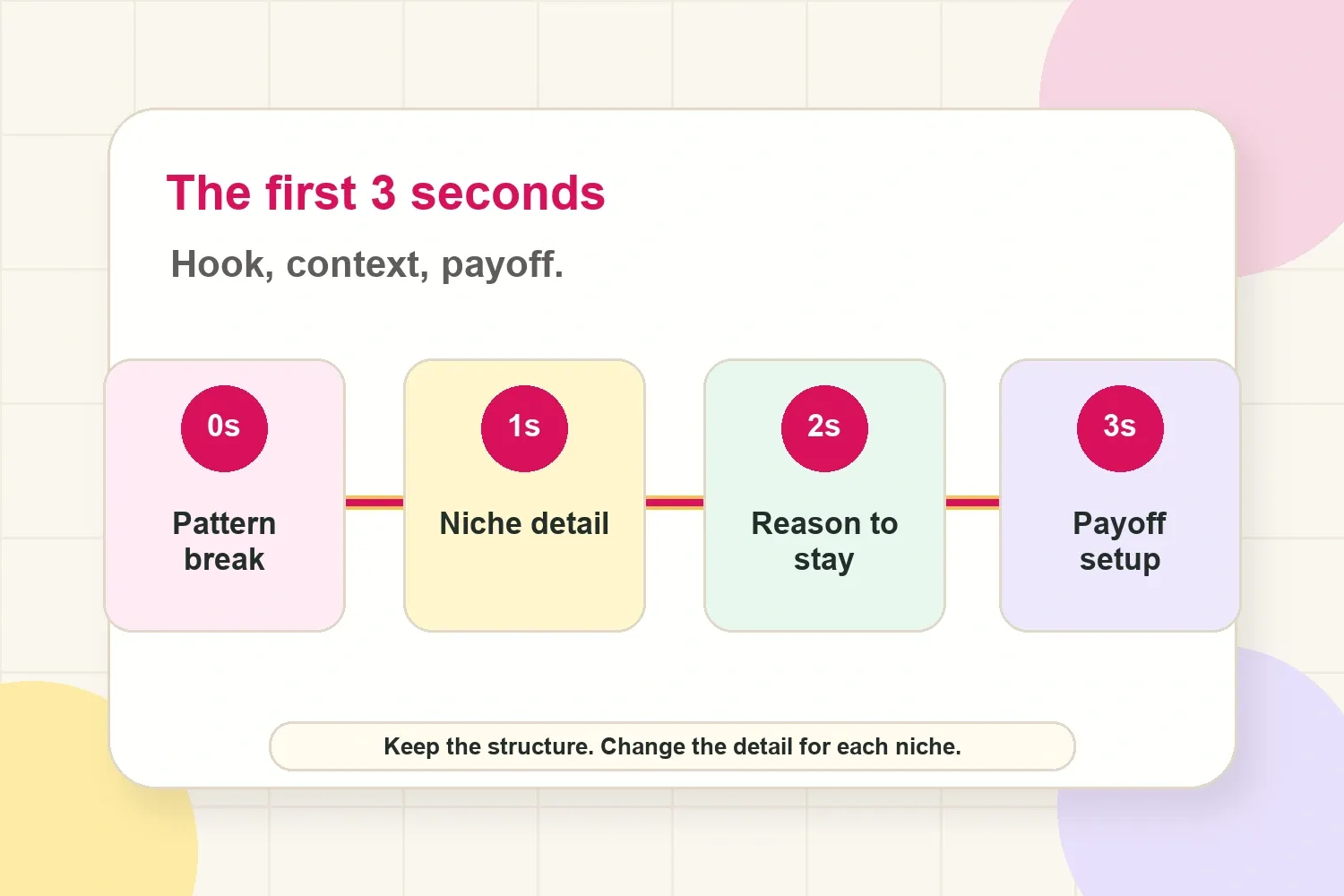
For example, a video about brand deals could open with “If brands ask for your rates and you freeze, use this pricing structure.” That line names the viewer, the problem, and the payoff without needing a long setup.
Common TikTok hook mistakes
The most common mistake is making the hook too broad. “How to grow on TikTok” is technically clear, but it does not feel urgent. “Why your TikToks get views but no followers” is sharper because it names a specific problem.
Another mistake is using a hook that the video does not answer. If the hook promises a result, the video needs to deliver that result. If the hook promises a template, the viewer should leave with a usable template.
Avoid these patterns:
- Hooks that sound dramatic but lead to basic advice.
- Hooks that target everyone instead of a specific viewer.
- Hooks that use too many ideas at once.
- Hooks that take too long before reaching the actual point.
- Hooks copied from another niche without adapting the context.
How to test TikTok hooks without guessing
Testing hooks works best when only one thing changes at a time. Keep the topic, format, and video length similar, then test different openings.
A simple testing process:
- Pick one recurring content topic.
- Write three hook options for the same idea.
- Post versions over time without changing the whole format.
- Compare retention, rewatches, comments, saves, shares, and follows.
- Keep the structure that brings better viewers, not just more views.
If the goal is to sharpen short-form intros across platforms, this companion guide on Instagram Reel hook formulas can help adapt the same thinking to Reels. For broader idea development, this list of viral TikTok content ideas for new creators gives formats that pair well with hook testing.
Hook testing also connects to the bigger question of what makes short-form content spread. This breakdown of what makes Reels go viral is useful when the goal is not only stronger openings, but better retention and share value across the whole post.
Final thoughts
TikTok hooks are easier to write when they are treated as structures, not magic words. A good template helps define the viewer, the problem, and the payoff fast.
Start with one hook family that fits the video: transformation, mistake, curiosity, checklist, proof, or identity. Then make the wording specific enough that the right viewer knows why they should keep watching.