

When a brand says they have no budget, the creator has two jobs: stay professional and protect the value of the work. A no-budget reply does not always mean the opportunity is useless. It can mean unpaid exposure, a gifted product offer, a low-budget test, an affiliate-only deal, or a real future campaign that is not funded yet.
The important part is not replying emotionally. The practical move is to ask what the brand is actually offering, decide whether it supports your creator business, and answer in a way that keeps your positioning clear.
What no budget usually means
When a brand says there is no budget for influencer work, the phrase can mean several different things.
It may mean:
- They want content in exchange for product.
- They want organic social coverage but cannot pay a fee.
- They have budget for paid ads, gifting, events, or product seeding, but not creator fees.
- They are testing creators before asking for internal budget.
- They have a small budget but are using "no budget" to start the negotiation low.
- They genuinely have no campaign budget and are hoping some creators will still say yes.
Those are very different situations. A gifted package from a brand you already use is not the same as a request for three Reels, usage rights, and a one-month exclusivity clause with no fee.
Before replying, separate the opportunity from the wording. The brand may not be trying to be disrespectful. But if the deliverables require real work, the response should make that clear.
First, ask what is included
Do not negotiate against the phrase "no budget" alone. Ask what the brand has in mind.
A simple reply can be:
Thanks for thinking of me. Could you share what you had in mind for deliverables, timeline, usage rights, exclusivity, and whether this is gifted, affiliate, or unpaid exposure?
That question does two things. It keeps the tone professional, and it forces the brand to define the scope.
The scope matters because "no budget" can hide expensive requests. A creator might be fine accepting a product with no posting obligation. That is different from creating edited content, posting to an audience, granting paid usage, and giving the brand approval rights.
Decide whether the opportunity is worth considering
Not every unpaid or gifted opportunity is bad. The problem is accepting unpaid work by default, without understanding what it costs.
Use a quick decision filter:
| Question | Why it matters |
|---|---|
| Would you use the product anyway? | A product you genuinely like is less risky than something you would never mention organically. |
| Is there a required post? | A required deliverable turns a gift into work with a deadline. |
| Does the brand want usage rights? | Usage rights can be valuable even if the post is unpaid. |
| Is there exclusivity? | Exclusivity can block paid deals in the same category. |
| Can it lead to credible proof? | A small opportunity may help if it gives you a result, testimonial, or brand relationship. |
| Does it weaken your positioning? | Saying yes to the wrong deal can teach the brand that your work is free. |
If the answer is mostly no, pass politely. If the answer is mixed, offer a smaller scope. If the answer is yes, set boundaries so the brand knows it is still a professional collaboration.
How to respond to a gifted-only offer
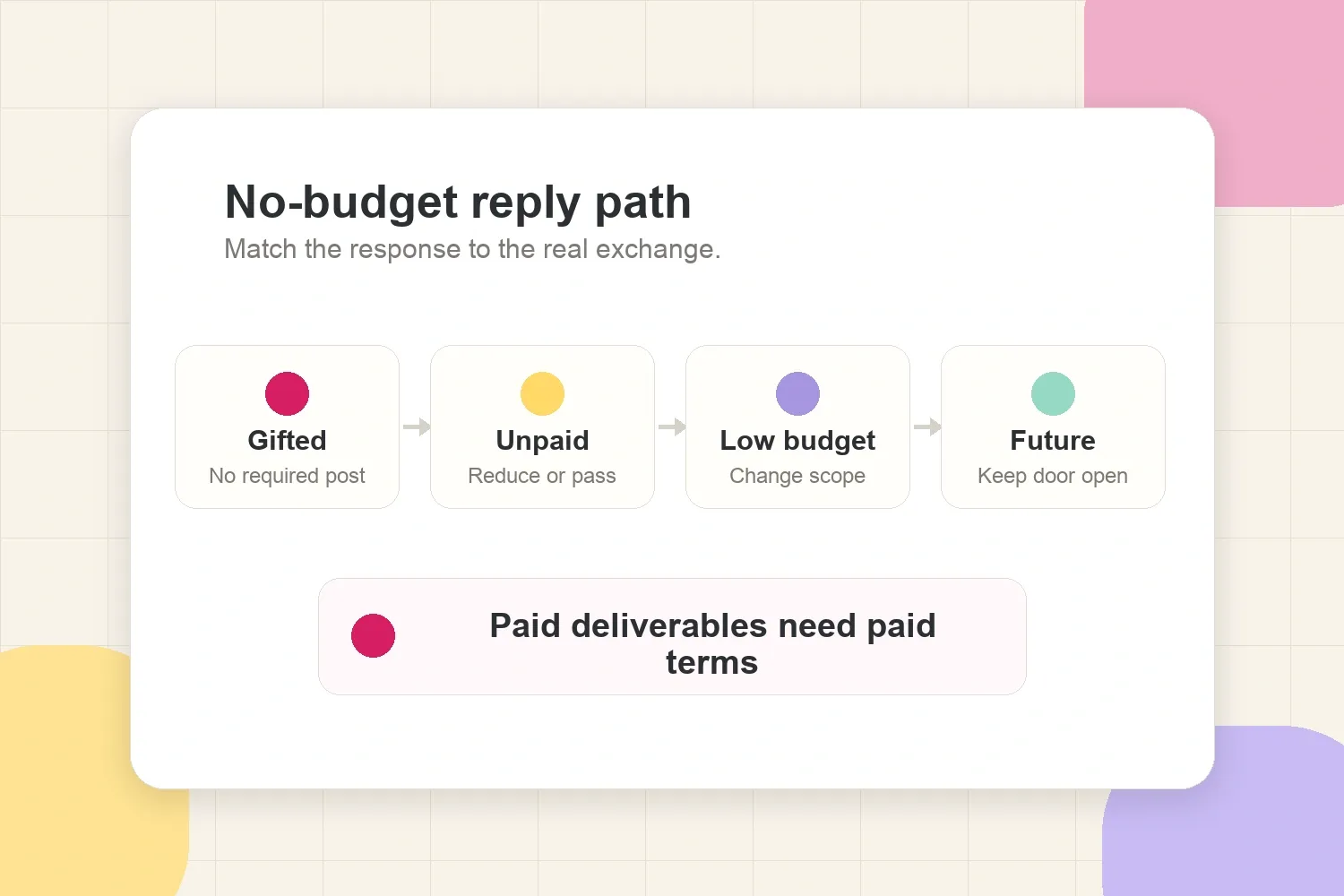
Gifted collaborations can make sense when the product is valuable, relevant, and the expectation is reasonable. The key is to separate receiving a gift from promising content.
If you are open to receiving the product, make the boundary clear. Receiving a product does not automatically mean a guaranteed post.
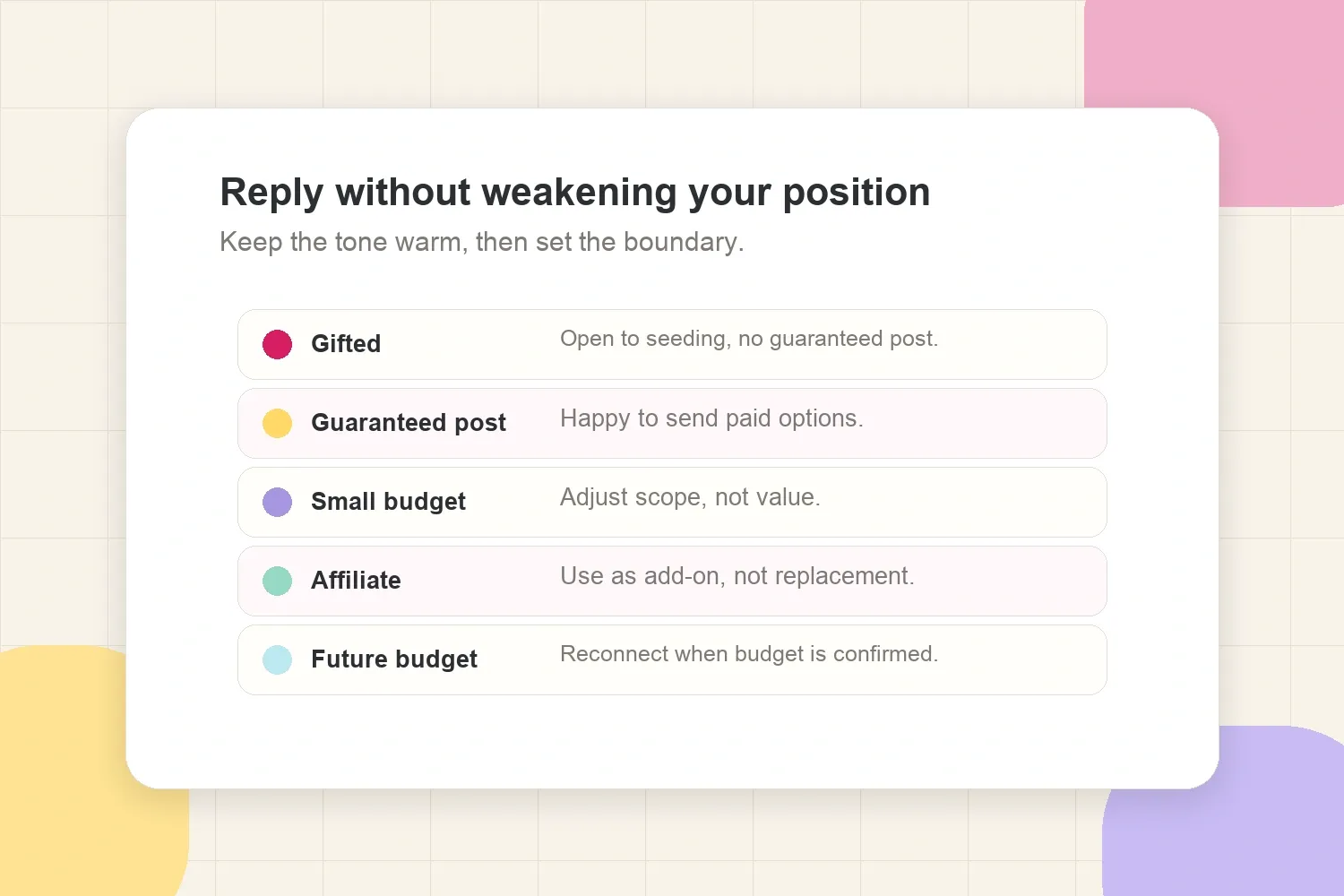
You can say that you are open to product seeding, but that any mention would be organic and only happen if the product genuinely fits your audience.
If the brand wants a guaranteed post, move the conversation back to paid scope.
For guaranteed content, frame it as real campaign work: planning, production, publishing, and reporting need paid terms.
This protects your positioning without sounding difficult. You are not rejecting the brand. You are separating product seeding from paid deliverables.
Also remember that product seeding can still create a brand relationship your audience should understand. Instagram's creator guidance on branded content is useful context when a gifted offer starts turning into a guaranteed or paid partnership.
How to respond when they offer exposure
"We cannot pay, but this will be great exposure" is usually weak unless the exposure is specific and useful.
Useful exposure might mean:
- A feature on a brand channel with an audience that matches yours.
- A clear tag and link to your profile.
- A credible portfolio moment with a brand your audience recognizes.
- Access to an event or product experience you can use for your own content.
Vague exposure is different. If the brand cannot explain what the exposure is, who will see it, and how it helps you, it is not a clear value exchange.
A professional response:
Thanks for explaining. I usually reserve guaranteed content for paid partnerships. If there is no budget, I can consider product seeding with no posting obligation, or we can revisit when there is budget for sponsored content.
If the opportunity does have real non-cash value, keep the scope small:
I could consider one organic Story mention if the product is a genuine fit and there is no approval process, usage, exclusivity, or required performance reporting.
That kind of answer prevents a casual "exposure" offer from turning into a full campaign.
How to respond to a low-budget offer
Low budget is different from no budget. If the brand has some money, the best move is usually to adjust the scope instead of lowering your rate for the same deliverables.
Do not say:
I can do the full package for less.
Say:
Thanks for sharing the budget. I can adjust the scope to fit that. For that range, I could offer one Story set, one short-form UGC video without usage rights, or a smaller deliverable instead of the full package.
This keeps your rate logic intact. You are not discounting the same work. You are changing the offer.
Good scope reductions include:
- One Story set instead of a Reel.
- UGC only instead of posting to your audience.
- No usage rights included.
- Shorter usage period.
- Fewer revisions.
- No exclusivity.
- No campaign report beyond basic screenshots.
If the brand wants paid usage, ad rights, whitelisting, exclusivity, or extra revisions, those should be priced separately. A low creator fee should not quietly include everything.
How to handle affiliate-only offers
Affiliate-only offers are common when a brand says there is no upfront budget. They are not automatically bad, but they shift the risk to the creator.
Affiliate can make sense when:
- The product has clear demand.
- The commission is meaningful.
- The brand's site converts well.
- The audience already asks for product recommendations in that category.
- The creator can share the offer naturally without overcommitting time.
Affiliate is risky when:
- The product is expensive, unknown, or hard to explain.
- The commission is tiny.
- The brand wants guaranteed posts.
- The brand wants usage rights.
- The brand expects creator labor without upfront compensation.
A balanced reply:
I am open to affiliate as an add-on, but I do not use affiliate-only for guaranteed content. If you have a small fixed fee plus commission, I can suggest a scope that keeps the risk fair for both sides.
That response leaves room for performance upside without making unpaid content the baseline.
How to keep the door open for future budget
Sometimes the best answer is not yes or no. It is "not for this scope, but keep me in mind."
Use this when the brand is relevant, professional, and likely to have future campaigns.
Reply:
Thanks for clarifying. I am not able to take on guaranteed unpaid content, but I would be happy to reconnect when there is budget for creator partnerships. For future campaigns, I can support Reels, Story sets, UGC, or usage-rights packages depending on the goal.
This is firm without burning the relationship.
You can also ask to be added to future paid campaign lists:
If you are planning paid campaigns later this quarter, feel free to keep my details on file. I would be happy to review a brief when budget is confirmed.
The phrase "when budget is confirmed" matters. It signals that you are open, but not waiting around for unpaid work.
Response templates for no-budget brand replies
Here are practical responses creators can adapt.
A quick exchange example
Brand says:
We do not have budget for this one, but we can send product and repost your content.
Better reply:
Thanks for clarifying. I am open to product seeding with no guaranteed post if the product is a good fit. If you need a confirmed post, approval process, usage rights, or repostable content, I would treat that as a paid collaboration and can suggest a smaller scope.
Why it works: the reply does not argue with the brand. It separates a gift from a deliverable, names the hidden scope, and gives the brand a way to continue with paid terms.
If you want to decline politely
Thanks for thinking of me. I am not taking on unpaid guaranteed content right now, but I appreciate you reaching out. If budget becomes available for a future campaign, I would be happy to review the brief.
If they have a small budget
Thanks for sharing the budget. I can adjust the scope to fit that range. A smaller package could include one Story set, UGC without posting, or a shorter usage period, depending on your goal.
If they offer affiliate only
I am open to affiliate as an add-on, but I do not usually accept affiliate-only for guaranteed content. If there is room for a small fixed fee plus commission, I can suggest a realistic scope.
What not to say
A calm reply protects your reputation better than a defensive one.
Avoid:
- "I do not work for free" as the full response.
- "You clearly do not value creators."
- "Come back when you have money."
- "My rates are non-negotiable" without offering a smaller scope.
- Saying yes while secretly resenting the scope.
The point is not to sound grateful for a bad offer. The point is to keep control of the conversation.
A better pattern is:
- Thank them for reaching out.
- Clarify the scope.
- State your boundary.
- Offer a paid or smaller alternative.
- Leave the door open if the brand is relevant.
Protect your positioning before the conversation starts
It is easier to handle no-budget replies when your creator assets already explain your value.
Before pitching brands, make sure your proof and collaboration offer shows audience quality, content examples, past results, and package options. If the brand can see why your work has value, it is harder for the conversation to slide into "free post for exposure."
Pricing clarity helps too. You do not need to publish every rate publicly, but you should know your own minimums, what is included, and what costs extra. If a brand asks for Reels, usage rights, exclusivity, or reporting, your response should not be improvised in the moment. The guide to checking your media kit before pitching a brand is useful here because it makes sure your proof and offer are clear before negotiation starts.
When saying yes can still make sense
There are cases where saying yes to no-budget work is reasonable.
It can make sense when:
- The product is high-value and genuinely useful.
- There is no required post.
- The brand is a perfect category fit.
- The content helps your own portfolio.
- The opportunity gives access you could not otherwise get.
- The scope is small and clearly limited.
- You are testing a relationship with a brand you want to work with later.
The difference is intention. Saying yes because the opportunity fits your strategy is different from saying yes because you feel pressured.
Brand-side influencer guides make the same point from the other direction. Modash's influencer marketing best-practices guide tells brands to set clear expectations around objectives, results, timelines, deliverables, communication, and value proposition. That is useful context for creators too: if the brand cannot define the exchange clearly, be careful about accepting it.
Final take
When a brand says they have no budget, do not panic, over-explain, or accept the full scope for free. Clarify what they want, decide whether the value exchange makes sense, and reply with a boundary that keeps your positioning intact.
The best response is usually calm and specific: gifted with no guaranteed content, paid for guaranteed deliverables, smaller scope for smaller budget, affiliate as an add-on, or a polite pass until future budget exists.