

An Instagram Reel hook is whatever happens in the first one to three seconds that convinces someone to keep watching: the opening frame, the on-screen text, and the first spoken line. Below are 100+ Reel hooks you can copy, each written as a reusable template with a filled-in example, grouped by the job they do.
Pick the group that matches your video, swap in your niche, and make sure the rest of the Reel delivers what the hook promises. A hook that overpromises gets the skip anyway, just a few seconds later.
What makes an Instagram Reel hook work
A Reel hook is not only a sentence. Many people scroll with the sound off, so the opening has to work on three layers at once:
- The visual hook: what the first frame shows. Movement, a result, a mess, or something slightly wrong.
- The text hook: the on-screen line that tells the viewer what the video is about, even on mute.
- The spoken hook: the first sentence out loud, which should add to the text rather than read it word for word.
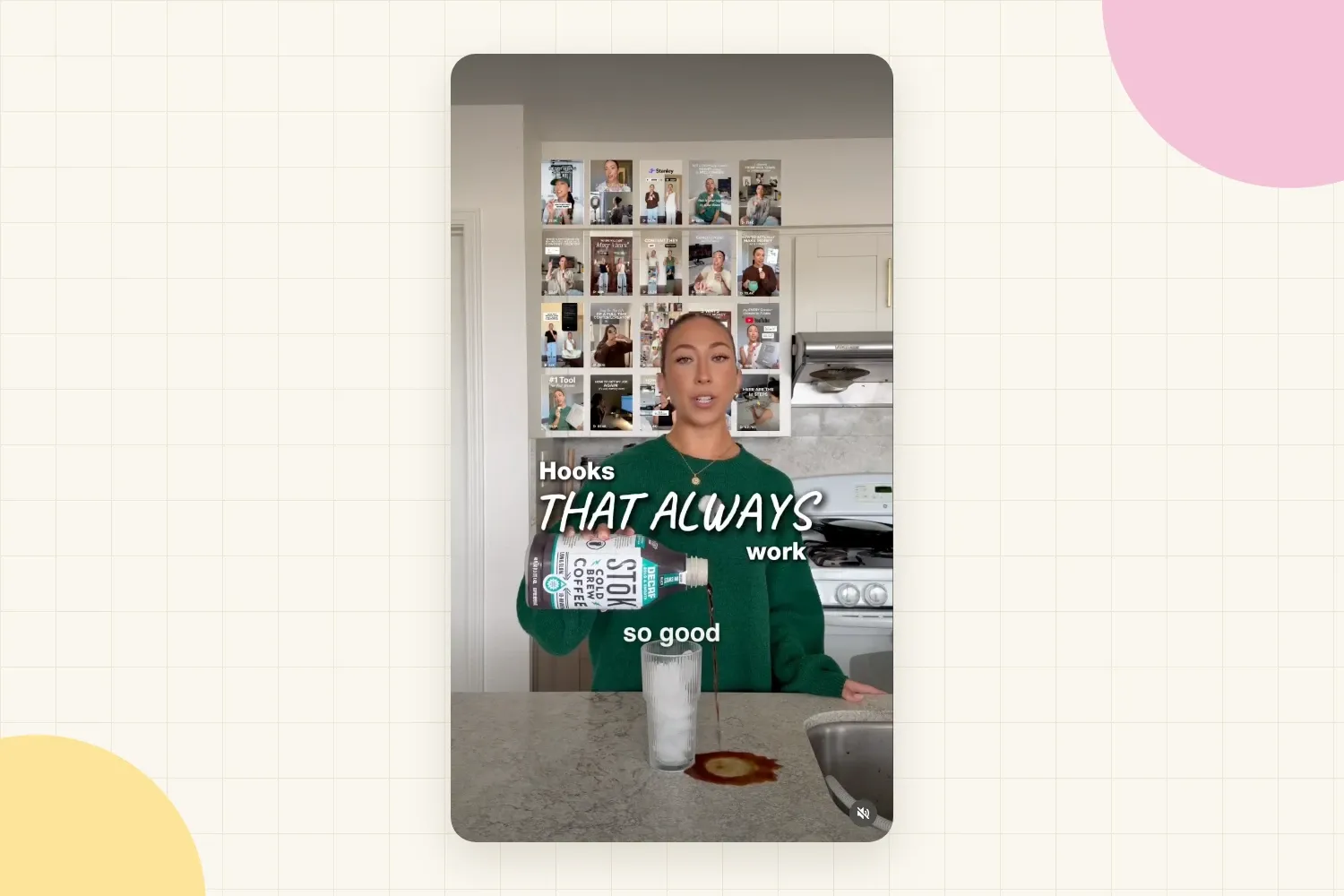
This Reel from @itsmodernmillie stacks all three. In the first frame she is pouring cold brew straight past the glass onto the counter, the text "Hooks that always work" names the payoff, and she is already talking to camera with captions on. The wall of her past Reels behind her adds quiet proof that she knows the topic. The spilled coffee has nothing to do with hooks. It simply looks wrong enough that the thumb stops, and the text does the rest.
The best openings follow the same rule: one clear promise, made fast, backed by something worth looking at.
How Instagram measures your hook
Instagram's own explanation of how ranking works says Reels are ranked partly on how likely someone is to watch a Reel all the way through, like it, and reshare it. None of that happens if the viewer leaves in the first seconds.
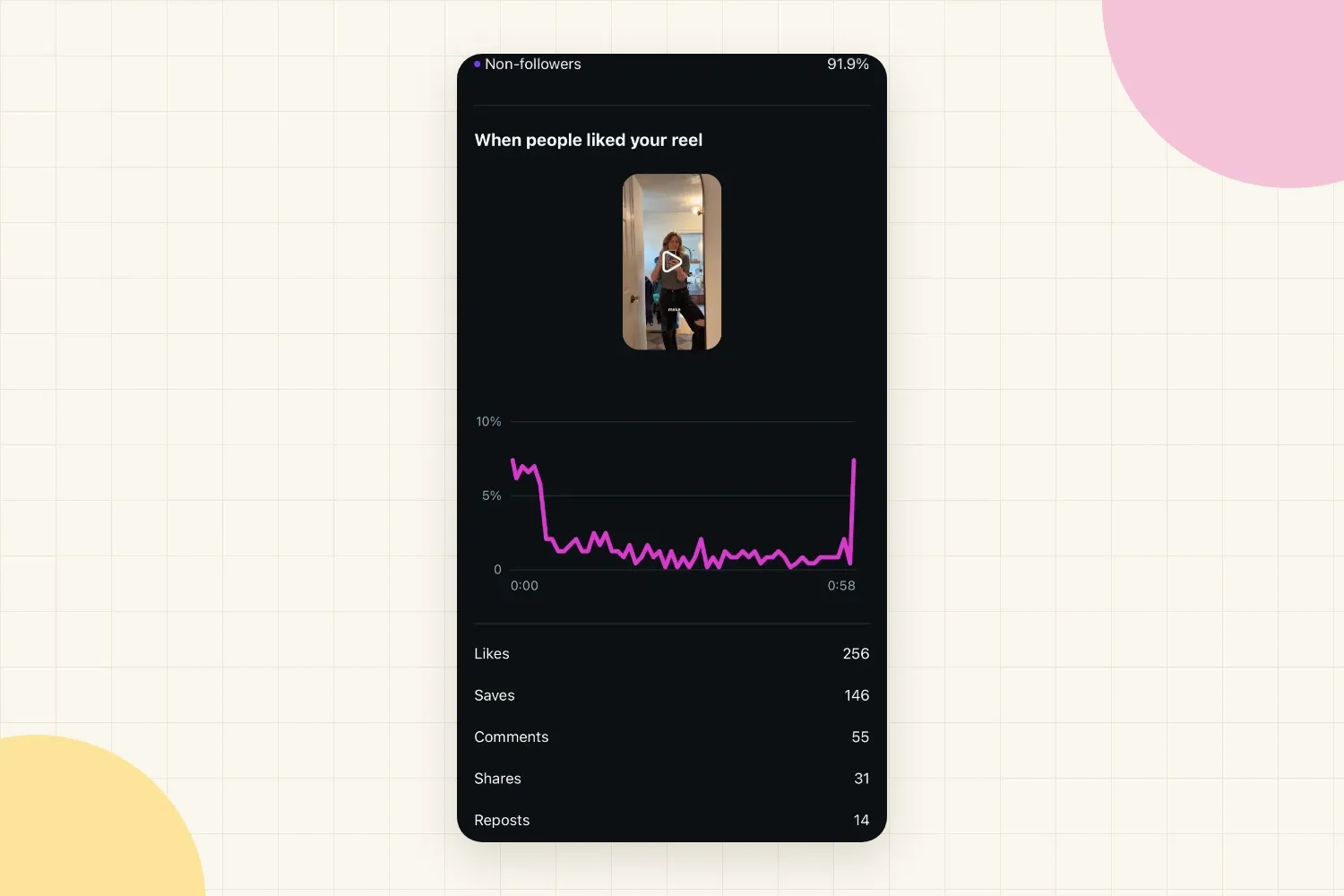
Reel insights now make that moment visible. Instagram replaced view rate with skip rate, which Social Media Today describes as the percentage of views from people who skipped the Reel during its first three seconds. A high skip rate points at the opening, not at the rest of the video. The retention chart next to it shows where the remaining viewers drop off.
100+ Instagram Reel hooks you can copy
Each hook below has a template in brackets and one example. Use the template, not the example: the example only shows how specific the filled-in line should be.
Curiosity hooks
Curiosity hooks open a question the viewer can only close by watching. They work best when the answer is genuinely useful or surprising.
- "Nobody tells you this about [topic]." Example: "Nobody tells you this about growing an account in a small niche."
- "This is the [thing] I wish I knew before [milestone]." Example: "This is the pricing rule I wish I knew before my first brand deal."
- "I didn't expect [result] from [small action]." Example: "I didn't expect a $9 phone clamp to fix my watch time."
- "There's a reason your [result] keeps [problem]." Example: "There's a reason your Reels keep stalling at 200 views."
- "The part of [job or hobby] nobody shows on camera." Example: "The part of running a bakery nobody shows on camera."
- "Wait until you see what [thing] does at the end." Example: "Wait until you see what this $4 paint does to an old dresser."
- "You've been [doing thing] wrong, and it's not your fault." Example: "You've been storing fresh herbs wrong, and it's not your fault."
- "Guess how much this [thing] cost." Example: "Guess how much this entire outfit cost."
- "This [thing] looks normal, but watch this." Example: "This kitchen looks finished, but watch what happens when the cabinet opens."
- "The real reason [surprising fact]." Example: "The real reason restaurant fries taste better than yours."
- "I found a way to [desirable result] without [cost]." Example: "I found a way to fly to Tokyo in business class without paying for it."
- "Don't scroll if you [situation]." Example: "Don't scroll if you're about to sign your first lease."
Question hooks
A direct question makes the viewer answer it in their head before they scroll. Aim it at the right person, and make sure the video answers it.
- "Why does nobody talk about [topic]?" Example: "Why does nobody talk about how long brands take to pay?"
- "Do you [habit]? Watch this first." Example: "Do you wash your face with hot water? Watch this first."
- "What would you do if [situation]?" Example: "What would you do if a client asked for a full refund after delivery?"
- "I asked [number] [people] [question]." Example: "I asked 50 recruiters what makes them skip a CV."
- "Can you spot the mistake in this [thing]?" Example: "Can you spot the mistake in this brand contract?"
- "Is it just me, or [observation]?" Example: "Is it just me, or does every rental kitchen have the same backsplash?"
- "Which one would you pick: [A] or [B]?" Example: "Which one would you pick: the $40 serum or the $12 one?"
- "How much should you charge for [service]?" Example: "How much should you charge for your first UGC video?"
Mistake and warning hooks
People react faster to avoiding a loss than to chasing a gain. These hooks name a mistake the viewer might be making right now.
- "If you're a [viewer], stop [mistake]." Example: "If you're a wedding photographer, stop delivering galleries as one giant download link."
- "Stop [habit] if you want [result]." Example: "Stop rinsing your pasta if you want the sauce to stick."
- "The biggest mistake [people] make with [topic]." Example: "The biggest mistake new freelancers make with their first invoice."
- "Do this before you [action]." Example: "Do this before you accept a free product from a brand."
- "Never [action] without checking [thing]." Example: "Never book a vacation rental without checking the cancellation tab."
- "[Number] mistakes that make your [thing] look [bad]." Example: "3 mistakes that make your home look cheaper than it is."
- "If your [thing] looks like this, [unexpected cause] is the problem." Example: "If your sourdough looks like this, your starter isn't the problem."
- "You're losing [resource] every time you [action]." Example: "You're losing money every time you round your rate down."
- "Most [people] get [topic] wrong because [reason]." Example: "Most beginners get deadlifts wrong because they treat them like a squat."
- "Red flags to watch for when [situation]." Example: "Red flags to watch for when a brand asks for usage rights."
- "Don't buy [product] until you watch this." Example: "Don't buy a ring light until you watch this."
- "I made this mistake so you don't have to." Example: "I made this mistake with my first rental property so you don't have to."
Quick win and how-to hooks
These promise a specific outcome in a short time. They earn saves when the Reel actually delivers the steps.
- "How to [result] in [short time]." Example: "How to fold a fitted sheet in 20 seconds."
- "The fastest way to [result]." Example: "The fastest way to clean grout without scrubbing."
- "One [small change] that [big outcome]." Example: "One camera setting that makes iPhone videos look sharper."
- "Steal my [process] for [result]." Example: "Steal my 15-minute Sunday meal prep."
- "How to [result] without [pain]." Example: "How to get a toddler to sleep without a 45-minute routine."
- "Try this the next time you [situation]." Example: "Try this the next time your laptop battery drains overnight."
- "This [trick] saves me [time] every [period]." Example: "This shortcut saves me an hour of editing every week."
- "Use this [line or script] when [situation]." Example: "Use this line when a brand asks for your lowest rate."
- "[Result] in [number] steps." Example: "Restaurant-style scrambled eggs in 3 steps."
- "You only need [few things] to [result]." Example: "You only need 4 ingredients for this pasta."
- "The [tool] feature most people never use." Example: "The Google Maps feature most travelers never use."
- "How I'd [goal] if I started from zero today." Example: "How I'd grow a new Instagram account if I started from zero today."
List and checklist hooks
A number in the opening line tells the viewer how long the payoff takes, which lowers the cost of staying.
- "[Number] things to check before [goal]." Example: "5 things to check before signing a brand contract."
- "[Number] [items] under [price] that [benefit]." Example: "5 kitchen tools under $20 that earn their counter space."
- "[Number] signs your [thing] needs [fix]." Example: "3 signs your running shoes need replacing."
- "[Number] things I'd never [do] again." Example: "4 things I'd never pack for a long-haul flight again."
- "Everything I [eat, spend, use] in a day as a [identity]." Example: "Everything I eat in a day as a night-shift nurse."
- "My top [number] [things] for [audience]." Example: "My top 3 apps for freelancers who hate admin."
- "[Number] ways to [result] that aren't [obvious answer]." Example: "3 ways to make a dark apartment brighter that aren't new lamps."
- "Ranking [things] from worst to best." Example: "Ranking every coffee chain's oat latte from worst to best."
- "The only [number] [things] you need for [goal]." Example: "The only 3 exercises you need for a full-body workout."
- "[Number] things nobody tells you before [milestone]." Example: "5 things nobody tells you before moving abroad."
Proof, results, and experiment hooks
Results hooks borrow credibility from a number, a timeframe, or a visible before and after. Use real figures, or the comments will catch it.
- "I went from [before] to [after] in [time]." Example: "I went from 300 to 10,000 followers in 6 months."
- "I tried [thing] for [time]. Here's what happened." Example: "I tried cold showers for 30 days. Here's what happened."
- "Here's what [number] [attempts] taught me about [topic]." Example: "Here's what 200 brand pitches taught me about rates."
- "This is what [amount] of [thing] actually looks like." Example: "This is what a $150 weekly grocery budget for a family of five actually looks like."
- "Before and after: [same thing], [constraint]." Example: "Before and after: same bedroom, $300 budget."
- "[Number] days of [habit]. Day [number]." Example: "100 days of learning guitar. Day 1."
- "I tested [number] [products] so you don't have to." Example: "I tested 6 drugstore sunscreens so you don't have to."
- "This one [thing] made me [result] last [period]." Example: "This one email made me $4,000 last month."
- "Is [popular thing] worth it? I tested it for [time]." Example: "Is the viral $80 hair tool worth it? I tested it for a week."
- "Watch me [action] in real time." Example: "Watch me fix a client's homepage in real time."
- "How [specific person] [got result], and how to copy it." Example: "How a 5,000-follower creator booked 12 brand deals, and how to copy it."
- "My honest [numbers] after [time] of [action]." Example: "My honest income after one year as a full-time creator."
Opinion and myth-busting hooks
Disagreement makes people stay to see whether they agree. Pick takes you can defend in the rest of the video, not takes chosen only to provoke.
- "Unpopular opinion: [take]." Example: "Unpopular opinion: you don't need a niche to grow."
- "You don't need [common belief] to [result]." Example: "You don't need a gym membership to build muscle."
- "[Popular advice] is wrong for most [people]." Example: "'Post every day' is the wrong advice for most small accounts."
- "Hot take: [take]." Example: "Hot take: most morning routines are productivity theater."
- "Stop believing [myth]." Example: "Stop believing that eating carbs at night ruins your progress."
- "[Thing] is overrated. Do this instead." Example: "Big Sunday meal preps are overrated. Do this instead."
- "Everyone says [advice]. They skip [missing part]." Example: "Everyone says 'follow your passion.' They skip the part about pricing."
- "Why I stopped [common practice]." Example: "Why I stopped using hashtags."
- "This will upset some [people], but [take]." Example: "This will upset some photographers, but presets aren't the problem."
- "[Option A] vs [option B]: which one actually [result]?" Example: "Retinol vs vitamin C: which one actually belongs in your routine?"
POV and relatable hooks
Relatable hooks work when the viewer recognizes themselves in the first line. The more specific the situation, the more people feel seen.
- "POV: [specific situation]." Example: "POV: you finally answered the email you've avoided for a week."
- "Tell me you're a [identity] without telling me you're a [identity]." Example: "Tell me you're a teacher without telling me you're a teacher."
- "When [relatable trigger]." Example: "When the client says 'quick question' at 6:58 pm."
- "Things [identity] say that make no sense to anyone else." Example: "Things dog owners say that make no sense to anyone else."
- "Me pretending [situation] is fine." Example: "Me pretending my budget survived the holidays."
- "If you've ever [experience], this one's for you." Example: "If you've ever cried in an IKEA parking lot, this one's for you."
- "[Identity] starter pack." Example: "First-time homeowner starter pack."
- "Nobody: ... [identity]: [behavior]." Example: "Nobody: ... Photographers at every golden hour:"
- "Day [number] of [ongoing struggle]." Example: "Day 12 of trying to get my toddler to eat a vegetable."
- "Rate my [thing] as a [identity]." Example: "Rate my desk setup as a remote worker in a studio apartment."
Story hooks
Story hooks start in the middle of the action and leave the outcome open. Save the backstory for later.
- "I [dramatic event], and [unexpected turn]." Example: "I got laid off on a Tuesday and launched my business on Friday."
- "This [object] has a ridiculous story." Example: "This $3 thrift-store chair has a ridiculous story."
- "[Time] ago, I [low point]. Today, [high point]." Example: "Two years ago, I couldn't pay rent. Today, I signed my first studio lease."
- "The day [moment] changed how I [do thing]." Example: "The day a customer returned my product changed how I run my shop."
- "Let me tell you about the worst [experience] I've ever had." Example: "Let me tell you about the worst client I've ever had."
- "I almost [gave up on goal]." Example: "I almost closed my Etsy shop last spring."
- "Here's what happened after [event]." Example: "Here's what happened after my Reel hit 1 million views."
- "Storytime: [setup]." Example: "Storytime: a brand ghosted me after I delivered the video."
- "I said yes to [big decision]." Example: "I said yes to a 3-month road trip with a newborn."
- "Nobody believed me when I said [ambition]." Example: "Nobody believed me when I said I'd open a bookstore in a village of 800 people."
Save and share hooks
These hooks frame the Reel as something to keep or pass on. Reshares are one of the signals Instagram uses to rank Reels, and saves show the video was worth keeping.
- "Save this for your next [situation]." Example: "Save this for your next grocery run."
- "Send this to the friend who [behavior]." Example: "Send this to the friend who always picks the restaurant."
- "Bookmark this before [event]." Example: "Bookmark this before your next job interview."
- "Screenshot this [list] before [moment]." Example: "Screenshot this packing list before your next trip."
- "Share this with someone who [situation]." Example: "Share this with someone starting a business this year."
- "You'll want this the next time [problem]." Example: "You'll want this the next time your sink clogs."
- "Keep this for when [moment]." Example: "Keep this for when your toddler refuses dinner."
- "Part 1 of [series]." Example: "Part 1 of renovating a 1970s kitchen on a budget."
Visual hooks that need no words
Some of the best openings work on mute. Pair any of these with a text hook from the lists above.
- Start with the result. Example: show the finished cake, then cut back to the empty bowl.
- Open mid-action. Example: the coffee is already missing the glass, the paint roller is already on the wall.
- Start with the mess. Example: the overflowing closet before the organizing, the cluttered desk before the reset.
- Fill the frame with the object. Example: a close-up of the product or ingredient, then pull back to reveal the scene.
- Hold up the proof. Example: the receipt, the invoice, the scale, or the screen with the result.
- Split screen before and after. Example: the same room, outfit, or skin, side by side from the first frame.
- Walk into frame mid-sentence. Example: the creator enters already talking, as if the viewer joined a conversation.
- Use an unexpected setting. Example: a budgeting tip filmed inside a car wash, a skincare routine filmed on a hiking trail.
Niche hook packs
Generic templates work best once they carry niche-specific detail. These ready-made lines show what that looks like in five common creator niches.
Fitness
- "If your knees hurt when you squat, check your feet first."
- "3 exercises to stop skipping if you sit all day."
- "What 120 grams of protein looks like without a single shake."
- "I trained like a complete beginner for 30 days. Here's what changed."
- "Do this 3-minute warm-up before your next run."
Beauty and skincare
- "If your foundation separates by noon, it's your prep, not the product."
- "5 drugstore products that replace a 10-step routine."
- "Rating every viral lip oil I bought this year."
- "The order you apply skincare matters more than the brand."
- "Watch what this one tool does to frizzy hair."
Food and cooking
- "This 3-ingredient sauce goes on everything."
- "Stop throwing out stale bread."
- "Dinner for four under $15, start to finish."
- "The mistake that makes your rice mushy."
- "What I cook when I have 10 minutes and zero energy."
Business, freelance, and UGC
- "If a brand asks for your rates first, send this."
- "3 lines that turn a cold DM into a paid brand deal."
- "What a $1,500 UGC package actually includes."
- "Stop offering unlimited revisions."
- "The invoice clause that gets you paid on time."
Travel
- "Don't book a hotel in Lisbon before watching this."
- "How to see Kyoto's temples without the crowds."
- "Everything I pack for two weeks in a carry-on."
- "What one day in Mexico City costs on a budget."
- "The airport mistake that cost me a flight."
How to write your own hook in five minutes
Templates speed things up, but the best hooks come from the video itself. A quick process:
- Write the payoff first. Finish the sentence "By the end of this Reel, the viewer will know or see..." If you cannot finish it, rethink the video before the hook. These Instagram Reels ideas can help you find a clearer angle.
- Name the viewer. Decide who should stop scrolling. "Freelancers" is vague. "Freelance designers who undercharge" is a hook on its own.
- Pick the job. Curiosity, question, mistake, quick win, list, proof, opinion, relatability, story, or save. One job per hook.
- Write three versions. Use three different groups from the list above and read them out loud. Keep the one you would stop for.
- Match the first frame. Choose a visual that shows the promise or creates tension, and put a short version of the hook on screen.
Keep the text hook under about ten words so it reads in one glance, and leave space around it so the caption and interface buttons do not cover it.
Add a caption hook
The Reel hook stops the scroll. The first line of the caption gives the people who stayed a reason to read on, save, or comment, and it is the only line visible before the caption is cut off. Treat it as a second hook, not a summary:
- Add what the video couldn't fit. The number, the price, the full list, or the step people will want to come back to.
- Don't repeat the on-screen text. Restate the promise from a new angle, or answer the question the hook raised.
- Point to the next action. A specific question or a reason to save works better than "Thoughts?"
For example, a Reel with the text hook "3 mistakes that make your home look cheaper than it is" could open its caption with "Mistake 2 costs nothing to fix, and almost every rental has it."
Hook mistakes that raise your skip rate
- A slow start. A logo, a greeting, or "Hey guys, so today..." spends the seconds that matter most.
- A promise the video doesn't keep. Viewers who feel tricked leave, and they remember the account.
- Vague lines. "You need to see this" could open any video. Specific beats clever.
- Text that fights the visual. If the on-screen text says one thing and the frame shows another, viewers process neither.
- Copying a hook word for word. The same line on thousands of Reels stops working as a pattern break. Keep the structure, change the words.
- Burying the subject. If the viewer cannot tell what the Reel is about within two seconds, the hook has failed regardless of how good the line is.
How to test Instagram Reel hooks
Hooks are easier to judge with data than with instinct. Instagram's Trial Reels feature shows a Reel to non-followers first, so you can test openings without flooding your followers' feeds.
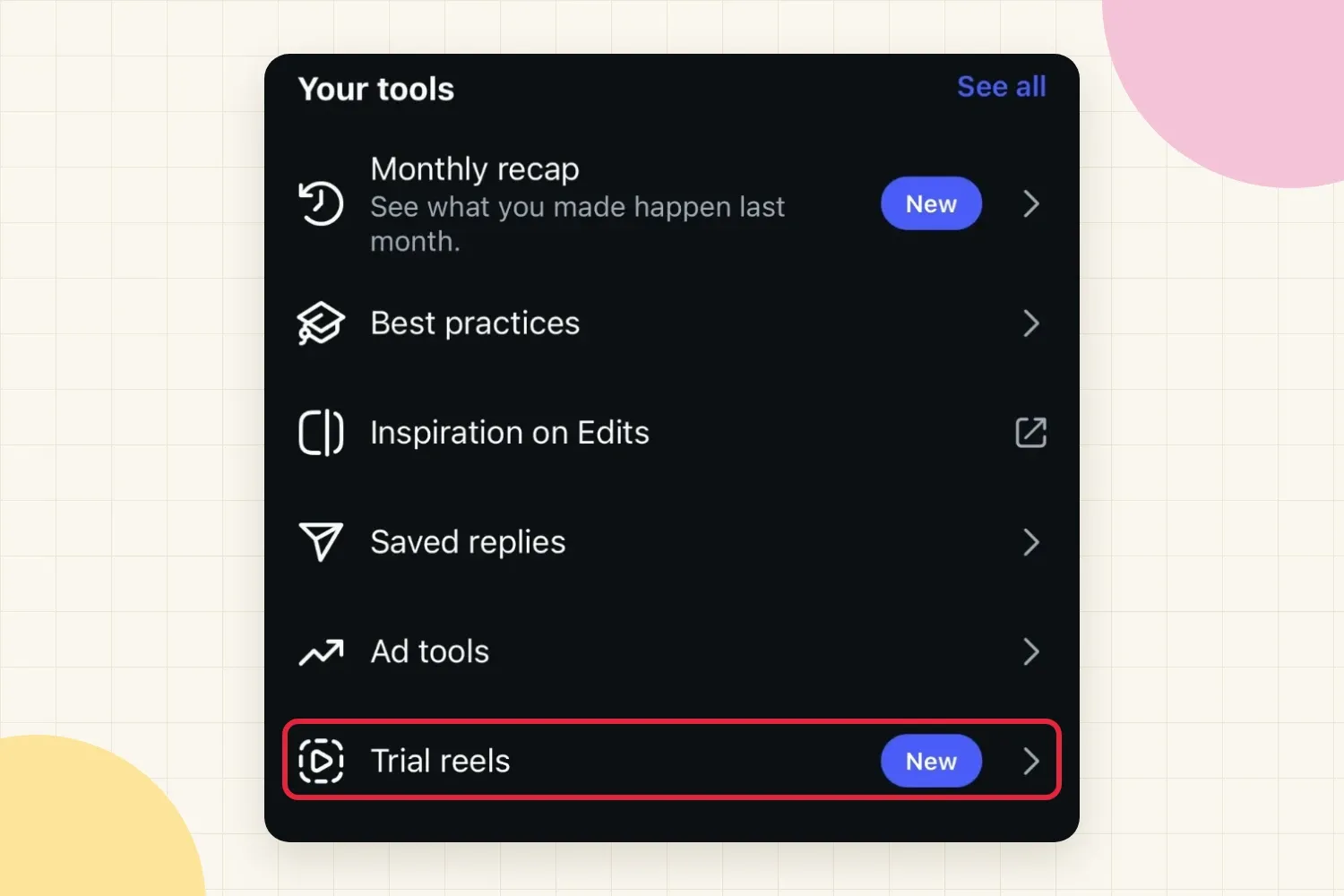
Trial Reels live in the professional dashboard under Your tools. This guide on how Instagram Trial Reels work covers the setup in detail. A simple testing routine:
- Film the Reel once and edit two or three versions that change only the first three seconds.
- Post each version as a Trial Reel a few days apart, at similar times.
- Compare skip rate first, then average watch time, then shares and saves.
- Keep the winning hook structure and reuse it on your next videos in the same format.
Change one thing at a time. If the hook, the cover, and the caption all change between versions, the result tells you nothing about the hook.
Final thoughts
The best Instagram Reel hooks are specific, fast, and honest about the payoff. Use these 100+ templates as starting points, layer a visual and a text hook on top of the spoken line, carry the promise into the caption, and let skip rate tell you which openings actually hold strangers. Once a structure works for your audience, reuse it until the numbers say it is time for a new one.