Most creators do not lose brand deals because their pitch email is too short. They lose them because the email makes the brand do too much work: figure out who the creator reaches, why the audience fits, what the collaboration could look like, and whether the creator can deliver.
An influencer pitch email should make that decision feel easy. It should be personal enough to show the message was not mass-sent, specific enough to show a collaboration idea, and clear enough that the brand can reply with one simple next step.
This guide keeps the focus on the email itself: the structure, templates, examples, subject lines, follow-ups, and small details that make a pitch feel more credible.
What a brand wants from a pitch email
When a brand opens a creator pitch, it is usually scanning for fit before enthusiasm. The person reading is asking a few practical questions:
- Does this creator understand the brand?
- Does their audience match the customer?
- Is there a clear campaign idea or deliverable?
- Is there enough proof to justify a reply?
- Can this conversation move forward quickly?
That is why a long introduction rarely helps. A brand does not need your full creator story in the first email. It needs a clean reason to care, a quick view of your audience, and a collaboration idea that makes sense for its current marketing.
The most useful pitch feels like a mini proposal, not a biography.
The pitch email structure that gets replies
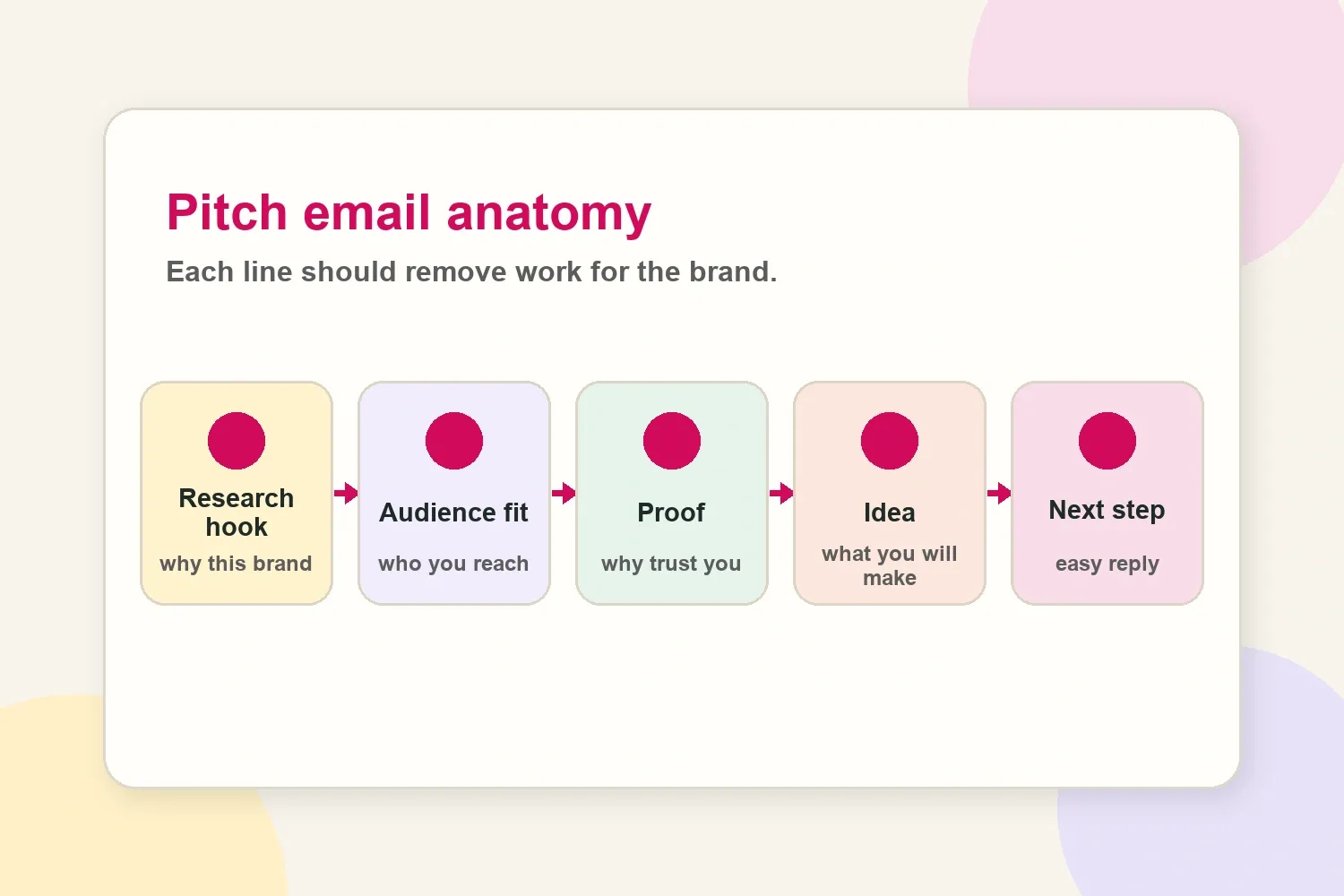
A persuasive influencer pitch email usually has five parts:
- Research hook: one sentence that proves the email is meant for this brand.
- Audience fit: who you reach and why that audience matters to the brand.
- Proof: a recent metric, campaign result, content example, or audience signal.
- Collaboration idea: a concrete angle, not just “open to collaborating.”
- Next step: one easy reply option.
The goal is not to squeeze every detail into one email. The goal is to remove the first round of uncertainty. A brand should know why you are relevant before it clicks your profile or opens your media kit.
Influencer pitch email template
Use this as the main template when you are pitching a brand for the first time.
Subject: Collaboration idea for [Brand] and [your audience]
Hi [Name],
I noticed [specific brand detail: product launch, campaign, founder message, creator partnership, seasonal push, or content angle], and it felt especially relevant to the audience I reach around [your niche].
I create content for [audience description], mainly on [platforms]. My audience is [location, demographic, interest, buying behavior, or community need], and recent content around [topic] has been performing well.
A collaboration idea that could fit [Brand] is:
- [Deliverable or concept 1]
- [Deliverable or concept 2]
- [Optional angle tied to campaign timing]
For context, [short proof point: follower count, average views, engagement rate, past brand result, content example, or audience insight]. You can see my current stats and content examples here: [media kit or portfolio link].
Would it be useful if I sent over a few package options for [campaign goal or product]?
Best,
[Your name]
This template works because it does not ask the brand to invent the collaboration. It gives the brand a reason, an audience, proof, and a next step.
Short pitch template for a first brand email
If the brand is smaller, the contact is informal, or you are pitching through a public email address, a shorter version can work better.
Subject: Creator idea for [Brand]
Hi [Name],
I’m a [niche] creator reaching [audience] on [platform]. I noticed [specific detail about the brand], and I think there is a clean content angle around [idea].
One idea: [one-sentence content concept].
My recent [platform/content type] averages [metric], and my audience is mainly [audience detail]. Here is my current media kit with examples: [link].
Open to seeing a few collaboration options?
Best,
[Your name]
Use this when the goal is to start a conversation, not send a full proposal. It still includes proof, but it keeps the email light.
UGC pitch email template
UGC pitching is slightly different because the brand may care less about your follower count and more about your ability to create useful content.
Subject: UGC content idea for [Brand]
Hi [Name],
I create [type of content] for [niche/category] brands, and I noticed [specific detail about product, audience, or campaign].
I think [Brand] could use a short-form content angle around [specific idea], especially for [TikTok, Reels, paid social, a product page, email, or a launch campaign].
The concept would be:
- Hook: [hook idea]
- Middle: [problem, product use, proof, comparison, routine, or testimonial angle]
- Ending: [CTA or takeaway]
I can share recent examples and usage options if creator-made content is useful for this campaign.
Best,
[Your name]
For UGC, make the content idea tangible. A vague “I can make UGC for you” sounds replaceable. A clear hook and use case gives the brand something to react to.
Follow-up email template after no reply
Most brand inboxes are busy. A follow-up is normal, but it should add context rather than repeat the same message.
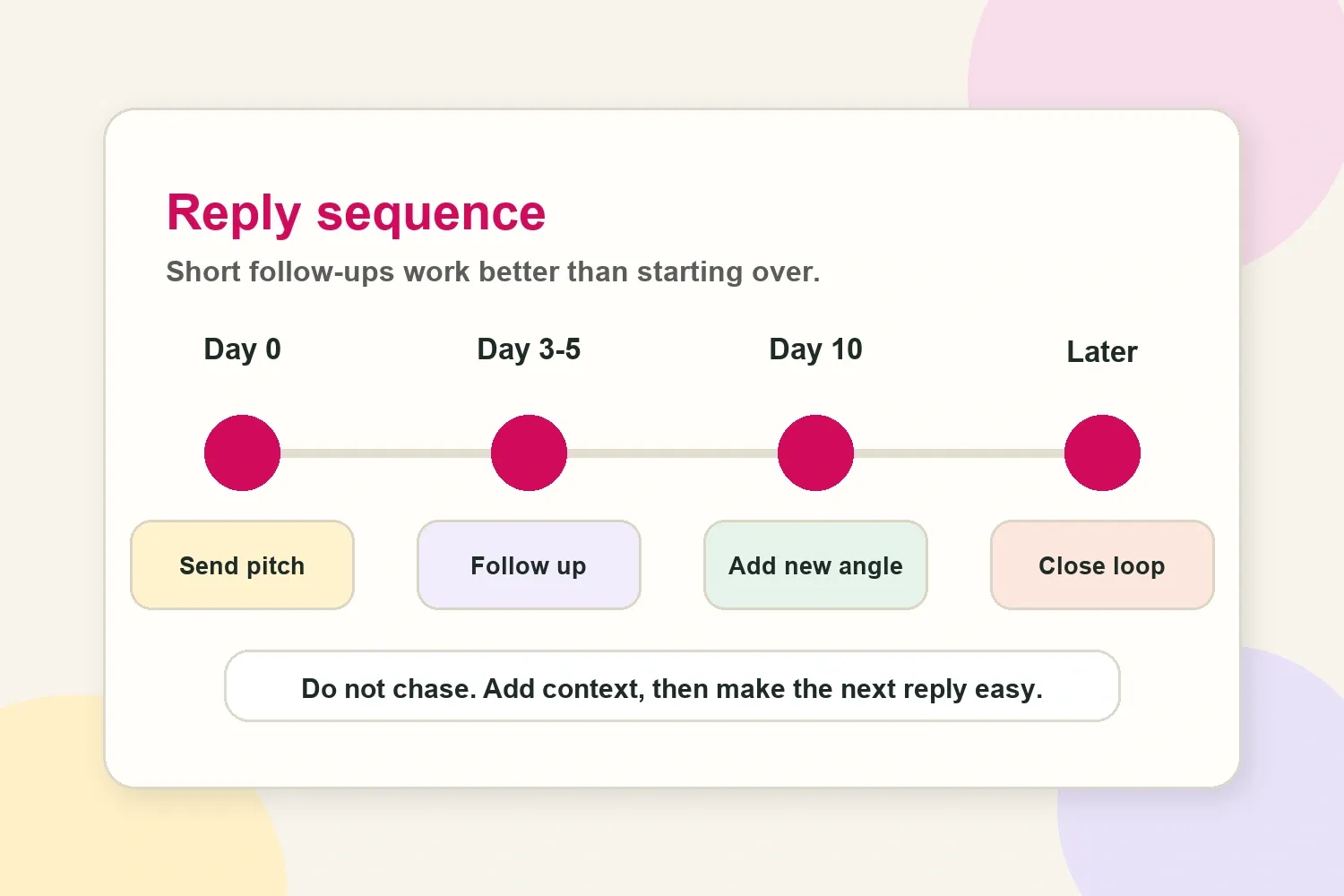
Send the first follow-up after three to five business days. If there is still no reply, send one more with a new angle or a timely reason. After that, close the loop and move on.
Follow-up 1
Hi [Name],
Just wanted to bring this back up in case it got buried.
I still think there is a useful angle around [specific idea] because [one sentence about brand fit, timing, audience, or campaign relevance].
Would it be helpful if I sent a simple package with deliverables and rates?
Best,
[Your name]
Follow-up 2 with a new angle
Hi [Name],
One more idea that could fit [Brand]: [new content angle].
This could work well for [platform, product, launch, seasonal moment, or audience need], especially because [short reason].
Happy to send examples if this is relevant.
Best,
[Your name]
Do not keep following up forever. A creator who respects the inbox feels easier to work with than a creator who pressures the brand for an answer.
Example of a good influencer pitch email
Here is what the structure looks like in a finished email.
Subject: Reels idea for Bloom & Co’s SPF launch
Hi Maya,
I saw Bloom & Co is pushing the mineral SPF stick this month, especially the “easy reapply” angle. That fits really well with my audience because I create skincare and everyday beauty content for women 24-34 who want simple routines, not 12-step product stacks.
One idea: a short Reel showing three realistic SPF reapply moments: before commuting, after lunch, and before an outdoor workout. The content would keep the product practical and show why the stick format is easier than carrying a full sunscreen bottle.
For context, my skincare Reels average 38K views, and my audience is 71% US-based. I also have a current media kit with audience screenshots and recent beauty examples here: [link].
Would it be useful if I sent over two package options for a Reel plus Story set?
Best,
Lena
This email works because every line has a job. It names the product angle, connects it to the creator’s audience, gives a realistic content idea, adds proof, and ends with a simple decision.
Subject lines that do not sound mass-sent
The subject line should be clear, not clever. A brand should understand the category of the email before opening it.
Good options:
- Collaboration idea for [Brand]
- Creator idea for [product or campaign]
- [Niche] creator for [Brand]
- UGC concept for [product]
- Reels idea for [campaign or launch]
Avoid subject lines that feel inflated or spammy:
- HUGE opportunity for your brand
- Let’s collab!!!
- Partnership request
- Quick question
- Influencer available
“Quick question” can get opened, but it often disappoints the reader because the email is not actually quick. Be direct instead.
What to personalize before you send
Personalization does not mean writing a long compliment. It means proving the pitch is based on the brand in front of you.
Personalize at least one of these:
- Product detail: mention the specific product, collection, or campaign.
- Audience match: explain why your audience overlaps with their buyer.
- Content angle: suggest a creator concept tied to their current positioning.
- Timing: connect the pitch to a launch, season, event, or content push.
- Proof: choose the metric or example that matches the brand’s likely goal.
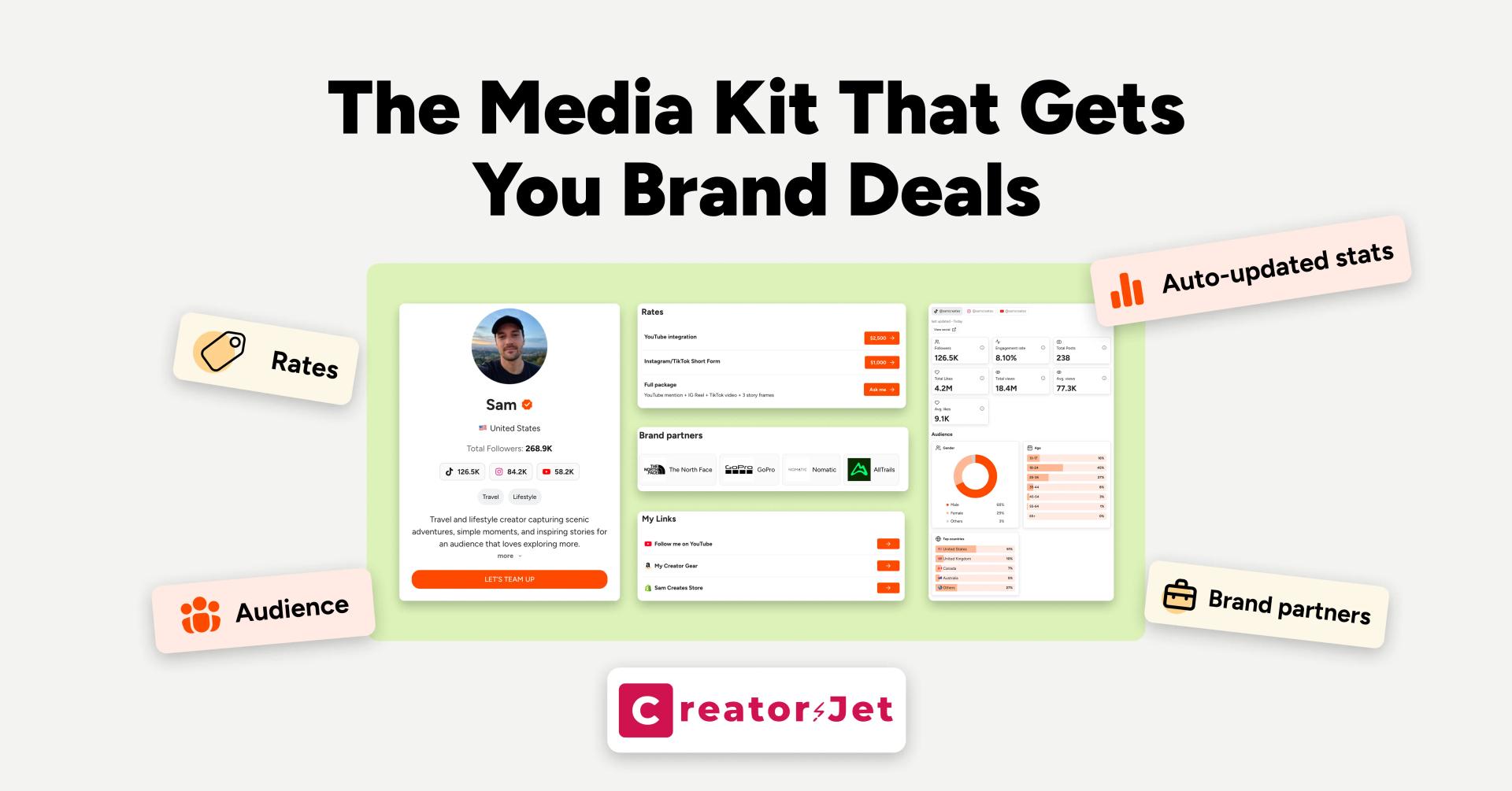
Before sending, check that your stats are current. If a brand opens your media kit and sees stale follower counts, old audience screenshots, or outdated examples, the pitch immediately feels weaker. A current kit is especially useful when your email is short because it lets the brand verify fit without asking for more information.
If your pitch includes paid promotion, gifted product, affiliate terms, or other material relationships, disclosure expectations also matter. The FTC guidance on endorsements and influencers is a useful reference for understanding why paid or incentivized endorsements need clear disclosure.
Mistakes that make pitch emails easier to ignore
Most weak pitch emails fail for predictable reasons.
They start with the creator, not the brand. A brand does not need three paragraphs about your journey before it knows why you are relevant.
They ask for a collaboration without suggesting one. “I would love to work together” is too vague. Offer an angle, format, or campaign idea.
They use inflated claims. Do not promise sales, virality, or guaranteed ROI unless you have evidence. Brands are more likely to trust specific proof than big promises.
They hide the useful information. If your audience, platform, niche, and proof are buried at the bottom, the email creates friction.
They send outdated numbers. A pitch should match your current audience and content performance. If your rates changed because your reach changed, check your package against a relevant tool such as an Instagram pricing calculator before sending.
They forget the next step. End with one clear question. The brand should know whether to ask for rates, examples, package options, or a call.
Before you send: 30-second pitch checklist
Use this quick check before sending the email. If one row is missing, the pitch probably needs one more edit.
| Check | Why it matters |
|---|---|
| First line is brand-specific | Proves it is not a mass email |
| Audience fit is clear | Helps the brand judge relevance fast |
| One proof point is included | Adds credibility without making the email long |
| Collaboration idea is specific | Gives the brand something to react to |
| Media kit link is current | Lets the brand verify stats and examples |
| Next step is easy | Makes replying feel low-effort |
Final takeaway
An influencer pitch email does not need to be long to work. It needs to be relevant, specific, and easy to answer.
The practical version is simple: research the brand, explain the audience fit, add one proof point, suggest a real content idea, and give the brand a low-friction next step. If the email feels like it was written for that brand and not copied into fifty inboxes, it has a much better chance of getting a reply.