

YouTube success rarely comes from one isolated trick. A video can have a beautiful thumbnail, a trendy topic, or a polished edit and still underperform if viewers do not understand the promise fast enough or leave before the result.
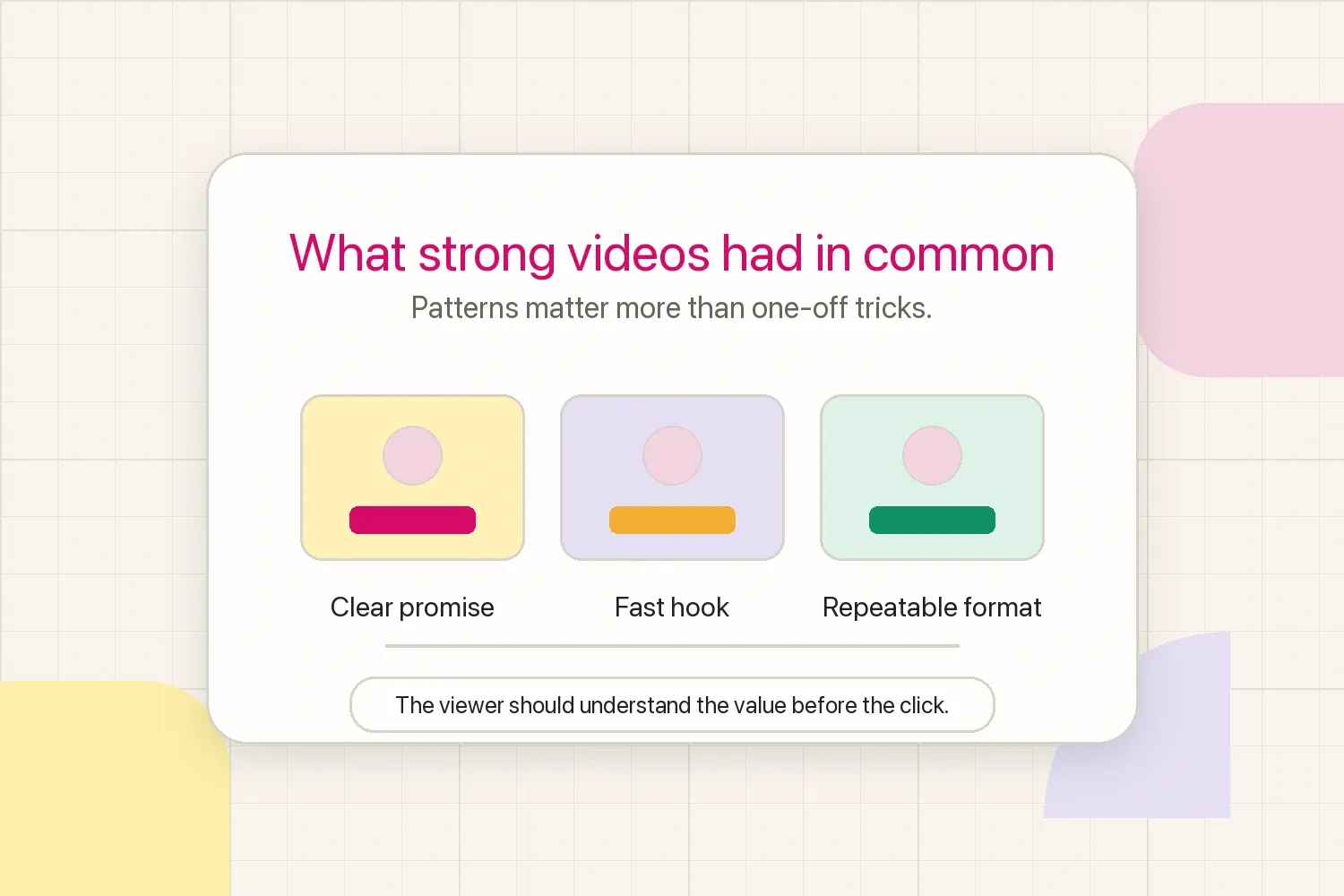
The useful lesson from a 10,000-video review is not “make every video look the same.” It is that high-performing videos tend to combine three things: a clear reason to click, a fast reason to keep watching, and a repeatable format the audience can recognize.
That matters because YouTube is not only a reach platform. It is a behavior platform. The system can see whether people click, watch, continue, come back, comment, and choose another video after the first one. YouTube Studio analytics group performance around reach, engagement, audience, and revenue for a reason: growth is usually the result of several signals working together.
The big pattern: clarity beats complexity
Across high-performing videos, the first pattern is simple: the viewer understands the value before committing time. The best-performing idea is usually easy to explain in one sentence: a transformation, a comparison, a test, a ranked list, a mistake to avoid, a story with stakes, or a tutorial with a visible outcome.
Underperforming videos often hide the promise. The title is vague, the thumbnail is busy, the intro starts with context, and the viewer has to work out why the video matters. Better videos reduce that friction. They make the idea legible in the feed, then validate the click quickly once the video starts.
This is why the title, thumbnail, and content cannot be separated. A clear thumbnail may lift clicks, but the video still has to deliver what the title and thumbnail implied. If the title promises a practical answer, the opening should move toward that answer. If the thumbnail shows a result, the video should confirm that result early enough for the viewer to feel oriented.
Video length matters less than earned attention
The old advice “make longer videos for watch time” is too blunt. Longer videos can work when the topic earns the length: tutorials, product reviews, breakdowns, creator essays, documentaries, experiments, and story-led formats. Shorter videos can work when the promise is narrow and the result arrives fast.
A more useful rule is this: make the video as long as the viewer’s intent can support. A viewer searching for a detailed camera comparison may accept 25 minutes. A viewer clicking a simple creator tip may not give the same patience. The same channel can need Shorts, 6-minute videos, 12-minute explainers, and 30-minute deep dives for different jobs.
For monetization, long-form still has an advantage because it can build watch time, loyalty, and more natural sponsorship moments. But extra minutes only help when they contain new value. Filler lowers retention, and retention is often more important than length.
The first 30 seconds decide whether the video has a chance
Most effective videos do not spend the opening apologizing, explaining the channel, or asking for likes. They quickly answer the viewer’s silent question: “Did I click the right thing?”
A good opening usually does one of four jobs. It shows the outcome, states the stakes, proves the problem is real, or creates a specific curiosity gap. The mistake is opening with general background before giving the viewer a reason to care.
Use YouTube Studio’s audience-retention graph to find the truth. If the curve drops hard in the first seconds, the title and thumbnail may have created curiosity but the opening did not validate it. If the curve stays flat, the video is probably delivering in the order viewers expected.
Shorts and long-form solve different problems
Shorts are still useful for discovery, testing topics, and reaching viewers who would not search for the channel. They are good at creating top-of-funnel attention. But Shorts views alone do not prove that a topic can sustain long-form watch time, sponsor value, or a loyal audience.
Long-form videos do the deeper work. They show expertise, personality, pacing, and trust. They create space for sponsorship integrations, affiliate context, stronger comments, and a better sense of who the audience is. A healthy YouTube strategy often uses Shorts to test or tease ideas and long-form videos to turn attention into relationship.
The important part is not to treat Shorts and long-form as the same KPI. A Short can be judged by reach, completion, rewatches, and profile actions. A long-form video should be judged by CTR, average view duration, retention shape, comments, returning viewers, and revenue.
There is another useful split: videos made to be found in search and videos made to be suggested by YouTube. Search videos answer active intent. Suggested videos earn attention from someone who was not looking for that exact topic yet. The best channels usually learn how to create both.
Use that distinction when planning formats. A search-led video needs a clear problem, direct title, and fast answer. A suggested video often needs stronger curiosity, sharper stakes, or a more visual premise because the viewer did not arrive with the same intent.
Repeatable formats beat random inspiration
The best channels rarely rely on disconnected uploads. They build formats viewers can recognize: “I tested X for 30 days,” “I compared X vs Y,” “I fixed this mistake,” “I ranked every option,” “I built this from scratch,” or “I tried the strategy so you do not have to.”
A repeatable format makes production easier and helps the audience understand what they are getting. It also gives the creator cleaner data. If three videos in the same format perform differently, the creator can compare topic, title, thumbnail, hook, pacing, and result instead of guessing from totally unrelated uploads.
If your channel feels scattered, start by choosing two or three formats that match your niche. A creator stuck at the idea stage can use a list of YouTube video ideas to find repeatable containers, then adapt them to their own audience instead of copying surface trends.
Packaging works only when it matches retention
A clear title and thumbnail create the click. Retention decides whether the click was worth it. That is why the best thumbnails are not just dramatic; they are specific, believable, and aligned with the video’s actual result.
Creators should plan the thumbnail and title before filming whenever possible. If the video promise cannot be expressed visually, the idea may still be too vague. The guide on YouTube thumbnails that get views goes deeper on making the promise clear at small size without turning the thumbnail into clickbait.
Metrics to check before copying a viral video
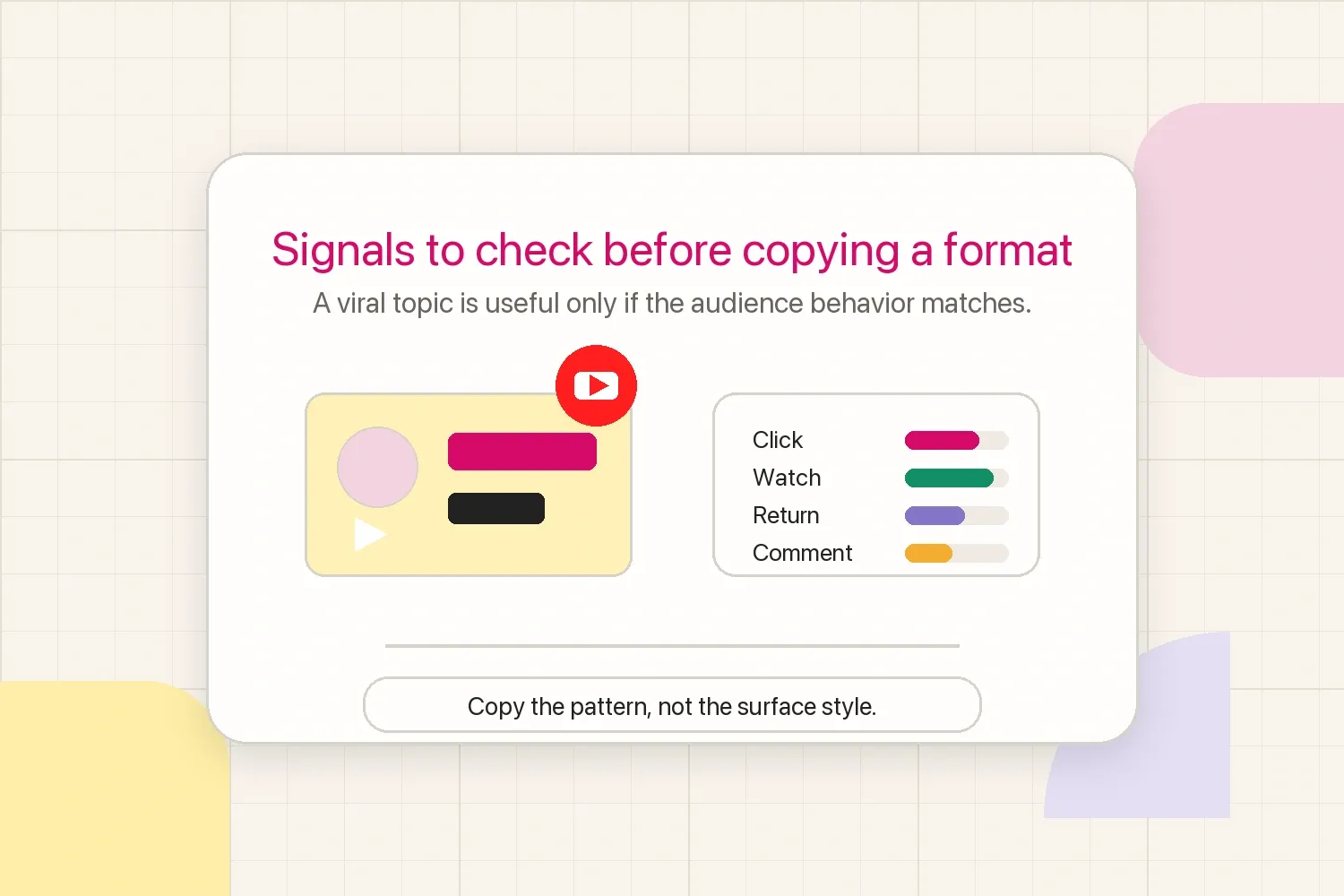
Copying a viral format without reading the signals is risky. A video may have views because the creator has a large audience, because the topic was timely, because the first 10 seconds were unusually effective, or because the thumbnail attracted clicks from the wrong viewers.
Before turning one viral example into a strategy, check the signals in your own analytics: impressions click-through rate, average view duration, audience retention, returning viewers, comments, shares, subscribers gained, and revenue. If a video gets clicks but poor retention, the title and thumbnail may be ahead of the content. If retention is solid but CTR is weak, the idea may need clearer positioning.
What not to copy from successful videos
Do not copy a creator’s personality if it does not fit yours. Do not copy a long runtime if your audience wants a fast answer. Do not copy a dramatic thumbnail if the video cannot deliver the same tension. And do not copy a topic just because it worked in another niche.
The better move is to copy the underlying pattern. Was the video a clear comparison? A contrarian explanation? A before-and-after transformation? A timely answer to a recurring problem? Once you know the pattern, you can rebuild it in a way that fits your own audience.
Turn YouTube performance into business value
Growth is only part of the picture. Creators who want sponsorships need to explain why their videos work. A brand does not only care about subscriber count; it cares about audience fit, trust, watch time, comments, clicks, and whether the creator can repeat performance.
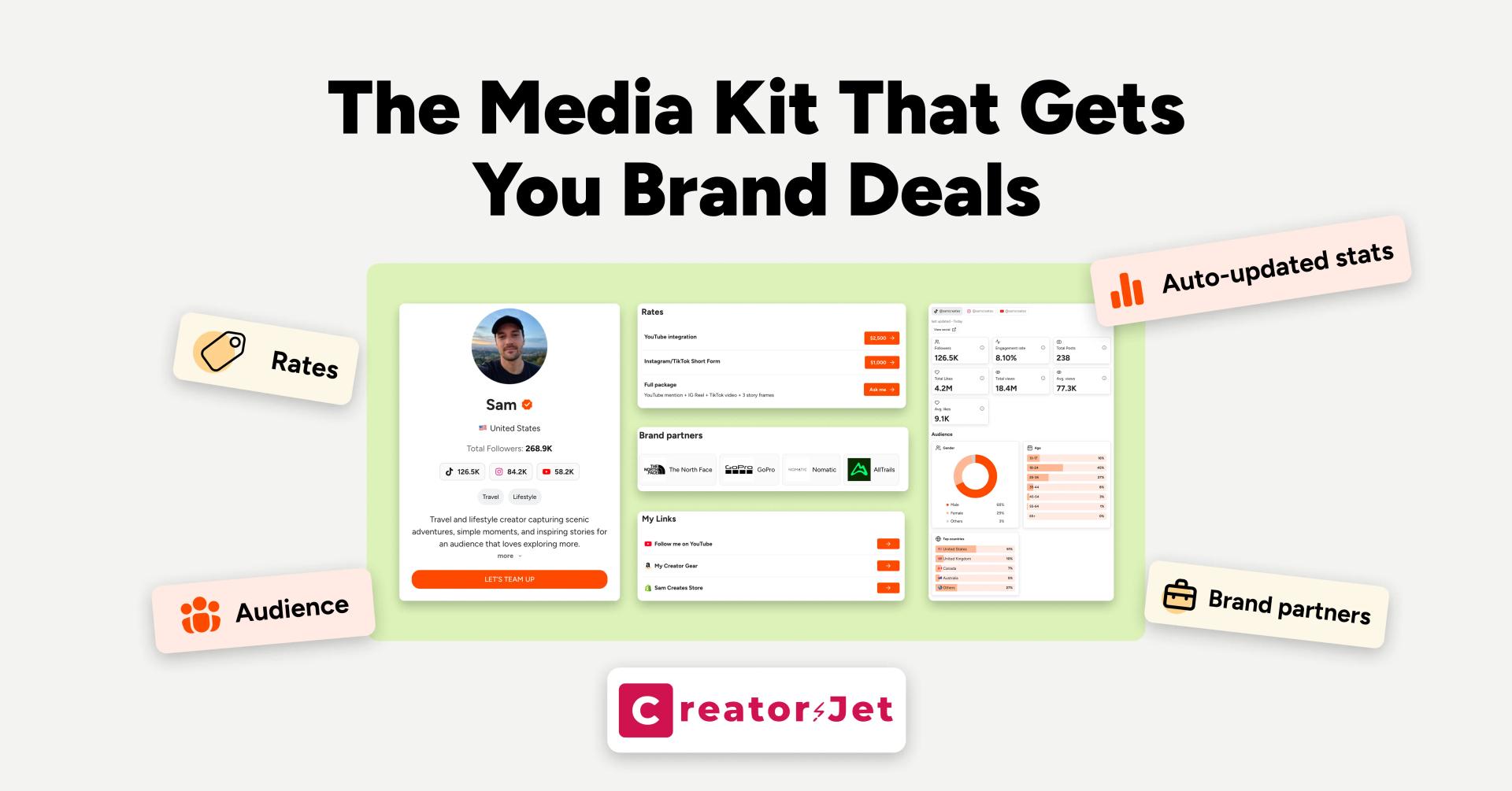
That is where a current influencer media kit helps. Instead of sending screenshots, a creator can show top videos, audience demographics, engagement, platform links, and examples of repeatable formats that already perform.
Final takeaway
What works on YouTube is not one perfect length, one posting schedule, or one thumbnail style. The most effective videos make a promise people understand, deliver early, keep the pacing tight, and belong to a format the creator can repeat.
Use viral videos as research, not instructions. Study what made the idea clickable, what kept viewers watching, and whether the same behavior appears in your own analytics. That is how a creator turns one good upload into a system for better future videos.