

A creator can have a month full of paid work and still have an income setup that feels fragile. One delayed campaign, one platform change, or one quiet affiliate period can expose how much of the business depends on a single source.
There is no universal creator income mix across niches, countries, platforms, and stages of a business. The practical question is more useful: what does your own income mix depend on, and which stream should become more reliable next?
This creator income breakdown separates the main ways creators get paid, explains what each stream needs to work, and gives you a simple 90-day audit. It is not a ranking of the highest earners or a promise that every creator needs every revenue stream.
What a useful creator income breakdown actually shows
Do not judge a revenue stream by its headline amount alone. A $2,000 campaign and $2,000 in digital-product sales can demand very different time, risk, and follow-up work.
| Question | Why it matters |
|---|---|
| How often does this income arrive? | Separates occasional wins from repeatable revenue |
| What does it cost in time and money? | Reveals whether the gross amount is worth keeping |
| Who controls the distribution? | Shows dependence on brands, platforms, or an owned audience |
| What proof makes it convert? | Points to the content, case studies, or trust you need next |
| Can it grow without doubling your workload? | Prevents a busy income stream from becoming a ceiling |
The goal is not an even split across categories. A creator with reliable YouTube search traffic may sensibly lean on ad revenue and affiliates. A small UGC creator may rely more on client work while testing a product. A good mix fits the business you actually have.
The three income buckets creators should track
1. Campaign income: brand deals, UGC, and client services
Campaign income is paid for a specific scope. It includes sponsored posts, ambassador work, UGC for paid ads, editing, strategy, photography, or a defined consulting package.
This is often the fastest route to meaningful cash flow because a brand or client is paying for a clear outcome. It is also the most dependent on active selling, negotiation, delivery, and renewals. A creator who earns well from campaign work needs a clean process for scope, revisions, usage, exclusivity, invoicing, and follow-up.
Do not combine every campaign payment into one vague “brand deals” line. Track the fee, usage rights, exclusivity, production cost, and hours separately. That makes it clear whether a $1,500 deal was actually a good deal after the work required. This practical guide to influencer rate negotiation helps with the parts of a quote that change the value of a campaign beyond the post itself.
2. Performance income: affiliate commissions and platform revenue
Performance income arrives after an audience action: someone buys through a link, watches an ad-supported video, joins through a referral, or uses a platform feature. It can compound when the content stays useful, but it is rarely passive at the beginning.
Affiliate revenue works best when a creator already makes helpful recommendations. A gear review, tutorial, routine, or comparison can keep sending qualified people to a product long after a Story disappears. The risk is trust: affiliate content becomes weak when it is disconnected from the creator’s real expertise.
Platform revenue depends on eligibility, geography, policy, format, and audience behavior. YouTube’s Partner Program currently includes revenue options such as Watch Page Ads, Shorts Feed Ads, memberships, Supers, and Shopping, subject to eligibility and policy requirements outlined by YouTube. Treat these payouts as a performance layer, not a guaranteed base salary.
3. Owned offers: products, memberships, and paid education
Owned offers are things a creator can package and sell directly: a template, guide, preset, workshop, membership, paid newsletter, or small product drop. They require more upfront thinking, but they give the creator more control over the offer, buyer relationship, and timing.
The test is not “could this scale?” The test is whether the audience already has a clear problem the creator can solve. A travel creator with repeated itinerary questions may have a useful digital guide. A fitness creator with regular form questions may test a live workshop. A creator with a loyal weekly audience may have a credible membership idea.
Patreon, for example, supports monthly and annual subscriptions, membership tiers, and one-time payments on its creator pricing page. The platform choice matters less than the promise. Start with one repeatable benefit that is realistic to deliver after the launch excitement wears off.
Income streams are not a menu you need to complete
Creators often see a list of monetization options and assume they should launch all of them. That usually creates a shop, an affiliate page, a course idea, and a membership plan before any one offer has a buyer.
Instead, use the stage of your business as the filter:
| Current position | More realistic next move | Avoid for now |
|---|---|---|
| Small audience, sellable production skill | Package a UGC or service offer | Building a high-maintenance membership |
| Helpful content with repeated questions | Test a small digital product or workshop | Recording a large course before demand is visible |
| Regular video traffic | Improve relevant affiliate content and platform eligibility | Assuming views alone will create stable income |
| Loyal returning audience | Test one paid recurring benefit | Promising daily access or custom support |
For a broader look at individual options, see these seven creator income streams beyond sponsorships. This article is about the decision behind the list: which stream deserves your next block of effort, and which one is only making you busy.
Run a 90-day income audit
Open a simple spreadsheet and list every payment received in the last 90 days. Do not group by platform first. Group by how the money was earned.
Use five columns:
- Income stream: campaign, affiliate, platform, product, membership, or service.
- Revenue received: what actually landed, not what was promised.
- Direct cost: contractor help, product cost, transaction fees, paid tools, shipping, or ad spend.
- Time required: content, calls, edits, support, admin, and follow-up.
- What created the sale: a specific video, a referral, a brand relationship, a launch, a recurring member, or a case study.
That last column is where the useful pattern appears. You may discover that one evergreen tutorial drove most affiliate sales, that repeat clients are more valuable than new pitches, or that a membership takes more support than it returns. Then you can improve something real rather than following a generic monetization trend.
Use the same three categories in your audit: cash collected, invoices outstanding, and contracted work. In her Q1 update, Chelsea separates those amounts instead of presenting one inflated total. Her figures are personal, not a benchmark or income target. The useful part is the tracking method: know what has been paid, what is owed, and what is signed but still conditional.
Keep signed work in a separate pipeline view. It helps you plan workload and likely cash flow, but it does not become received income until the payment lands. That distinction keeps a promising month from looking safer than it is.
Decide what to improve first
After the audit, choose one of these directions.
- Protect a reliable stream when it already produces good income with manageable work. Improve renewal terms, delivery systems, product pages, or content that already converts.
- Fix the bottleneck when demand exists but the process is weak. For example, affiliate content may need clearer recommendations, or a service offer may need a sharper scope and portfolio.
- Add one adjacent stream when your current work gives you a credible starting point. A UGC creator can turn proven production into a scoped service. A tutorial creator can test a small template. A community-led creator can test a recurring benefit.
- Stop subsidising a weak stream when it consumes time without producing learning, audience trust, or credible revenue. Not every idea needs more consistency. Some need to be removed.
Before choosing the next move, compare revenue, direct cost, time required, and audience demand on the same page. The largest number is not automatically the best stream if it takes too much delivery time or depends on demand you cannot repeat.
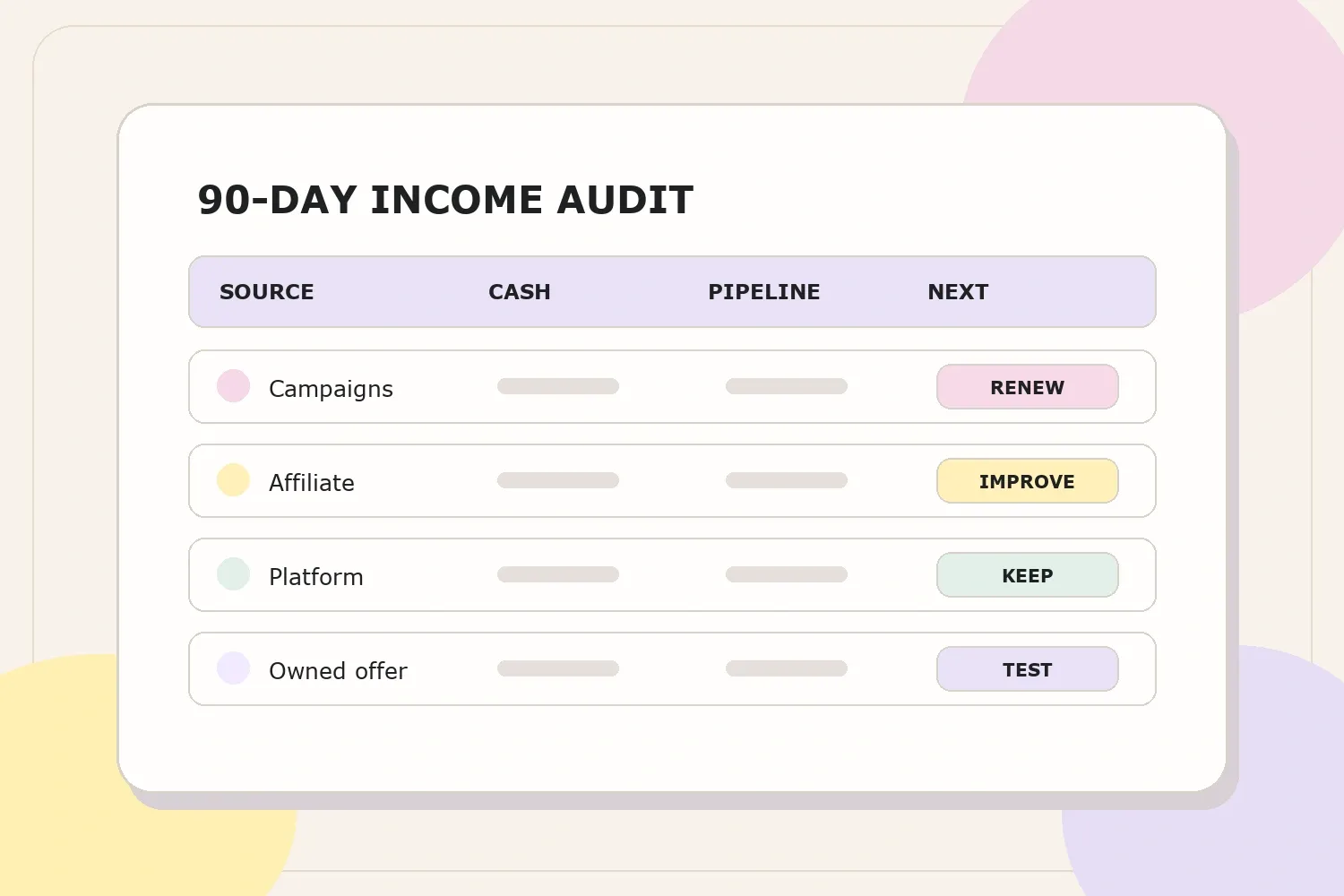
Copy this 90-day income audit template
Copy these two tables into a spreadsheet. They answer different questions, so keep them separate.
1. Audit money already received
Use one row for each income stream, not one row for every invoice. This is the table that helps you decide where your time is actually paying off.
| Income stream | Cash received (90 days) | Time + direct cost | Next 90-day move |
|---|---|---|---|
| Brand deals or UGC | Enter amount | Enter hours + cost | Renew, reprice, or stop |
| Affiliate income | Enter amount | Enter hours + cost | Improve one useful recommendation or pause |
| Platform revenue | Enter amount | Enter hours + cost | Keep, reduce, or change the format |
| Products, memberships, or services | Enter amount | Enter hours + cost | Test one clear next step |
2. Track signed work in a separate pipeline
Signed work can help you plan, but it is not cash received. Keep it out of the audit until payment lands.
| Project or client | Signed value | Invoice / payment due | Status |
|---|---|---|---|
| Client or project | Signed amount | Invoice / due date | Signed / invoiced / paid |
| Client or project | Signed amount | Invoice / due date | Signed / invoiced / paid |
At the end, compare the income sources on the same basis. The best next move is usually the one with clear demand, manageable delivery time, and a decision you can test within the next 90 days.
A sensible 30-day plan
For the next month, keep the plan narrow:
- Audit the last 90 days and identify the one stream with the best mix of demand, margin, and manageable effort.
- Make one improvement to that stream: update a service package, create a better recommendation page, simplify a membership benefit, or ask a repeat brand about a renewal.
- Test one adjacent offer with a small commitment. A waitlist, a paid workshop, a single template, or a clearer UGC package is enough to learn from.
- Track the outcome separately. Revenue matters, but so do conversion, support burden, delivery time, and whether you would be happy to repeat the work.
Final takeaway
Creators who build more stable income are not necessarily doing every monetization tactic. They understand what their audience trusts them for, what their work actually costs, and which source of income can become more repeatable without damaging the content or the creator’s time.
Build from the evidence you already have. Protect the income that works, make one focused improvement, then add another layer only when it earns its place.