

When a creator sends a brand pitch and gets silence back, it is easy to assume the brand did not like the content. Sometimes that is true. More often, the brand simply could not see the business case fast enough.
A good influencer pitch is not a compliment, a follower count, or a vague collaboration request. It is a short case for why this creator, this audience, and this content idea make sense for the brand right now.
That matters because brands are more careful with creator partnerships than they were a few years ago. The Influencer Marketing Hub 2026 benchmark report describes a market where budgets, measurement pressure, creator quality checks, and platform choices are all getting more serious. In that environment, a weak pitch is easy to ignore even when the creator is talented.
The practical fix is not to send more messages. It is to make each pitch easier to evaluate.
Start by diagnosing the rejection reason
Most rejected influencer pitches fail for one of five reasons: generic outreach, missing proof, creator-first framing, poor brand fit, or messy execution. Once you know which gap is hurting the pitch, the rewrite becomes much easier.
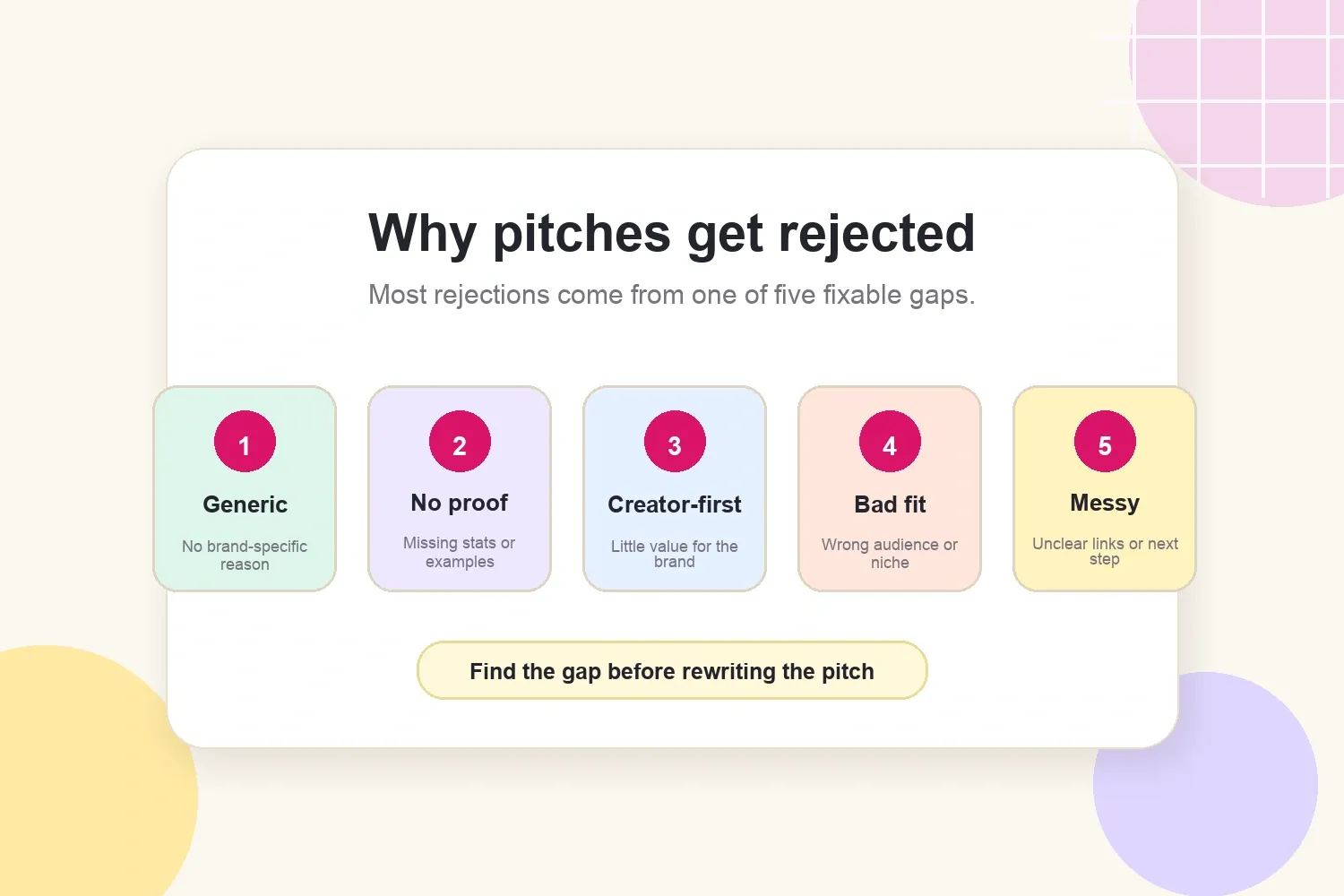
This is useful because different problems need different fixes. A generic pitch needs more research. A proof problem needs better metrics or examples. A fit problem needs better targeting, not a prettier email.
The pitch feels generic
Generic pitches are the easiest for brands to ignore because they create extra work. If the brand has to guess why the creator chose them, what product would make sense, or why the audience would care, the pitch is not doing its job.
Weak version:
- “I love your brand and would love to collaborate.”
- “I think my audience would be a great fit.”
- “Let me know if you want to work together.”
Better version:
- “Your new mineral SPF line fits my audience because my skincare content performs best when it solves routine-specific problems for women in their late 20s.”
- “A short Reel comparing daily sunscreen textures would fit the education style your brand already uses, but with a creator-led demo.”
The fix is specificity. Mention the product, campaign, audience overlap, or content angle that makes the partnership believable. A pitch should sound like it was written for that brand, not copied from a template with the name swapped out.
Morgan Lee’s advice lands because she has been on the receiving side of creator pitches for years. Her point is simple: a good pitch is intentional, warm, short, and useful. A lazy “I want to work with your brand” email with no links, no reason, and no personalization makes it too easy for the brand to ignore the email.
The media kit is weak or missing
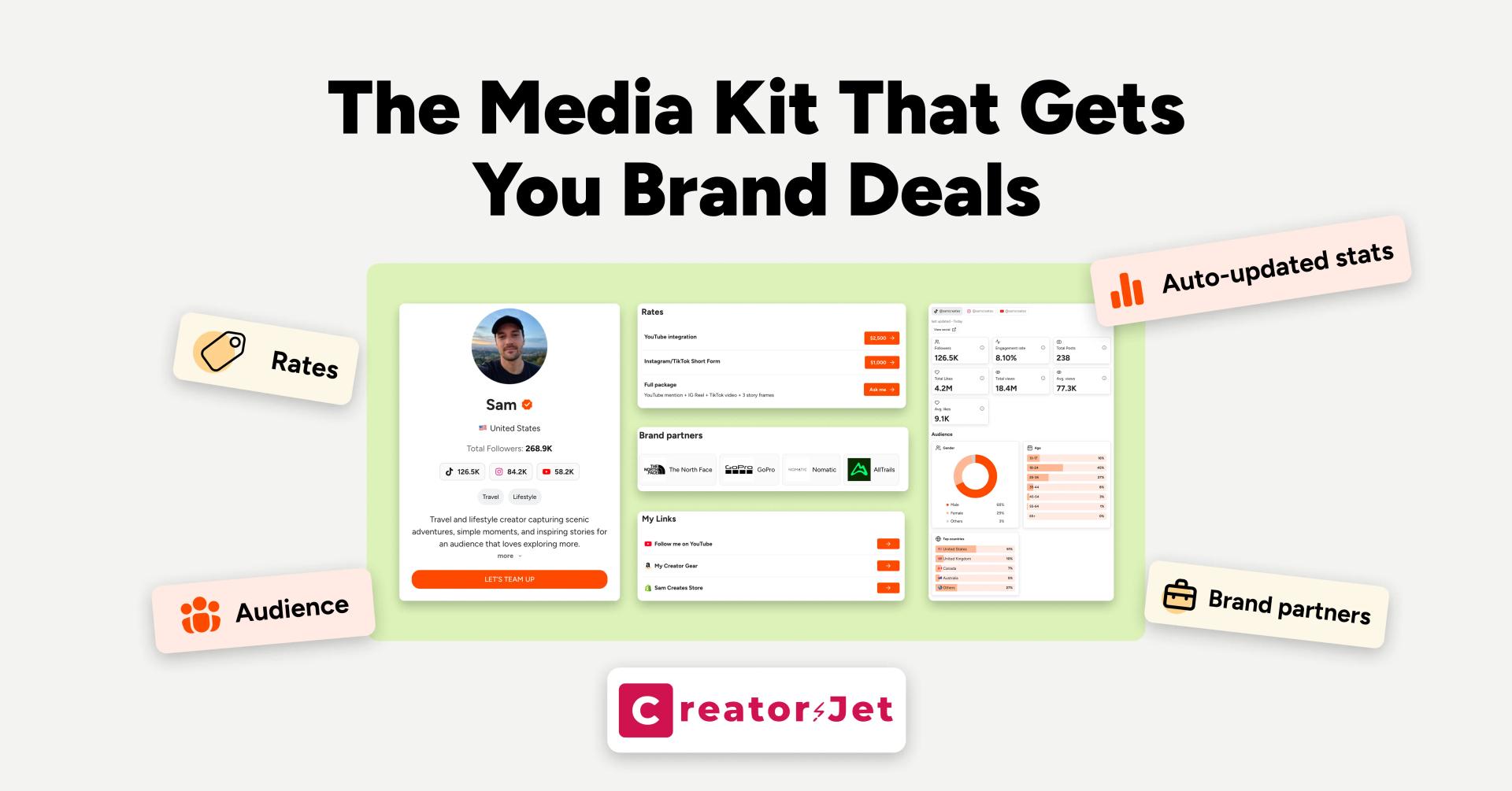
Brands do not need every metric a creator has ever collected. They need enough proof to understand audience quality, content quality, and commercial relevance.
A follower count alone is not enough. A creator with 12,000 followers, high saves, clear audience demographics, and good past content examples can look more brand-ready than a larger account with no proof attached.
Useful proof includes:
- Audience location, age range, and interests.
- Engagement rate, reach, views, saves, clicks, or Story interactions where relevant.
- Examples of content that match the type of campaign being pitched.
- Past collaborations, gifted work, UGC samples, testimonials, or performance notes.
- A clean way for the brand to review everything quickly.
This is where a clear creator media kit helps. It turns scattered proof into one organized asset and reduces the brand’s effort. If the pitch mentions performance, the media kit should make that performance easy to verify.
The pitch focuses too much on the creator
Many pitches explain why the creator wants the collaboration. Brands care more about what the collaboration can do for them.
That does not mean pretending every pitch will drive sales. It means tying the idea to a realistic brand goal: awareness, trust, content volume, product education, launch support, community credibility, or paid ad creative.
Creator-first version:
- “I have been following your brand for years and would love to work together.”
Brand-ready version:
- “Your product solves a problem my audience already asks about, so I would frame the content around a common objection and show how the product fits into a real routine.”
The second version gives the brand something to evaluate. It shows the creator understands the audience and has a content angle, not just enthusiasm.
The audience or content is not the right fit
Sometimes the pitch is well-written, but the brand fit is weak. A fitness creator can love a skincare brand. A travel creator can want a coffee partnership. That does not automatically mean the audience, content style, or campaign goal lines up.
Before pitching, check:
- Does the creator’s audience match the brand’s likely buyer?
- Has the creator posted content that connects naturally to the product?
- Would the partnership feel believable to existing followers?
- Is the brand currently marketing to this platform, niche, or creator tier?
- Can the creator explain the content idea without forcing the connection?
The best pitches usually feel obvious once the brand reads them. If the fit needs a long explanation, it may be better to pitch a different brand or a different angle.
The pitch lacks a clear content idea
Brands reject vague pitches because they cannot picture the deliverable. “Let’s collaborate” does not tell the team what they are buying, approving, or testing.
A clearer pitch includes one simple content idea. It does not need to be a full campaign deck. It can be a compact concept that shows the creator has thought about the brand’s goal.
Examples:
- “A 30-second Reel showing three ways to style the product for work, weekend, and travel.”
- “A TikTok built around the mistake your target customer makes before trying this type of product.”
- “A UGC-style demo with two hooks the brand can test in paid ads.”
- “A Story sequence with a poll, product explanation, and link sticker.”
If the creator wants a paid collaboration, the pitch should also make the deliverable clear enough to discuss scope and rates. For pricing context, link the conversation to the actual work, usage, and rights. The article on influencer rate negotiation is a useful next step when a brand asks for numbers.
The pitch looks hard to act on
Sometimes the pitch fails because the details are messy. Broken links, long paragraphs, unclear attachments, missing contact info, or no next step can make a good creator look risky.
Before sending, check:
- The media kit link opens without a login.
- The best content examples are easy to find.
- The email is short enough to read on mobile.
- The deliverable idea is obvious.
- The next step is simple, such as “happy to send a few concepts” or “open to discussing scope.”
- The email has no typos, dead links, or outdated metrics.
This part sounds basic, but it matters. A polished pitch signals that the creator will probably be organized during the collaboration too.
Rebuild the pitch into a decision-ready offer
The easiest way to improve a rejected pitch is to rewrite it around the brand’s decision process. The brand is usually asking: does this creator fit, can they deliver, what would the content be, and what happens next?
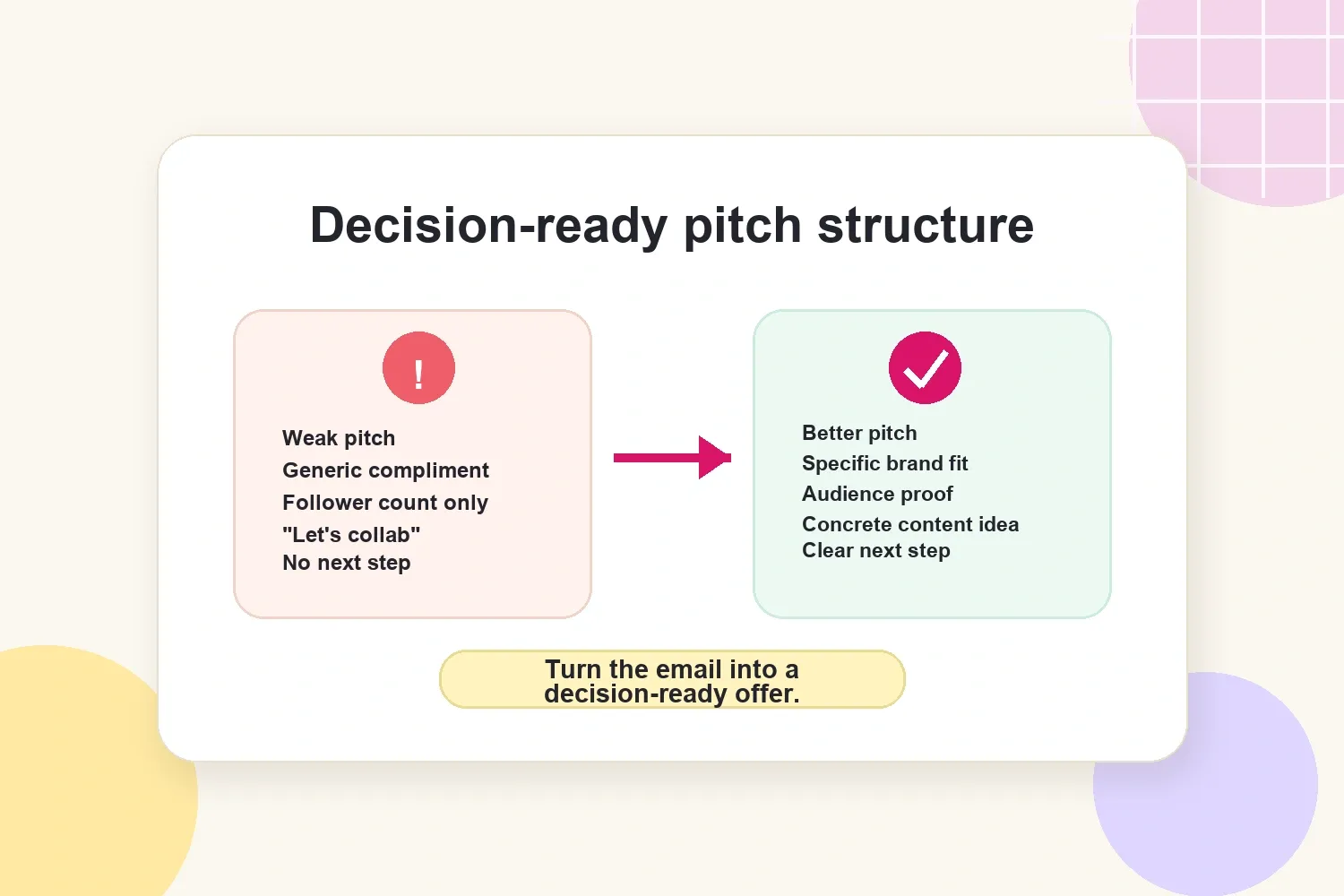
Use this structure:
- Specific brand reason: one line showing why this brand, product, or campaign makes sense.
- Audience proof: one or two metrics or audience facts that support the fit.
- Content idea: one practical idea the brand can picture quickly.
- Relevant proof: a media kit, portfolio, or examples that match the pitch.
- Simple next step: a clear opening for the brand to reply.
Here is a simple pitch skeleton:
“Hi [Name], I noticed [specific product, campaign, launch, or content angle]. My audience is [relevant audience detail], and my recent [format] content around [topic] has been performing well with [metric or proof].
One idea: [short content concept tied to the brand’s goal]. I can share examples and a media kit here: [link].
Open to discussing whether this would fit your upcoming creator plans.”
This works because it keeps the pitch short while still answering the brand’s core questions.
A weak pitch says: “I love your brand and would love to collaborate.” A better pitch says: “Your travel-size cleanser fits the carry-on skincare routines my audience asks about, and I can create a 30-second Reel showing how it works after a workout.” The second version gives the brand a product, audience reason, format, and angle in one sentence. For more wording ideas, use the influencer pitch email template as a companion resource.
What to do after a rejection
A rejection is not always a dead end. It can mean the timing is wrong, the budget is closed, the product is not a fit, or the pitch did not make the value clear enough.
If the brand replies with a no, keep the response short and professional. Thank them, ask whether it is okay to stay in touch for a better-fit campaign, and save the relationship. If the brand does not reply, wait before following up and keep the follow-up useful, not pushy.
A good follow-up can include:
- A new content example that is relevant to the brand.
- A clearer campaign idea.
- A seasonal angle tied to a launch or buying moment.
- A shorter version of the original pitch.
Creators who pitch consistently should also track what they send. A simple spreadsheet or CRM view with brand name, contact, pitch angle, date, status, and follow-up date makes patterns easier to see. If every ignored pitch has no audience proof, that is the next thing to fix.
Quick pitch audit before sending
Before sending another brand pitch, ask:
- Is the first sentence specific to this brand?
- Is the audience fit obvious?
- Is there proof beyond follower count?
- Does the email explain what the brand gets?
- Is the content idea clear enough to picture?
- Are the media kit and examples easy to open?
- Is the next step simple?
If the answer is no, the pitch is not ready yet.
Final takeaway
Brands reject influencer pitches when the value is hard to see. That does not mean the creator is not good enough. It usually means the pitch did not connect the creator’s content, audience, proof, and idea to a brand need.
The better version is simple: make the fit specific, show proof, explain the content idea, and remove friction. A pitch that is easy to evaluate has a much better chance of turning into a real brand conversation.