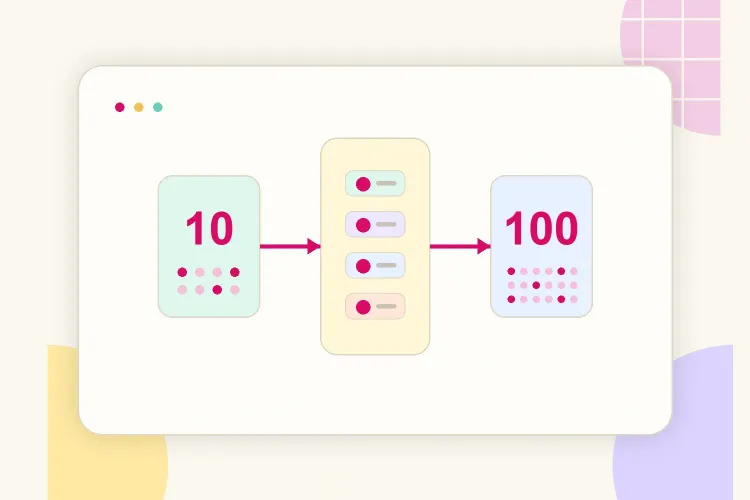


Scaling an agency from 10 to 100 creators is not a bigger version of the same job. At 10 creators, the founder can remember relationships, deadlines, rates, and client preferences. At 100 creators, memory becomes a liability.
The agency does not break because it signs too many creators. It breaks because the operating model stays founder-led while the roster becomes team-led. The fix is to scale in stages: centralize creator data, standardize repeat work, assign ownership, automate only clear handoffs, and build capacity checks before accepting more volume.
The real problem is not creator count
Creator count is the visible number. The hidden number is coordination load.
Every new creator adds more than one relationship. They add campaign matching, rate history, content approvals, contract notes, payment timing, performance data, and client-fit decisions. If those details live in inboxes and memory, each creator makes the agency slower.
The practical question is not “Can the agency sign 100 creators?” It is can the agency find the right creator, brief them, approve content, report results, and pay them without rebuilding the process every time?
Scale by stage, not by ambition
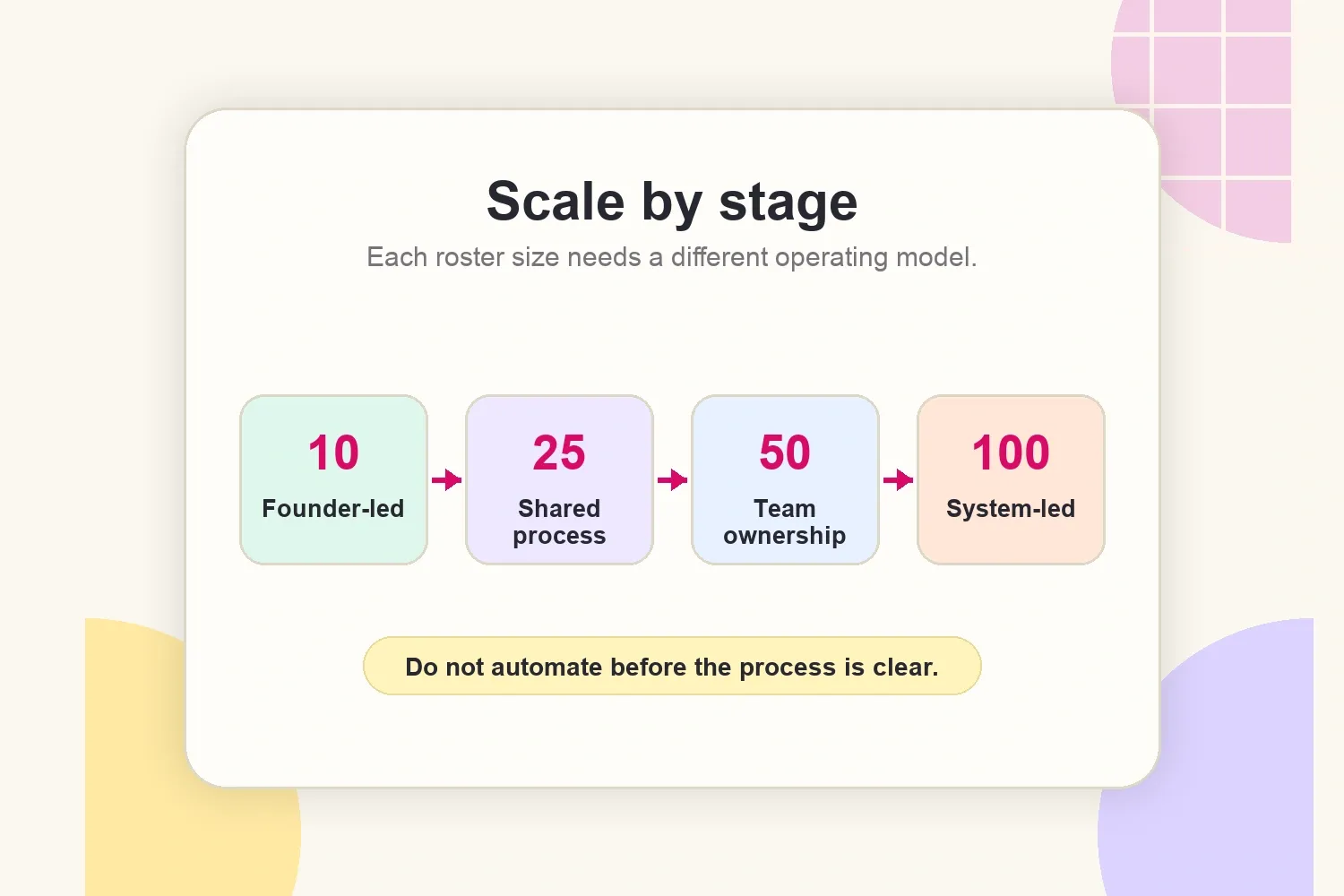
Agencies usually break when they skip the middle stage. They go from a founder-managed roster to a large roster without changing how work is assigned.
Use this stage map:
| Roster size | Operating model | Main risk | What to fix first |
|---|---|---|---|
| 10 creators | Founder-led | Everything depends on memory | Document relationship notes |
| 25 creators | Shared process | Team members work differently | Create standard statuses |
| 50 creators | Team ownership | Handoffs become unclear | Assign owners and risk flags |
| 100 creators | System-led | Quality drops under volume | Build reporting and capacity reviews |
The goal is not to make the agency more complex. The goal is to make the work visible enough that growth does not depend on one person holding every detail.
Build the creator database before hiring more people
Hiring helps only if new team members can trust the data they inherit. If creator information is scattered across email, spreadsheets, Slack, and personal notes, every new hire becomes another person asking where things are.
Before adding more coordinators, centralize:
- Creator contact details, platform links, niche, audience notes, language, location, and availability.
- Rate history, contract terms, exclusivity notes, usage rights, and payment preferences.
- Campaign history, deliverables, approval notes, performance snapshots, and client feedback.
- Current status, owner, risk flag, and next action.
A dedicated influencer CRM can help here because the work is relationship-heavy and campaign-specific. But the principle matters more than the tool: one source of truth beats five partial sources.
Standardize the work that repeats
At 10 creators, custom process feels personal. At 100 creators, custom process becomes expensive.
The agency should standardize anything that repeats often and does not need senior judgment every time:
- Outreach messages for common campaign types.
- Creator onboarding questions.
- Brief structure.
- Draft submission rules.
- Approval statuses.
- Payment and invoice checks.
- Reporting fields.
This does not make the agency less strategic. It protects the strategic work from admin noise. Senior people should spend time on client fit, creator quality, negotiation, and campaign decisions, not searching for the latest version of a brief.
Separate judgment from administration
This is the biggest operational shift between 10 and 100 creators. Some work should remain human. Some work should become a process.
Human judgment should stay close to:
- Deciding whether a creator fits a client’s audience and brand risk.
- Negotiating price, usage rights, exclusivity, and timelines.
- Reviewing creative quality and brand safety.
- Handling sensitive creator or client conversations.
Repeatable administration should be systemized:
- Moving a creator from “briefed” to “draft due.”
- Sending reminder messages after a missed deadline.
- Collecting live links.
- Updating report fields.
- Flagging missing contracts or invoices.
Workflow tools are useful once those decisions are clear. Asana describes work management as a coordination layer and source of truth for growing teams, which is the same principle agencies need as creator volume increases (Asana work management guide).
Add automation only after the handoff is clear
Automation is not a rescue plan for unclear process. If the team has not agreed what “approved,” “late,” “ready to post,” or “reporting complete” means, automation will only move confusion faster.
Use automation for narrow, agreed handoffs:
- When a creator submits a draft, notify the content owner.
- When a post goes live, request the live link.
- When a deadline is missed, create a follow-up task.
- When campaign metrics are submitted, update the reporting sheet.
- When a contract is signed, mark the creator as ready for activation.
Zapier’s own workflow explanation frames automation around triggers and actions between apps, which is exactly the right mental model for agencies: automate the handoff, not the judgment (Zapier workflows).
Hire around bottlenecks, not job titles
The first instinct is often to hire “another account manager.” That can help, but only if the bottleneck is relationship management.
Map the current constraint before hiring:
| Bottleneck | Hiring or system response |
|---|---|
| Too many unanswered creator messages | Creator coordinator or shared inbox rules |
| Draft approvals are slow | Content reviewer or approval workflow |
| Client reports take too long | Reporting owner and metrics template |
| Contracts and payments create stress | Operations support and finance checklist |
| New creators are hard to activate | Onboarding process and profile completeness rules |
This keeps hiring practical. The agency should not add people to absorb chaos. It should add people to own specific parts of a clearer system.
Track capacity before accepting more creators
Agencies often measure roster size but ignore capacity. That is risky because 100 passive creators may be easy to hold, while 40 active campaign creators can overwhelm the team.
Track capacity by workload:
- Active campaigns per manager.
- Drafts due this week.
- Approvals waiting more than 24 hours.
- Payments or contracts unresolved.
- Reports due in the next seven days.
- Creators with no owner or no next action.
These signals tell the agency whether it can add more creators without lowering service quality.
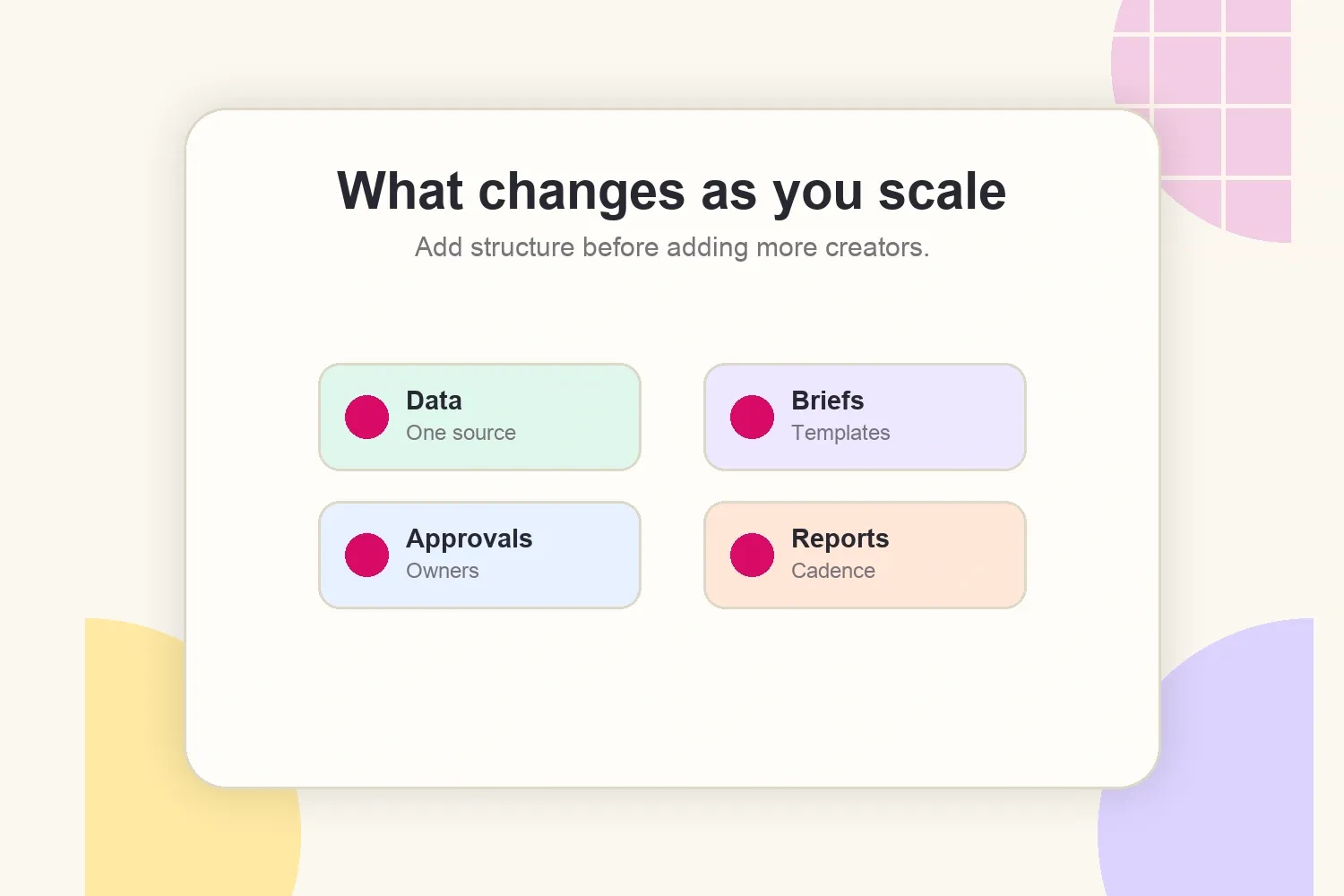
A simple rule for accepting new creators
Before adding another wave of creators, the agency should ask one operational question: can this creator be activated without creating hidden work for the team? If the answer is no, the creator can still be valuable, but they should enter a nurture pool instead of the active roster.
Use this rule to protect quality. A creator is ready for the active roster when their profile is complete, their niche is clear, their expected rate is known, their content examples are reviewed, and one team member owns the next action. Anything less creates invisible admin debt.
Example: a 90-day scale plan
This is a sample plan, not a real client case study. It shows how an agency could move from a fragile 25-creator setup toward a system that can support 100 creators.
| Month | Focus | Practical output |
|---|---|---|
| Month 1 | Visibility | One roster, standard statuses, owner field, risk flags |
| Month 2 | Repeatability | Brief templates, approval workflow, reporting fields |
| Month 3 | Capacity | Hiring map, automation rules, weekly operations review |
The order matters. Visibility comes before automation. Repeatability comes before hiring. Capacity review comes before signing more creators.
Connect scaling to client proof
Scaling is not only internal. Clients feel the difference when the agency can answer basic questions quickly:
- Which creators are active?
- Which drafts are delayed?
- Which posts are live?
- Which creators are performing?
- Which relationships deserve renewal?
That is why the scaling system should connect to reporting. The operations article on managing 50+ influencers efficiently goes deeper on campaign boards, ownership, and reporting cadence. This article is the step before that: how to design the agency so it can reach that stage without breaking.
What not to scale
Scaling is also about deciding what should not grow with the roster. If the agency scales bad habits, every new creator makes the problem more expensive.
Do not scale:
- Custom reporting for every client unless the client pays for that level of service. Keep a standard reporting base, then add custom views only when needed.
- Unlimited creator access where every creator can message any team member about anything. Define support channels, response windows, and escalation rules.
- Founder-only approvals for normal campaign work. Keep the founder involved in high-risk decisions, but move routine approvals to trained owners.
- Unqualified creator intake where every interested creator enters the same roster. Add minimum data, niche, audience, availability, and quality checks before a creator becomes active.
This is where many agencies protect their margin. They do not only build more process. They remove work that should never have become operational weight.
The bottom line
An agency can scale from 10 to 100 creators when it stops treating scale as a sales goal and starts treating it as an operating model.
More creators require more visibility, not more improvisation. The agency needs a central creator database, clear campaign stages, defined ownership, selective automation, capacity tracking, and hires tied to real bottlenecks. When those pieces are in place, 100 creators becomes a managed system instead of a bigger version of the founder’s inbox.