

Sponsorships can pay well, but they are rarely the most predictable way to build a creator business. Brand budgets change, campaigns get delayed, and a creator can have a good month followed by silence.
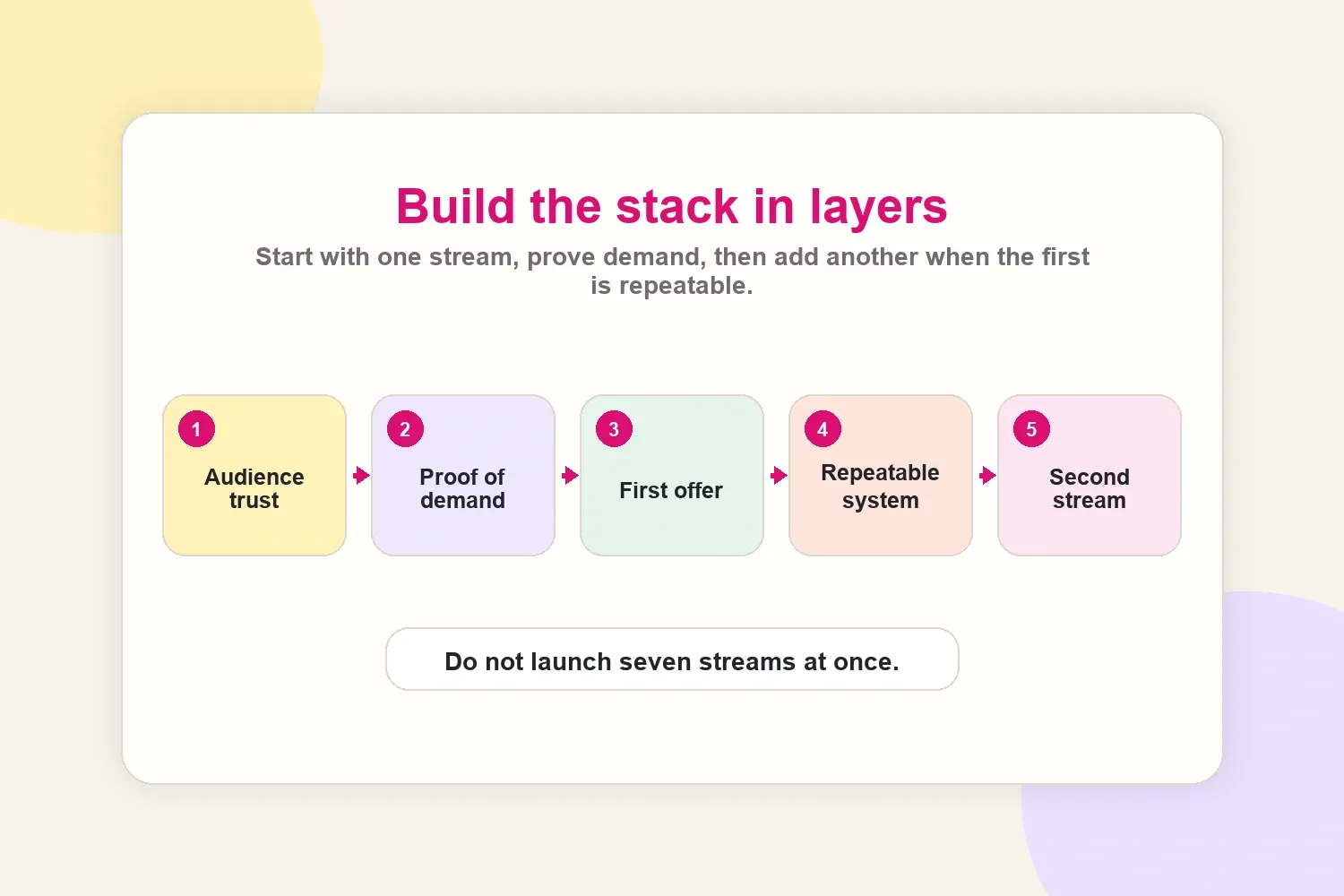
The practical answer is not to chase every monetization trend. It is to build one reliable income stream beyond sponsorships, prove that your audience actually wants it, then add a second stream when the first is working.
This guide breaks down seven content creator income streams beyond sponsorships and explains who each one fits, how to test it, and what to avoid.
Why sponsorships should not be the only plan
Brand deals are useful because they can create meaningful cash flow quickly. The problem is that they depend on timing, budget cycles, campaign fit, and whether a brand needs your audience right now.
Other income streams give creators more control. A digital product can keep selling after launch, affiliate content can keep earning from search or evergreen videos, and a membership can make revenue more predictable. None of these are automatic. They work when they match the audience relationship you already have.
If you want the broader version of this topic, this guide on how to monetise social media compares more creator monetization routes. This article focuses on the seven that make the most sense when the goal is to reduce dependence on sponsorships.
Quick comparison: which income stream fits first?
| Income stream | Best fit | First test |
|---|---|---|
| Digital products | Creators who solve repeatable problems | Sell one template, guide, preset, or checklist |
| Courses or workshops | Creators who teach a skill clearly | Run one live paid session |
| Affiliate marketing | Reviewers, educators, niche experts | Publish one useful recommendation page or video |
| Platform monetization | Video creators with consistent views | Improve retention and apply to eligible programs |
| Memberships | Creators with loyal repeat viewers | Offer one paid perk for a small group |
| Merch or product drops | Creators with a clear identity or community | Test one small limited product |
| Freelance or consulting | Creators with sellable production skills | Package one service with a clear scope |
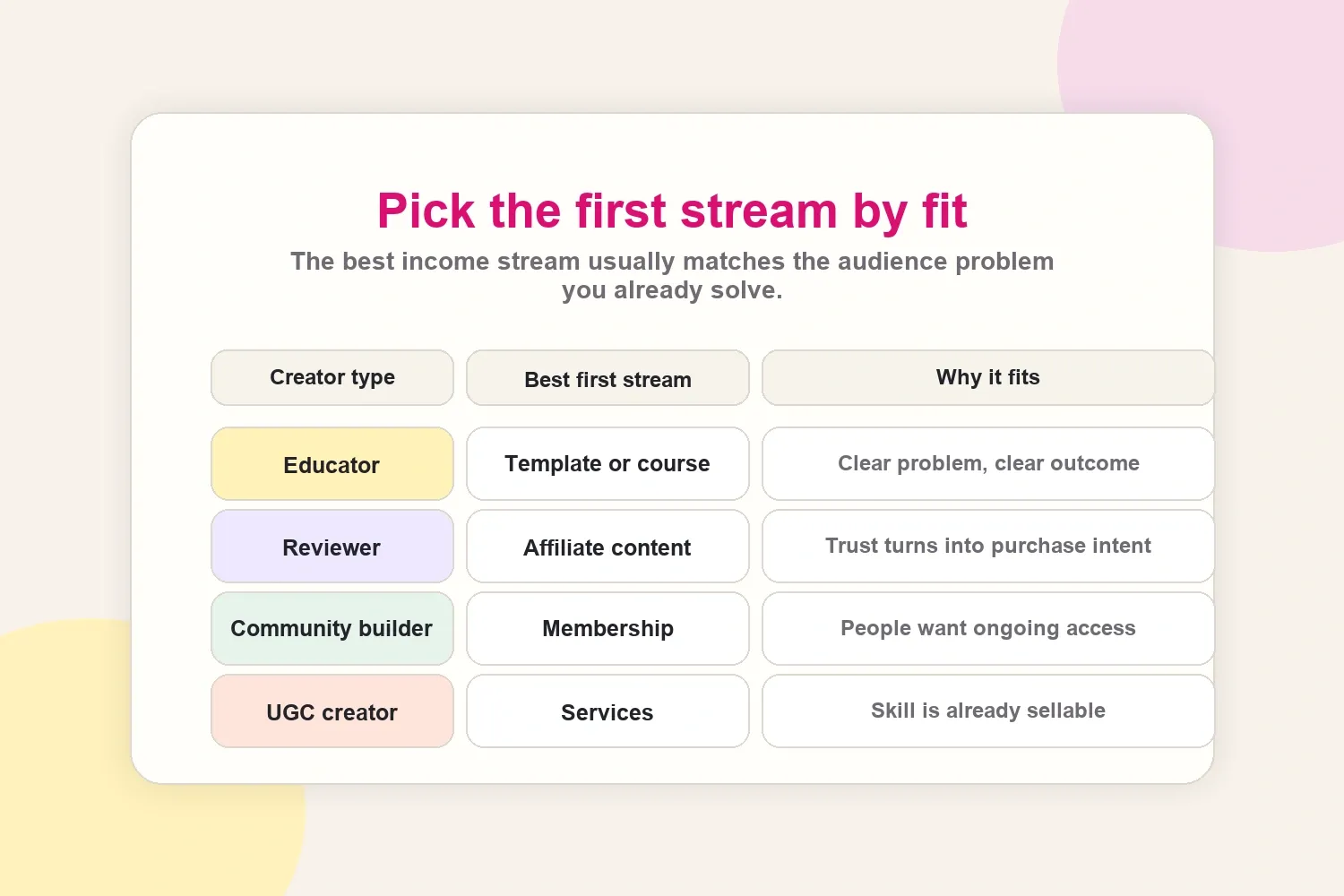
The table is not a ranking. A beauty creator, a finance educator, a gaming YouTuber, and a travel micro-influencer may all choose different first streams.
1. Digital products
Digital products work when your audience repeatedly asks for the same shortcut. That could be a Notion planner, editing preset, content calendar, recipe guide, workout plan, caption pack, swipe file, or niche checklist.
The appeal is margin: once the product exists, each sale does not require a new client call or deliverable. But the hard part is not uploading a file. The hard part is choosing a problem specific enough that people understand why they should pay.
Good digital product ideas usually come from comments, DMs, repeated questions, or content that already performs. A creator who teaches better Reels filming might sell a shot-list template. A travel creator might sell a trip-planning spreadsheet. A skincare creator might sell a routine tracker.
Start small. A $9 checklist that sells ten times teaches more than a huge course no one asked for.
2. Paid workshops or courses
Courses and workshops are a better fit when the audience needs a transformation, not just a file. The creator is not selling information alone. They are selling structure, feedback, practice, or a clear path from problem to result.
A workshop is usually safer than a full course at the beginning. It lets you test demand, language, questions, and objections before building a larger product.
Good examples:
- A food creator teaches phone lighting for recipe videos.
- A fitness creator runs a beginner mobility workshop.
- A TikTok creator teaches local businesses how to script short-form videos.
- A finance creator teaches freelancers how to organize quarterly taxes.
The biggest mistake is building a course because “courses are scalable.” Courses scale only after the promise is specific and the audience trusts you to deliver it.
3. Affiliate marketing
Affiliate marketing works when your audience already trusts your recommendations. It is not just posting random links. The best affiliate content usually explains why a product fits a specific use case, who should avoid it, and how to get a better result from it.
This is a natural fit for creators who publish tutorials, reviews, comparison posts, gear breakdowns, routines, recipes, software workflows, or buying guides.
Affiliate revenue often starts slowly because it depends on consistent, high-intent content. A single story link may disappear quickly. A well-made YouTube tutorial, blog post, pinned resource page, or evergreen comparison can keep working for months.
The practical rule: recommend fewer things, explain them better, and avoid products that would make your audience trust you less.
4. Platform monetization and ad revenue
Platform monetization is income from the platform itself: ads, creator rewards, fan funding, shopping features, or other native monetization tools. YouTube’s official creator resources list multiple ways to earn through the YouTube Partner Program, including ads, Shorts, memberships, Supers, Shopping, and more YouTube monetization features.
This stream is attractive because it connects directly to content performance. The downside is that it can change quickly. Eligibility rules, payout rates, geography, content format, and platform priorities all matter.
Use platform monetization as part of the stack, not the whole business. A creator with consistent YouTube search traffic may benefit from ad revenue. A short-form creator may use platform payouts as bonus money while building affiliates, products, or services around the same audience.
Do not measure this stream only by views. Retention, watch time, format consistency, advertiser suitability, and audience geography can all affect whether views turn into meaningful money.
5. Memberships and subscriptions
Memberships work when people want ongoing access, not just occasional content. That access can be extra videos, private posts, community chats, templates, live Q&As, behind-the-scenes notes, or early access.
This stream is most realistic for creators with audience loyalty. A huge audience is not required, but passive followers are not enough. People need a reason to keep paying every month.
Patreon, for example, describes creator memberships around monthly and annual subscriptions, one-time payments, community tools, and analytics on its pricing page. Instagram Subscriptions, YouTube memberships, Ko-fi, Substack, and other platforms can also fit depending on where your audience already spends time.
The danger is overpromising. A membership with weekly calls, daily posts, private replies, and custom feedback can become exhausting. Start with one repeatable benefit you can deliver consistently.
6. Merch or product collaborations
Merch works best when the audience identifies with the creator, the phrase, the inside joke, the niche, or the visual world. Product collaborations work when the creator’s taste or expertise helps sell something specific.
This does not have to mean launching a full brand. A small drop can be enough: a limited shirt, a printable pack, a physical planner, a recipe card set, a creator-designed accessory, or a co-branded item with a small business.
The key is fit. Generic merch usually underperforms because it asks people to buy the creator’s logo. Better merch gives the audience something they would want even if it were not attached to the creator.
Test demand before ordering inventory. Print-on-demand, preorders, small batches, or waitlists can reduce risk.
7. Freelance or consulting services
Services are often the fastest non-sponsorship income stream because creators already have sellable skills. Editing, UGC production, short-form strategy, content audits, scripting, photography, community management, and creator consulting can all become paid offers.
This is especially useful for small creators. A small audience may not support a membership yet, but the creator may still be good enough at filming, editing, hooks, product demos, or social strategy to sell that skill to brands, founders, coaches, or local businesses.
The service should be packaged clearly. “I can help with content” is vague. “Four short-form product videos per month, including hooks, filming, editing, and captions” is easier to price and easier to buy.
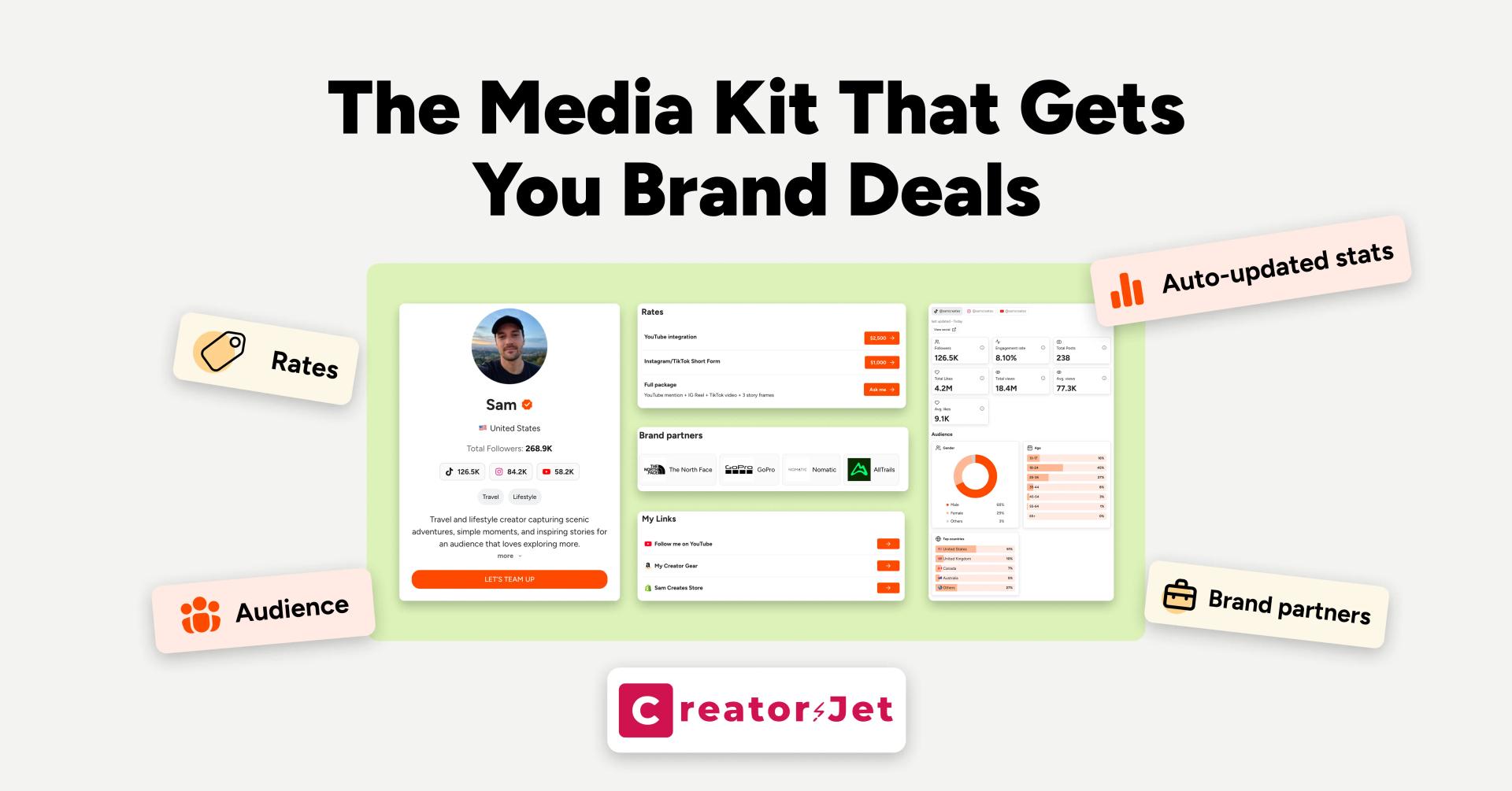
If you use services to support other income streams, keep proof organized. A clean portfolio page can help show your audience, examples, and previous work without sending messy screenshots.
How to choose the right first income stream
The best first stream is not always the one with the highest upside. It is the one you can test with the least confusion and the clearest signal from your audience.
Use this filter:
| Question | What it tells you |
|---|---|
| What do people already ask you for? | Possible product, course, or service demand |
| What content earns trust, not just views? | Possible affiliate or membership fit |
| What skill do brands or peers compliment? | Possible freelance or consulting offer |
| What would be simple to test in 30 days? | Best first experiment |
| What would be painful to keep delivering? | A stream to simplify or avoid |
Creators who want a deeper look at where revenue tends to come from can also read the creator income breakdown. The useful pattern is clear: higher-quality income usually comes from trust, positioning, and repeatable systems, not just audience size.
Common mistakes when diversifying income
The most common mistake is launching too many streams at once. A creator adds a shop, a course, affiliate links, a membership, and services before any one of them has a clear buyer.
Other mistakes to avoid:
- Choosing a monetization stream because another creator made it work.
- Building a product before validating the audience problem.
- Promoting affiliate products that do not match your niche.
- Treating platform payouts as guaranteed income.
- Creating a membership that requires more work than it earns.
- Selling services without a clear scope, price range, or revision process.
- Forgetting to track revenue, time, costs, and conversion by stream.
The last point matters. A stream can look profitable until you count hours, refunds, software, product costs, or customer support. Track each stream separately so you can see which one actually deserves more time.
Final takeaway
The best content creator income streams beyond sponsorships are the ones that fit your audience, skills, and current proof. Digital products, workshops, affiliates, platform monetization, memberships, merch, and services can all work, but they should not all launch at the same time.
Pick one stream, test it with a small offer, and measure what happens. Once it becomes repeatable, add another layer. That is how creator income becomes more stable without turning the creator business into chaos.